The Most Beautiful House in the World
by Witold Rybczynski
On This Page
Description
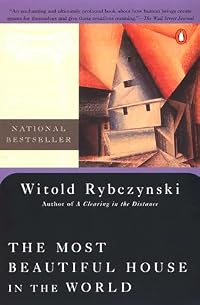
Witold Rybczynski takes us on an extraordinary odyssey as he tells the story of designing and building his own house. His project began as a workshed, but through a series of "happy accidents," the structure gradually evolved into a full-fledged house. In tracing this evolution, he touches on matters both theoretical and practical, writing on such diverse topics as the ritualistic origins of the elements of classical architecture and the connections between dress and habitation. He discusses show more feng-shui and considers the theories of such architects as Palladio, Le Corbusier, and Frank Lloyd Wright. An eloquent examination of the links between being and building, The Most Beautiful House in the World offers insights into the joys of "installing ourselves in a place, of establishing a spot where it would be safe to dream." show lessTags
Recommendations



















Member Reviews
"The most beautiful house in the world is the one you build for yourself" (p. 186). Fortunately for Rybczynski and his fellow architects, this is not true. The difference in financial firepower and professional skill will see to it that most fail to build something as grand as the Taj Mahal. Your self-designed and self-built house, however, can accommodate your personal preferences and foibles, and acquire an intimate connection in the process. I wish Rybczynski's long suffering wife had told her story in an epilogue. After all, it took Rybczynski three years to add walls and a roof to his house (first intended as a workshop for a boat). It took another two years to convert the barn into a private residence. Only if you are your own show more client, can you bungle a job like this. A valuable lesson for any prospective builder. Transforming a dream into reality is hard work which tests organizational skills, financial resources and the strengths of relationsships.
In this personal recollection, Rybczynski concentrates mostly on the architecture bit, enlightening readers to the core ideas of feng shui, the process of designing, architectural history as well as famous architects. Curiously absent are any mentions of building codes and permits as well as financial aspects. Not missing are trivia about Rybczynski and his life, and a rather preposterous lineage of great writers and their houses, in whose company the author places himself. To get to the morsels about architecture, one has to listen to the Rybczynskiana. Overall, it's not bad, especially his short introduction to domestic architecture. Tracy Kidder's House, however, gives a much closer and humane report of the building process. show less
In this personal recollection, Rybczynski concentrates mostly on the architecture bit, enlightening readers to the core ideas of feng shui, the process of designing, architectural history as well as famous architects. Curiously absent are any mentions of building codes and permits as well as financial aspects. Not missing are trivia about Rybczynski and his life, and a rather preposterous lineage of great writers and their houses, in whose company the author places himself. To get to the morsels about architecture, one has to listen to the Rybczynskiana. Overall, it's not bad, especially his short introduction to domestic architecture. Tracy Kidder's House, however, gives a much closer and humane report of the building process. show less
A sweet and fascinating history of an architect's dream of building a shed in which to build a boat, but that evolves into a home. Great discussion on what defines a building's character.
How readable could a book about building a boat shed be? You'd be surprised. Rybczynski skillfully brings together his reflections on history, art, architecture, games and myriad of other things into a text that is a pleasure to read. After you're done, it feels like you just spent a great evening with your best friend.
Rybczynski is a talented writer who could probably write a captivating book about the sex life of roofing nails. The fact that he writes about architecture is an added bonus.
A great read (perhaps because I want to do the same sort of thing someday). I thoroughly enjoy first person accounts of personal projects. Maybe because I'm analytical by nature, but I revel in the minutiae, the trials & errors and the highs & lows of achieving your personal goals.
Interesting, rambling, under-illustrated.
Members
- Recently Added By
Author Information

31+ Works 6,192 Members
Witold Rybczynski is an architect and emeritus professor of urbanism at the University of Pennsylvania.
Awards and Honors
Awards
Distinctions
Notable Lists
Common Knowledge
- Canonical title
- The Most Beautiful House in the World
- Original publication date
- 1989
- Dedication
- In memoriam, Baroness Herta Riedl-Ursin
- First words
- It began with the dream of a boat.
- Publisher's editor
- Frank, Dan
Classifications
- Genres
- Art & Design, Nonfiction, General Nonfiction, Biography & Memoir
- DDC/MDS
- 728.373092 — Arts & recreation Architecture Residential and related buildings Specific kinds of conventional housing Separate houses, detached; cottages Single-story house, bungalows, ranches, split-level houses
- LCC
- NA7120 .R93 — Fine Arts 2599.5-2599.9 Architectural criticism Architecture Special classes of buildings Classed by use Domestic architecture. Houses. Dwellings
- BISAC
Statistics
- Members
- 573
- Popularity
- 51,201
- Reviews
- 7
- Rating
- (3.62)
- Languages
- English
- Media
- Paper, Audiobook, Ebook
- ISBNs
- 6
- ASINs
- 6