Kipling: Victorian Balladeer (Illustrated Poetry Anthology Series)
by Rudyard Kipling  , K. E. Sullivan (Editor)
On This Page
Description
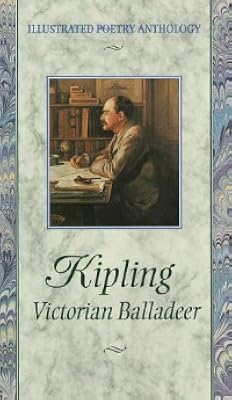
A collection of verse by Victorian writer Joseph Rudyard Kipling selected from his mature work, illustrated with artwork inspired by the poetry, and including a biographical introduction and a chronology of Kipling's life.Tags
Recommendations























Member Reviews
This illustrated small book of Kipling's work appeared to do an effective job demonstrating his overall work. Topics included Rome, war, and the Jungle Book. Most of the poems had the feel of songs. Parts of the Ballad of East and West and Sussex, 1902 were particularly memorable. This was an adequate representation of Kipling's work, but it can be difficult to place Kipling's poems in a context that can foster appreciation in the twenty-first century.
This is a beautifully illustrated edition with some poems like The Children's Song, Mesopotamia, The Queen's Men and The Gypsy Trail. I picked it up primarily because of the lovely paintings. It's a small book and a delightful read.
Featuring a selection of Rudyard Kipling's greatest poetry, this edition is illustrated with beautiful works of art--a celebration of the life and worl of one of the world's most exceptional and celebrated poets. Contains a biographical introduction.
Ratings
Members
- Recently Added By
Author Information

2,458+ Works 90,992 Members
Kipling, who as a novelist dramatized the ambivalence of the British colonial experience, was born of English parents in Bombay and as a child knew Hindustani better than English. He spent an unhappy period of exile from his parents (and the Indian heat) with a harsh aunt in England, followed by the public schooling that inspired his "Stalky" show more stories. He returned to India at 18 to work on the staff of the Lahore Civil and Military Gazette and rapidly became a prolific writer. His mildly satirical work won him a reputation in England, and he returned there in 1889. Shortly after, his first novel, The Light That Failed (1890) was published, but it was not altogether successful. In the early 1890s, Kipling met and married Caroline Balestier and moved with her to her family's estate in Brattleboro, Vermont. While there he wrote Many Inventions (1893), The Jungle Book (1894-95), and Captains Courageous (1897). He became dissatisfied with life in America, however, and moved back to England, returning to America only when his daughter died of pneumonia. Kipling never again returned to the United States, despite his great popularity there. Short stories form the greater portion of Kipling's work and are of several distinct types. Some of his best are stories of the supernatural, the eerie and unearthly, such as "The Phantom Rickshaw," "The Brushwood Boy," and "They." His tales of gruesome horror include "The Mark of the Beast" and "The Return of Imray." "William the Conqueror" and "The Head of the District" are among his political tales of English rule in India. The "Soldiers Three" group deals with Kipling's three musketeers: an Irishman, a Cockney, and a Yorkshireman. The Anglo-Indian Tales, of social life in Simla, make up the larger part of his first four books. Kipling wrote equally well for children and adults. His best-known children's books are Just So Stories (1902), The Jungle Books (1894-95), and Kim (1901). His short stories, although their understanding of the Indian is often moving, became minor hymns to the glory of Queen Victoria's empire and the civil servants and soldiers who staffed her outposts. Kim, an Irish boy in India who becomes the companion of a Tibetan lama, at length joins the British Secret Service, without, says Wilson, any sense of the betrayal of his friend this actually meant. Nevertheless, Kipling has left a vivid panorama of the India of his day. In 1907, Kipling became England's first Nobel Prize winner in literature and the only nineteenth-century English poet to win the Prize. He won not only on the basis of his short stories, which more closely mirror the ambiguities of the declining Edwardian world than has commonly been recognized, but also on the basis of his tremendous ability as a popular poet. His reputation was first made with Barrack Room Ballads (1892), and in "Recessional" he captured a side of Queen Victoria's final jubilee that no one else dared to address. (Bowker Author Biography) show less
Rudyard Kipling has a Legacy Library. Legacy libraries are the personal libraries of famous readers, entered by LibraryThing members from the Legacy Libraries group.
Classifications
Statistics
- Members
- 55
- Popularity
- 554,282
- Reviews
- 3
- Rating
- (3.33)
- Languages
- English
- Media
- Paper
- ISBNs
- 2
- ASINs
- 1