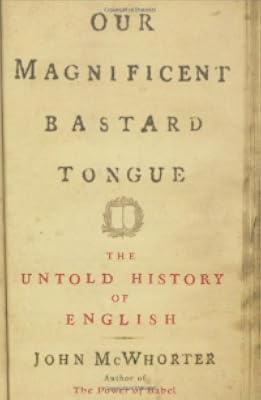
Our Magnificent Bastard Tongue: The Untold History of English
by John McWhorter
On This Page
Description
Why do we say "I am reading a catalog" instead of "I read a catalog"? Why do we say "do" at all? Is the way we speak a reflection of our cultural values? Delving into these provocative topics and more, author McWhorter distills hundreds of years of lore into one lively history. Covering the little-known Celtic and Welsh influences on English, the impact of the Viking raids and the Norman Conquest, and the Germanic invasions that started it all during the fifth century AD, and drawing on show more genetic and linguistic research as well as a cache of trivia about the origins of English words and syntax patterns, McWhorter ultimately demonstrates the arbitrary, maddening nature of English--and its ironic simplicity, due to its role as a streamlined lingua franca during the early formation of Britain. This is the book that language aficionados have been waiting for.--From publisher description. show lessTags
Recommendations













Member Reviews
Fascinating. As he says (and says, and says), most "how did English get to be the language it is" books focus primarily on vocabulary and how Germanic Saxon and Romantic Norman French crossed to produce our odd language. And then he points out that borrowing vocabulary is not even unusual, but the way English grammar works is unique. It's not Germanic, it's not Romantic - it has some features that it shares (only) with Celtic languages, specifically Welsh and Cornish, but even there it doesn't match exactly. He goes through the likely history of the language, and discusses how these grammar changes didn't show up in the written language and have therefore been largely invisible to etymologists and linguists studying the development of show more English. Another section discusses the illogic of prescriptivist rules, comparing some of the things we insist on today (it's Sam and I went to the store, not Sam and me...) to earlier requirements that sound just silly now. He also goes into the Sapir-Whorf theory that grammar influences/controls perceptions - mostly to argue that it's nonsense - and presents a theory that Old Norse, before the Vikings came to England, was already modified...by Phoenician. Lots of neat ideas, not a lot of supporting evidence (for good reason, he argues), a very enjoyable voice. I think I'll be looking up some of his books on various Creoles - I'd like to hear more from him. show less
A linguistics book for the lay reader, it is like listening to an excellent lecturer argue his opinions on his subject of expertise at a casual get-together with friends who are not in academia. McWhorter here takes on what he calls the "official history" of English, which in his persuasive view has made significant mistakes.
Whereas the "official history" decided that the Celtic languages had little to no impact on English, McWhorter argues that speakers of Welsh and Cornish changed English grammar to a significant degree, applying the very different grammar rules of their native tongue to the new Old English tongue they learned from the Anglo-Saxon invaders. This explains why “Said she to my daughter that my father alone come is and show more himself better feels” makes no sense in English, whereas a similar construction would in any other Germanic language. It's the Celtic grammar making our English sentence construction so different from our language cousins. This happened because the native Celts were likely to have hung around as a majority of the population rather than being comprehensively slaughtered as the "official history" has it, so their changes to Old English stuck. Celtic also gave to English the "meaningless 'do'", as in "Do you want it?" instead of just "You want it?" This makes me want to start a band and name it Meaningless Do...
When the waves of Vikings invaded centuries later, these people spoke Old Norse. McWhorter argues that an effect of all these adult males learning the language spoken in this land they'd just settled in, and taken wives from, is that they simplified it a lot, ie, spoke it "wrong". Thus English dropped a lot of features such as gendered nouns and case endings in the mouths of the "English Vikings", and they passed this battered language down to their children. These changes from Old English to Middle English are evident first in North England and gradually spreading southwards, which corresponds with the fact that the Vikings concentrated in the North.
Aside from other arguments in the book, McWhorter makes a plea I'm very sympathetic to: we shouldn't fret over our language continuing to evolve and change. Language always has. There is no such thing as "pure" English; it has been beaten up and changed massively already. No one would argue that we shouldn't speak this "perverted" modern English and go back to Old English. So if people start saying "who" when they 'should' say "whom"... eh, so what. English has lost lots of case markers already.
Entertaining and informative. show less
Whereas the "official history" decided that the Celtic languages had little to no impact on English, McWhorter argues that speakers of Welsh and Cornish changed English grammar to a significant degree, applying the very different grammar rules of their native tongue to the new Old English tongue they learned from the Anglo-Saxon invaders. This explains why “Said she to my daughter that my father alone come is and show more himself better feels” makes no sense in English, whereas a similar construction would in any other Germanic language. It's the Celtic grammar making our English sentence construction so different from our language cousins. This happened because the native Celts were likely to have hung around as a majority of the population rather than being comprehensively slaughtered as the "official history" has it, so their changes to Old English stuck. Celtic also gave to English the "meaningless 'do'", as in "Do you want it?" instead of just "You want it?" This makes me want to start a band and name it Meaningless Do...
When the waves of Vikings invaded centuries later, these people spoke Old Norse. McWhorter argues that an effect of all these adult males learning the language spoken in this land they'd just settled in, and taken wives from, is that they simplified it a lot, ie, spoke it "wrong". Thus English dropped a lot of features such as gendered nouns and case endings in the mouths of the "English Vikings", and they passed this battered language down to their children. These changes from Old English to Middle English are evident first in North England and gradually spreading southwards, which corresponds with the fact that the Vikings concentrated in the North.
Aside from other arguments in the book, McWhorter makes a plea I'm very sympathetic to: we shouldn't fret over our language continuing to evolve and change. Language always has. There is no such thing as "pure" English; it has been beaten up and changed massively already. No one would argue that we shouldn't speak this "perverted" modern English and go back to Old English. So if people start saying "who" when they 'should' say "whom"... eh, so what. English has lost lots of case markers already.
Entertaining and informative. show less
I went to a Grammar School (no, really) so you'd think I'd know a bit about the history of English grammar. Turns out, to misquote Donald Rumsfeld, that when it comes to my knowledge of grammar not only are there are known unknowns — that is to say, I know there are some things I do not know — but there are also unknown unknowns, the ones I didn’t know I didn’t know.
I knew, for example, that English is a weird mix of Germanic and Romance languages. I know German has three genders and French two genders. And so I knew it was a little odd that English is genderless, but I didn't know why English is genderless. Apparently the standard textbook explanation is that this just happened. Languages change and drift over time, and show more English drifted from having male spoons, female forks, and neuter knives to having plain old sexless cutlery. This explanation seems a little unlikely to me, but then dammit, Jim, I'm a doctor of maths, not of comparative linguistics.
An unknown unknown for me was English's predilection towards a single verb from it's catalogue of a few hundred thousand, the verb to do. I know enough French that this quirk of English should have been more obvious to me, and yet I'd utterly overlooked it. Here's a typical conversation in French (names have been changed to protect the innocent):
Moi: Sais-tu ce que j'ecris?
Matthias: Non, je ne sais pas.
Moi: Zut alors! Tu es un pamplemousse!
Verbs abound in this example, to know, to write, to be. But not a do in sight. In English we merrily drop two dos in a sentence: “Do you know what I am doing?”, and another one in the response: “No, I do not.” French would settle for the odd-to-English-ears “Know-you what I am doing?” and thence “No, I know not.” But English is the odd one, most languages don't have this extraneous do floating about pell-mell and everywhither. And even English sounds odd if you happen to drop a do into a sentence that is traditionally a do-free zone. If you finally understand a difficult concept you'd probably not say “Aha, I do see now” and yet if a Tyrannosaurus Rex ran past the window we'd happily ask “Did you see that?” Quite where this obsession with do came from is something I'd never even wondered. Again, the answer usually given is to be found in the linguistic hypothesis that John McWhorter colourfully refers to as “shitte happens.”
Our Magnificent Bastard Tongue is essentially a two hundred page repudiation of this hypothesis, that the development of English over the past two millennia can be summed up by “our vocabulary changed because of the Vikings, the Normans, and the Bard, and our grammar changed because, well, shitte happens.” (As an aside, if someone tells you over the phone that they're on a one-way train to shitte station, then they're either in trouble, or else they're actually on the train to Shitte Station.) McWhorter is an engaging writer and makes his point coherently and in a manner entertaining enough to belie the slightly dry subject matter. I suspect that classically trained language scholars might be tearing their hair out at his care free use of common sense over masses of data taken from contemporary documents, but then that's one of his points: people don't write like they speak, so drawing conclusions solely from the written record is always going to give misleading results. This discrepancy can still be seen today. I, for example, have a bad habit when speaking of tailing off mid-sentence and assuming people know what I was going to say next, but when I'm writing… show less
I knew, for example, that English is a weird mix of Germanic and Romance languages. I know German has three genders and French two genders. And so I knew it was a little odd that English is genderless, but I didn't know why English is genderless. Apparently the standard textbook explanation is that this just happened. Languages change and drift over time, and show more English drifted from having male spoons, female forks, and neuter knives to having plain old sexless cutlery. This explanation seems a little unlikely to me, but then dammit, Jim, I'm a doctor of maths, not of comparative linguistics.
An unknown unknown for me was English's predilection towards a single verb from it's catalogue of a few hundred thousand, the verb to do. I know enough French that this quirk of English should have been more obvious to me, and yet I'd utterly overlooked it. Here's a typical conversation in French (names have been changed to protect the innocent):
Moi: Sais-tu ce que j'ecris?
Matthias: Non, je ne sais pas.
Moi: Zut alors! Tu es un pamplemousse!
Verbs abound in this example, to know, to write, to be. But not a do in sight. In English we merrily drop two dos in a sentence: “Do you know what I am doing?”, and another one in the response: “No, I do not.” French would settle for the odd-to-English-ears “Know-you what I am doing?” and thence “No, I know not.” But English is the odd one, most languages don't have this extraneous do floating about pell-mell and everywhither. And even English sounds odd if you happen to drop a do into a sentence that is traditionally a do-free zone. If you finally understand a difficult concept you'd probably not say “Aha, I do see now” and yet if a Tyrannosaurus Rex ran past the window we'd happily ask “Did you see that?” Quite where this obsession with do came from is something I'd never even wondered. Again, the answer usually given is to be found in the linguistic hypothesis that John McWhorter colourfully refers to as “shitte happens.”
Our Magnificent Bastard Tongue is essentially a two hundred page repudiation of this hypothesis, that the development of English over the past two millennia can be summed up by “our vocabulary changed because of the Vikings, the Normans, and the Bard, and our grammar changed because, well, shitte happens.” (As an aside, if someone tells you over the phone that they're on a one-way train to shitte station, then they're either in trouble, or else they're actually on the train to Shitte Station.) McWhorter is an engaging writer and makes his point coherently and in a manner entertaining enough to belie the slightly dry subject matter. I suspect that classically trained language scholars might be tearing their hair out at his care free use of common sense over masses of data taken from contemporary documents, but then that's one of his points: people don't write like they speak, so drawing conclusions solely from the written record is always going to give misleading results. This discrepancy can still be seen today. I, for example, have a bad habit when speaking of tailing off mid-sentence and assuming people know what I was going to say next, but when I'm writing… show less
I like McWhorter's columns in the NYT, so I expected to like this book. It turned out to be a mixed bag. McWhorter focuses on a few topics; it is not in any sense a full history of the English language. He is very knowledgeable and thinks clearly, two things I don't take for granted in academics after spending most of a half-century in what we euphemistically call higher education. Even more impressive, he writes clearly, with only the necessary minimum of academic jargon.
Each chapter covers a topic of particular interest to the author, usually aimed at refuting the received wisdom of orthodox historians of English. These include the significant influence of Celtic languages on English, the influence of the Vikings who settled in show more England on English grammar, that there is no such thing as grammatical blunders, and the Sapir-Whorf hypothesis (basically that our language determines how we think). The first two developments are largely denied by historians of English. McWhorter effectively proves his case, but keeps going on, repeatedly smashing gnats with sledgehammers.
McWhorter, like most linguists, takes an entirely descriptive stance on grammar. I do not. Good grammar promotes clarity and comprehension; it preserves nuances and distinctions often lost otherwise.
He also deconstructs, several times over, Sapir-Whorf, which is uncritically accepted by a lot of people who should know better. There were several times I nearly gave up on the book, simply because McWhorter didn't know when to quit. If you have good arguments (he mostly does), you only need to make the case once, not a dozen times. There is no virtue in being the Lizzie Borden of linguistics.
That complaint aside, there were parts I enjoyed and I did learn a number of things about the peculiarities of English that we native speakers tend to be blithely unaware of and learners of English tend to despair of. show less
Each chapter covers a topic of particular interest to the author, usually aimed at refuting the received wisdom of orthodox historians of English. These include the significant influence of Celtic languages on English, the influence of the Vikings who settled in show more England on English grammar, that there is no such thing as grammatical blunders, and the Sapir-Whorf hypothesis (basically that our language determines how we think). The first two developments are largely denied by historians of English. McWhorter effectively proves his case, but keeps going on, repeatedly smashing gnats with sledgehammers.
McWhorter, like most linguists, takes an entirely descriptive stance on grammar. I do not. Good grammar promotes clarity and comprehension; it preserves nuances and distinctions often lost otherwise.
He also deconstructs, several times over, Sapir-Whorf, which is uncritically accepted by a lot of people who should know better. There were several times I nearly gave up on the book, simply because McWhorter didn't know when to quit. If you have good arguments (he mostly does), you only need to make the case once, not a dozen times. There is no virtue in being the Lizzie Borden of linguistics.
That complaint aside, there were parts I enjoyed and I did learn a number of things about the peculiarities of English that we native speakers tend to be blithely unaware of and learners of English tend to despair of. show less
I went to a Grammar School (no, really) so you'd think I'd know a bit about the history of English grammar. Turns out, to misquote Donald Rumsfeld, that when it comes to my knowledge of grammar not only are there are known unknowns — that is to say, I know there are some things I do not know — but there are also unknown unknowns, the ones I didn’t know I didn’t know.
I knew, for example, that English is a weird mix of Germanic and Romance languages. I know German has three genders and French two genders. And so I knew it was a little odd that English is genderless, but I didn't know why English is genderless. Apparently the standard textbook explanation is that this just happened. Languages change and drift over time, and show more English drifted from having male spoons, female forks, and neuter knives to having plain old sexless cutlery. This explanation seems a little unlikely to me, but then dammit, Jim, I'm a doctor of maths, not of comparative linguistics.
An unknown unknown for me was English's predilection towards a single verb from it's catalogue of a few hundred thousand, the verb to do. I know enough French that this quirk of English should have been more obvious to me, and yet I'd utterly overlooked it. Here's a typical conversation in French (names have been changed to protect the innocent):
Moi: Sais-tu ce que j'ecris?
Matthias: Non, je ne sais pas.
Moi: Zut alors! Tu es un pamplemousse!
Verbs abound in this example, to know, to write, to be. But not a do in sight. In English we merrily drop two dos in a sentence: “Do you know what I am doing?”, and another one in the response: “No, I do not.” French would settle for the odd-to-English-ears “Know-you what I am doing?” and thence “No, I know not.” But English is the odd one, most languages don't have this extraneous do floating about pell-mell and everywhither. And even English sounds odd if you happen to drop a do into a sentence that is traditionally a do-free zone. If you finally understand a difficult concept you'd probably not say “Aha, I do see now” and yet if a Tyrannosaurus Rex ran past the window we'd happily ask “Did you see that?” Quite where this obsession with do came from is something I'd never even wondered. Again, the answer usually given is to be found in the linguistic hypothesis that John McWhorter colourfully refers to as “shitte happens.”
Our Magnificent Bastard Tongue is essentially a two hundred page repudiation of this hypothesis, that the development of English over the past two millennia can be summed up by “our vocabulary changed because of the Vikings, the Normans, and the Bard, and our grammar changed because, well, shitte happens.” (As an aside, if someone tells you over the phone that they're on a one-way train to shitte station, then they're either in trouble, or else they're actually on the train to Shitte Station.) McWhorter is an engaging writer and makes his point coherently and in a manner entertaining enough to belie the slightly dry subject matter. I suspect that classically trained language scholars might be tearing their hair out at his care free use of common sense over masses of data taken from contemporary documents, but then that's one of his points: people don't write like they speak, so drawing conclusions solely from the written record is always going to give misleading results. This discrepancy can still be seen today. I, for example, have a bad habit when speaking of tailing off mid-sentence and assuming people know what I was going to say next, but when I'm writing… show less
I knew, for example, that English is a weird mix of Germanic and Romance languages. I know German has three genders and French two genders. And so I knew it was a little odd that English is genderless, but I didn't know why English is genderless. Apparently the standard textbook explanation is that this just happened. Languages change and drift over time, and show more English drifted from having male spoons, female forks, and neuter knives to having plain old sexless cutlery. This explanation seems a little unlikely to me, but then dammit, Jim, I'm a doctor of maths, not of comparative linguistics.
An unknown unknown for me was English's predilection towards a single verb from it's catalogue of a few hundred thousand, the verb to do. I know enough French that this quirk of English should have been more obvious to me, and yet I'd utterly overlooked it. Here's a typical conversation in French (names have been changed to protect the innocent):
Moi: Sais-tu ce que j'ecris?
Matthias: Non, je ne sais pas.
Moi: Zut alors! Tu es un pamplemousse!
Verbs abound in this example, to know, to write, to be. But not a do in sight. In English we merrily drop two dos in a sentence: “Do you know what I am doing?”, and another one in the response: “No, I do not.” French would settle for the odd-to-English-ears “Know-you what I am doing?” and thence “No, I know not.” But English is the odd one, most languages don't have this extraneous do floating about pell-mell and everywhither. And even English sounds odd if you happen to drop a do into a sentence that is traditionally a do-free zone. If you finally understand a difficult concept you'd probably not say “Aha, I do see now” and yet if a Tyrannosaurus Rex ran past the window we'd happily ask “Did you see that?” Quite where this obsession with do came from is something I'd never even wondered. Again, the answer usually given is to be found in the linguistic hypothesis that John McWhorter colourfully refers to as “shitte happens.”
Our Magnificent Bastard Tongue is essentially a two hundred page repudiation of this hypothesis, that the development of English over the past two millennia can be summed up by “our vocabulary changed because of the Vikings, the Normans, and the Bard, and our grammar changed because, well, shitte happens.” (As an aside, if someone tells you over the phone that they're on a one-way train to shitte station, then they're either in trouble, or else they're actually on the train to Shitte Station.) McWhorter is an engaging writer and makes his point coherently and in a manner entertaining enough to belie the slightly dry subject matter. I suspect that classically trained language scholars might be tearing their hair out at his care free use of common sense over masses of data taken from contemporary documents, but then that's one of his points: people don't write like they speak, so drawing conclusions solely from the written record is always going to give misleading results. This discrepancy can still be seen today. I, for example, have a bad habit when speaking of tailing off mid-sentence and assuming people know what I was going to say next, but when I'm writing… show less
People who have followed me for a while will probably guess that I'm a fan of John McWhorter's work. I enjoy his common sense approach to linguistics, particularly when he applies it to the English language. And so this book was exactly what I wanted, an exploration of the influences on and development of English syntax.
One of my favorite quotes, from James Nicoll, is: "The problem with defending the purity of the English language is that English is about as pure as a cribhouse whore. We don't just borrow words; on occasion, English has pursued other languages down alleyways to beat them unconscious and rifle their pockets for new vocabulary." But no language is entirely about vocabulary as McWhorter shows us. If the only changes show more language ever made was stealing words from other languages, all spoken languages would sound very different from what we're used to. Language evolution is about syntax/grammar, about how speakers of other languages influence a language by getting it wrong for so long, and so pervasively, that the "wrong" syntax becomes the accepted one, and finally the "right" one. Ultimately Nicoll's comments about English miss the part where English got the crap kicked out of it by the Celts and the Vikings, but lived to tell the tale. In a new form of English.
One of the most interesting things about this book is how McWhorter makes his case for the influence of Celtic languages, specifically Cornish and Welsh, on some of the most basic English syntax, most specifically the "meaningless do." In English we ask things like "What do you want?" using do as... well, a kind of place marker. It has no real meaning; the action here is about wanting, not doing. And no other proto-Germanic language uses that construction. But Celtic languages do. And so in spite of the insistence of many linguists that Celtic tongues had no effect on English, McWhorter shows how they absolutely did, and in some very essential ways.
We know English was influenced by the Roman invasion, but what really kicked snot out of the language were the waves of Viking invaders, who dropped out huge hunks of English grammar when they settled in the islands, and began to intermarry with the locals. Gender markers? We don't need no stinking gender markers. Nominative, Genitive, Dative cases? Forgeddaboutit. Just, y'know talk until someone understands what you want. Their children grew up hearing Mom or Dad getting it wrong, and they did the same, and eventually English became simpler, and more direct.
McWhorter doesn't have a lot of patience with language purists as a result, and points out that none of them seem to want to change back to what English originally was, they just want to keep it from changing now. And that's nonsense. English, as with every other language on the planet, will change or it will die.
I always come away from one of John McWhorter's books with the sense that we speak a wonderful, vital, rich, and flexible language that will live on in spite of the people who want to freeze it in time. In 500 years it may sound different, but it'll still be English. show less
One of my favorite quotes, from James Nicoll, is: "The problem with defending the purity of the English language is that English is about as pure as a cribhouse whore. We don't just borrow words; on occasion, English has pursued other languages down alleyways to beat them unconscious and rifle their pockets for new vocabulary." But no language is entirely about vocabulary as McWhorter shows us. If the only changes show more language ever made was stealing words from other languages, all spoken languages would sound very different from what we're used to. Language evolution is about syntax/grammar, about how speakers of other languages influence a language by getting it wrong for so long, and so pervasively, that the "wrong" syntax becomes the accepted one, and finally the "right" one. Ultimately Nicoll's comments about English miss the part where English got the crap kicked out of it by the Celts and the Vikings, but lived to tell the tale. In a new form of English.
One of the most interesting things about this book is how McWhorter makes his case for the influence of Celtic languages, specifically Cornish and Welsh, on some of the most basic English syntax, most specifically the "meaningless do." In English we ask things like "What do you want?" using do as... well, a kind of place marker. It has no real meaning; the action here is about wanting, not doing. And no other proto-Germanic language uses that construction. But Celtic languages do. And so in spite of the insistence of many linguists that Celtic tongues had no effect on English, McWhorter shows how they absolutely did, and in some very essential ways.
We know English was influenced by the Roman invasion, but what really kicked snot out of the language were the waves of Viking invaders, who dropped out huge hunks of English grammar when they settled in the islands, and began to intermarry with the locals. Gender markers? We don't need no stinking gender markers. Nominative, Genitive, Dative cases? Forgeddaboutit. Just, y'know talk until someone understands what you want. Their children grew up hearing Mom or Dad getting it wrong, and they did the same, and eventually English became simpler, and more direct.
McWhorter doesn't have a lot of patience with language purists as a result, and points out that none of them seem to want to change back to what English originally was, they just want to keep it from changing now. And that's nonsense. English, as with every other language on the planet, will change or it will die.
I always come away from one of John McWhorter's books with the sense that we speak a wonderful, vital, rich, and flexible language that will live on in spite of the people who want to freeze it in time. In 500 years it may sound different, but it'll still be English. show less
http://nwhyte.livejournal.com/1613278.html
Our Magnificent Bastard Tongue is a short book (less than 200 pages), looking at grammar. McWhorter makes five main points, one of which was completely new and intriguing to me.
1) That the '-ing' present progressive and 'do' constructions in English come from Celtic languages. I had twigged to the former while dabbling in Irish last year; but it seems that both Welsh and Cornish also use the verb 'do' in the equivalent of questions and negatives - Do you agree? I don't agree. McWhorter argues that English should be regarded as having a strong element of Celtic grammar as well as Germanic at its root. I basically agreed with this already but he goes on a bit too much about it, almost accusing the show more likes of Crystal and McCrum of deliberately ignoring it. A side argument is that written Anglo-Saxon is a poor guide to how it was spoken.
2) That there is no harm in linguistic innovation and no absolutely right way to write or speak English. That's his privilege as a linguist, though in fact denies the interesting social process by which some innovations do become acceptable.
3) That the drop-off in inflection of English nouns was caused by mixing with Old Norse from the Viking invasions. Not a lot to say on this, though he says it at length, and I'm pretty sure I had heard this before.
4) That the Sapir-Whorf theory is rubbish. He doesn't spend as much time on this as Steven Pinker, but it is after all stating the bleeding obvious.
5) That the differences between Proto-Germanic, as reconstructed, and the other Indo-European languages might be explained by its speakers around 500 BC having been strongly influenced by a Semitic language. This was a new and fascinating idea for me. McWhorter says he is quoting a German scholar, Theo Vennemann (who also argues for hidden influence from Basque on most Northern European languages including the Germanic ones), and that there are three key observations here:
i) the shifts from stops to fricatives of p -> f (pater/father), t -> th (tres/three) and k -> h (canis/hound) would fit with contact with a language which had a lot more sibilants, as Semitic languages do. On the surface this is the weakest of the points, but it's slightly stronger than McWhorter realises - he notes without further comment that the only other Indo-European language group to have undergone that kind of shift is Armenian, but in fact Armenian is demonstrably geographically close to various Semitic languages and for all I know has more evident signs of contact;
ii) vowel shifts to mark tenses - sing/sang/sung, ride/rode/ridden - a mutation found universally in Germanic languages, not at all in other Indo-European languages, and universally in the Semitic languages (at least between present and past tenses)
iii) an area where again I think the evidence is stronger than McWhorter allows, the etymology of some of the words that are found in Germanic and not in other languages is not a bad match for Semitic: "fear"; being /furkhtaz/ in Proto-Germanic and /p-r-kh/ in Proto-Semitic; the word for a group of soldiers that became our "folk" and Hebrew פלוגה ("detachment") from Proto-Germanic /fulka/, Proto-Semitic /p-l-kh/; the Germanic word from which we get "over" and German and Dutch get "Ufer" and "oever" meaning "shore", linked to the Biblical Hebrew ʔeƀer/עבר, a root with various travelling and crossing-over connotations which is itself the source of the word "Hebrew".
McWhorter doesn't even mention the British Israelites, who will love this theory once they find out about it, but instead postulates contact through Phoenician maritime exploring, for which there is some archaeological evidence, though more such evidence may be drowned on the floor of the North Sea. Anyway, I love this theory, and someone should write a novel about Phoenicians getting lost among the swamps and bogs of Scandinavia. (Harry Harrison, if memory serves me right, already did one suggesting such a lost mariner getting involved in the building of Stonehenge, but that would have been a bit earlier.)
Anyway, a book that is slightly uneven in style but provocative and well-sourced. Great for those of us who are interested in that sort of thing. There's a lot of metaphorical reference to other languages beating English up, reminiscent of James Nicoll's famous statement, but different in that McWhorter is discussing grammar rather than vocabulary and portrays English as the victim rather than the perpetrator. show less
Our Magnificent Bastard Tongue is a short book (less than 200 pages), looking at grammar. McWhorter makes five main points, one of which was completely new and intriguing to me.
1) That the '-ing' present progressive and 'do' constructions in English come from Celtic languages. I had twigged to the former while dabbling in Irish last year; but it seems that both Welsh and Cornish also use the verb 'do' in the equivalent of questions and negatives - Do you agree? I don't agree. McWhorter argues that English should be regarded as having a strong element of Celtic grammar as well as Germanic at its root. I basically agreed with this already but he goes on a bit too much about it, almost accusing the show more likes of Crystal and McCrum of deliberately ignoring it. A side argument is that written Anglo-Saxon is a poor guide to how it was spoken.
2) That there is no harm in linguistic innovation and no absolutely right way to write or speak English. That's his privilege as a linguist, though in fact denies the interesting social process by which some innovations do become acceptable.
3) That the drop-off in inflection of English nouns was caused by mixing with Old Norse from the Viking invasions. Not a lot to say on this, though he says it at length, and I'm pretty sure I had heard this before.
4) That the Sapir-Whorf theory is rubbish. He doesn't spend as much time on this as Steven Pinker, but it is after all stating the bleeding obvious.
5) That the differences between Proto-Germanic, as reconstructed, and the other Indo-European languages might be explained by its speakers around 500 BC having been strongly influenced by a Semitic language. This was a new and fascinating idea for me. McWhorter says he is quoting a German scholar, Theo Vennemann (who also argues for hidden influence from Basque on most Northern European languages including the Germanic ones), and that there are three key observations here:
i) the shifts from stops to fricatives of p -> f (pater/father), t -> th (tres/three) and k -> h (canis/hound) would fit with contact with a language which had a lot more sibilants, as Semitic languages do. On the surface this is the weakest of the points, but it's slightly stronger than McWhorter realises - he notes without further comment that the only other Indo-European language group to have undergone that kind of shift is Armenian, but in fact Armenian is demonstrably geographically close to various Semitic languages and for all I know has more evident signs of contact;
ii) vowel shifts to mark tenses - sing/sang/sung, ride/rode/ridden - a mutation found universally in Germanic languages, not at all in other Indo-European languages, and universally in the Semitic languages (at least between present and past tenses)
iii) an area where again I think the evidence is stronger than McWhorter allows, the etymology of some of the words that are found in Germanic and not in other languages is not a bad match for Semitic: "fear"; being /furkhtaz/ in Proto-Germanic and /p-r-kh/ in Proto-Semitic; the word for a group of soldiers that became our "folk" and Hebrew פלוגה ("detachment") from Proto-Germanic /fulka/, Proto-Semitic /p-l-kh/; the Germanic word from which we get "over" and German and Dutch get "Ufer" and "oever" meaning "shore", linked to the Biblical Hebrew ʔeƀer/עבר, a root with various travelling and crossing-over connotations which is itself the source of the word "Hebrew".
McWhorter doesn't even mention the British Israelites, who will love this theory once they find out about it, but instead postulates contact through Phoenician maritime exploring, for which there is some archaeological evidence, though more such evidence may be drowned on the floor of the North Sea. Anyway, I love this theory, and someone should write a novel about Phoenicians getting lost among the swamps and bogs of Scandinavia. (Harry Harrison, if memory serves me right, already did one suggesting such a lost mariner getting involved in the building of Stonehenge, but that would have been a bit earlier.)
Anyway, a book that is slightly uneven in style but provocative and well-sourced. Great for those of us who are interested in that sort of thing. There's a lot of metaphorical reference to other languages beating English up, reminiscent of James Nicoll's famous statement, but different in that McWhorter is discussing grammar rather than vocabulary and portrays English as the victim rather than the perpetrator. show less
Members
- Recently Added By
Published Reviews
ThingScore 25
It’s basically a combination of two items, each of which would ideally be very slim: a primer on descriptivist views of language (no, English isn’t going to hell in a handbasket), and a popularization of McWhorter’s work on creolization and the history of English. The latter takes up most of the book, and it is, to my mind, overwritten and unnecessarily repetitive.
added by thorold
Lists

Top Five Books of 2018
802 works; 265 members

Books Read in 2014
2,344 works; 89 members

Penguin Random House
458 works; 4 members

Books Read in 2021
5,361 works; 114 members

At the Library
217 works; 1 member

TBR of Books I Don't Own
132 works; 1 member
Author Information

69+ Works 7,111 Members
John H. McWhorter is Associate Professor of Linguistics at the University of California, Berkeley.
Common Knowledge
- Original publication date
- 2008-11
- People/Characters
- Alfred Bloom; David Crystal; Orm Gamalson; Edward Sapir; Samuel Langhorne Clemens (Mark Twain)
- Important places
- England, UK
- First words
- Introduction
Was it really all just about words?
One
We Speak a
Miscegenated Grammar
The Welshness of English
The first chapter in the new history of English is that bastardization I mentioned. - Last words
- (Click to show. Warning: May contain spoilers.)To bring the book full circle by quoting the Introduction, English is miscegenated, abbreviated. Interesting.
- Publisher's editor
- Shinker, William; Mulligan, Patrick
- Blurbers
- Pinker, Steven
Classifications
Statistics
- Members
- 1,442
- Popularity
- 16,403
- Reviews
- 48
- Rating
- (3.71)
- Languages
- English, French
- Media
- Paper, Audiobook, Ebook
- ISBNs
- 6
- ASINs
- 9