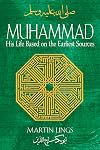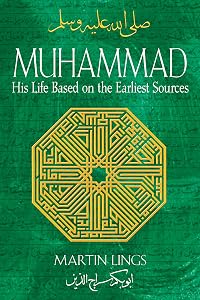
Muhammad: His Life Based on the Earliest Sources
by Martin Lings
On This Page
Description
An objective biography of the Prophet, drawn from primary Arabic sources of the 8th and 9th centuries, including passages never before translated. It owes its freshness and directness of approach to the words of the men and women who heard Muhammad speak and witnessed the events of his life.--From publisher description.Tags
Recommendations









Member Reviews
An exhaustive but ultimately disappointing biography of Muhammad. Martin Lings' book endeavours to draw on Arabic texts to inspire his readers with a love and admiration for the founder of Islam, but I finished the book not the reverence Lings was aspiring for, and not even with the opposite feeling of scepticism or criticism, but with nothing more than a sense of confusion.
The main flaw in the book, at least to me as an outsider, was its excessively devotional nature. While reasonably well-written, it gets bogged down in an excess of detail and loses narrative pace – for Lings cannot omit any event, no matter how small or narratively unimportant, if it is held in esteem by the religion to this day. And by drawing on original, show more uncritical religious sources, there's none of the critique an author should give to explain why and how this man rose to power, how he generated a following, how he won battles and spread his creed. Instead, everything happens because God wills it, without explanation, and my main interest in reading the book – to gain an overview of the religion's growth or an insight into the reasons for its military success – was left completely unsatisfied.
The book, then, quickly reveals itself to be more hagiography than sober biography. Uncomfortable events such as the Satanic verses debacle are omitted entirely even though it is clearly unscholarly to do so. Muhammad's enemies can become allies and converts merely by being invited to recite a devotional verse (apparently, its beauty dissuades them from their former course), and while this might be self-evident to a believer, it does not convince someone like myself who approaches the book from a different perspective. Other biographical details related by Lings are startling from the outside; not least the 50-year-old prophet's betrothal to the 6-year-old girl Aisha (married and consummated at 9), who becomes his 'favourite' wife. Lings relates Aisha being called in from the playground with her friends on her wedding day as though it was the most unremarkable thing in the world.
Lings also fails to deliver any sort of deeper philosophy or way of thinking that may be present in Islam. There's a narrative of the religion's rise that involves banditry, slave-gathering, concubines and executions of prisoners of war; deeds which unravel the humanistic teachings of previous prophets like Jesus – noted here as being a legitimate former prophet of God – and recall, instead, the bloody days of the Books of Moses. Where there is philosophical thinking, all that Lings gives us is how the Koran is a book of pure light and how there will be many tangible benefits in the afterlife if you submit to Islam, such as access to pure flowing water in Paradise.
This is not to say that Islam does not have that deeper thinking, or its deeds in history – only that Lings' book does not provide any of them. The book fails to show Muhammad's character as a man and a leader, which led to his veneration as head of a fledgling religion. It also fails to relate any philosophical wisdom beyond surface-level implorations to light and praise and submission to God, and fails to give any biographical or historical insight into the prophet's evident abilities as a general of an expanding power. Considering veneration of Muhammad is a core tenet of Islam, Lings' failure to provide any of this here means the book must be said to be a failure. show less
The main flaw in the book, at least to me as an outsider, was its excessively devotional nature. While reasonably well-written, it gets bogged down in an excess of detail and loses narrative pace – for Lings cannot omit any event, no matter how small or narratively unimportant, if it is held in esteem by the religion to this day. And by drawing on original, show more uncritical religious sources, there's none of the critique an author should give to explain why and how this man rose to power, how he generated a following, how he won battles and spread his creed. Instead, everything happens because God wills it, without explanation, and my main interest in reading the book – to gain an overview of the religion's growth or an insight into the reasons for its military success – was left completely unsatisfied.
The book, then, quickly reveals itself to be more hagiography than sober biography. Uncomfortable events such as the Satanic verses debacle are omitted entirely even though it is clearly unscholarly to do so. Muhammad's enemies can become allies and converts merely by being invited to recite a devotional verse (apparently, its beauty dissuades them from their former course), and while this might be self-evident to a believer, it does not convince someone like myself who approaches the book from a different perspective. Other biographical details related by Lings are startling from the outside; not least the 50-year-old prophet's betrothal to the 6-year-old girl Aisha (married and consummated at 9), who becomes his 'favourite' wife. Lings relates Aisha being called in from the playground with her friends on her wedding day as though it was the most unremarkable thing in the world.
Lings also fails to deliver any sort of deeper philosophy or way of thinking that may be present in Islam. There's a narrative of the religion's rise that involves banditry, slave-gathering, concubines and executions of prisoners of war; deeds which unravel the humanistic teachings of previous prophets like Jesus – noted here as being a legitimate former prophet of God – and recall, instead, the bloody days of the Books of Moses. Where there is philosophical thinking, all that Lings gives us is how the Koran is a book of pure light and how there will be many tangible benefits in the afterlife if you submit to Islam, such as access to pure flowing water in Paradise.
This is not to say that Islam does not have that deeper thinking, or its deeds in history – only that Lings' book does not provide any of them. The book fails to show Muhammad's character as a man and a leader, which led to his veneration as head of a fledgling religion. It also fails to relate any philosophical wisdom beyond surface-level implorations to light and praise and submission to God, and fails to give any biographical or historical insight into the prophet's evident abilities as a general of an expanding power. Considering veneration of Muhammad is a core tenet of Islam, Lings' failure to provide any of this here means the book must be said to be a failure. show less
Romanticised, but very enjoyable read. Shows Muhammad as prophet earlier and life, and as political figure later in life, when Jibreel's revelations concerned Muhammad's household and politics more than really spiritual life.
I liked the book, it is not a dry recitation of facts and battles and dates, but tries to be more of a biography, to bring the historical figure to life in the reader's mind.
I liked the book, it is not a dry recitation of facts and battles and dates, but tries to be more of a biography, to bring the historical figure to life in the reader's mind.
I was told this is the best seerah of Prophet Muhammad ﷺ and I can easily see it (despite not reading others. The way this was written is so masterfully done and it made me fall in love with the Prophet ﷺ even more.
This book is great and I would recommend it to anyone interested in learning more about Muhammad or the beginnings of Islam. It's very thorough, detailed, and concise. The best thing about it is that as a biography, even though is it in chronological order, it starts telling the tale of Muhammad from -before- his birth. This fact alone gives a lot of insight and helps establish the setting of the time period that he was born into. Martin Lings as well is very talented. His eloquent way of writing this biography made this book actually fun to read, whereas many people (like myself) find that biographies get very long, boring, and difficult to read.
wonderful book and a great introduction to the Prophet (pbuh). I find Islam a very interesting subject to read about and this book is one of the best I have read.
religion, history, Islam, Judaism, Christianity
Martin Ligs tiene un don inusual para la narración. Ha adoptado un estilo extremadamente legible y que refleja a un tiempo tanto la sencillez como la grandeza de la historia. El resultado es un libro que será leído con igual placer por quienes ya están familiarizados con la vida de Muhammad como por quienes se acerquen a ella por primera vez.
Ver el texto en línea: https://www.webislam.com/media/2008/01/45101_217.pdf
Ver el texto en línea: https://www.webislam.com/media/2008/01/45101_217.pdf
Oct 22, 2021Spanish
Members
- Recently Added By
Lists

The Emergence of the Modern Middle East
289 works; 13 members

Shaykh Hamza's Book Recommendations
439 works; 3 members

Books Referenced by Tarsin's Being Muslim
29 works; 1 member
Recommended Reading List of Professor Timothy J. Winter
60 works; 1 member
Author Information

Martin Lings was born in Lancashire in 1909. After a classical education he read English at Oxford where he was a pupil and later a close friend of C. S. Lewis. In 1935 he went to Lithuania where he lectured on Anglo-Saxon and Middle English and subsequently he went to Egypt and and lectured mainly on Shakespeare at Cairo University. In 1952 he show more returned to England and took a degree in Arabic and in 1955 he joined the staff of the British Museum where from 1970-73 he was Keeper of Oriental Manuscripts. For the following year he held the same post in the newly founded British Library. In addition to writing many books, as well as articles for Studies in Comparative Religion, Sophia, The New Encyclopaedia of Islam and the Encyclopaedia Britannica show less
Common Knowledge
- People/Characters
- Muhammad (Prophet); God; Gabriel; Khadija, wife of Muhammad; Ali ibn Abi Talib; Fatima, daughter of Muhammad (show all 11); Abu Bakr; Aisha, wife of Muhammad; Umar ibn al-Khattab; Abu Jahl; Abu Lahab
- Important places
- Mecca, Saudi Arabia; Medina, Saudi Arabia; Hejaz, Saudi Arabia; Abyssinia
Classifications
- Genres
- Religion & Spirituality, Nonfiction, Biography & Memoir, History, General Nonfiction
- DDC/MDS
- 297.63 — Religion Other religions Islam Islamic Leaders and Structures The Prophet Muhammad
- LCC
- BP75 .L56 — Philosophy, Psychology and Religion Islam. Bahaism. Theosophy, etc. Islam. Bahai Faith. Theosophy, etc. Biography Muammad, Prophet, d. 632
- BISAC
Statistics
- Members
- 642
- Popularity
- 45,450
- Reviews
- 9
- Rating
- (4.23)
- Languages
- 8 — English, French, German, Italian, Malay, Portuguese, Spanish, Turkish
- Media
- Paper, Audiobook, Ebook
- ISBNs
- 24
- ASINs
- 7