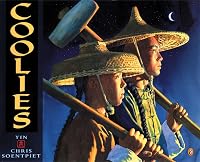
Coolies
by Yin
On This Page
Description
A young boy hears the story of his great-great-great-grandfather and his brother who came to the United States to make a better life for themselves helping to build the transcontinental railroad.Tags
Recommendations

Member Reviews
“This is the land of opportunity! Shek marvels as he and Little Wong step off the overcrowded ship that had brought them to America in 1865.”
In “Coolies”, Yin shares a historical fiction about the brothers of Shek and Little Wong, who left a village in Canton due to government corruption that led to starvation. They said goodbye to their family, promising to send money home, as they embark on a journey that will result in their becoming ‘coolies’ working on the transcontinental railroad, risking life and limbs, freezing temperatures, inhumanely long working hours, life-threatening explosives, and fed just barely enough food to work another long day ahead. The book begins and ends with a grandmother and a grandson paying show more respects to their elders; the grandmother explains why they have this ritual by sharing their family history.
As a kid’s book (maybe 10-ish years age), Yin did a very fine job telling a difficult tale with limited sugar coating. The illustrations by Soentpiet are on point also, notably with readable Chinese characters. Two things I want to address:
1. The term ‘coolies’ is very outdated and is a derogatory term. If this book was titled differently and the term used only as a historical reference within the book, I would be giving the book two big thumbs up. (Note the book was released in 2001, so the book name is somewhat understandable.)
2. The one key sugar coating in the book is that the brothers mailed money home to bring their family over to end their story. While such a storyline is an understandable deviation within a kid’s book, it’s important to note that was impossible, unless illegally done (look up paper son). The Page Act of 1875, the first restrictive federal immigration law in the US, effectively prohibited the entry of Chinese women, ended open borders for the first time. The 1882 Chinese Exclusion Act banned immigration by Chinese men also. Essentially, after building the railroads for them, the Chinese weren’t wanted anymore. It was infuriatingly insulting. (This ban wasn’t rescinded until the US wanted China’s collaboration against the Japanese during WWII in 1943!)
In any case, I still recommend this book due to its largely accurate story. Especially for Chinese Americans rising their children in the US, this is a part of their history that cannot be forgotten. show less
In “Coolies”, Yin shares a historical fiction about the brothers of Shek and Little Wong, who left a village in Canton due to government corruption that led to starvation. They said goodbye to their family, promising to send money home, as they embark on a journey that will result in their becoming ‘coolies’ working on the transcontinental railroad, risking life and limbs, freezing temperatures, inhumanely long working hours, life-threatening explosives, and fed just barely enough food to work another long day ahead. The book begins and ends with a grandmother and a grandson paying show more respects to their elders; the grandmother explains why they have this ritual by sharing their family history.
As a kid’s book (maybe 10-ish years age), Yin did a very fine job telling a difficult tale with limited sugar coating. The illustrations by Soentpiet are on point also, notably with readable Chinese characters. Two things I want to address:
1. The term ‘coolies’ is very outdated and is a derogatory term. If this book was titled differently and the term used only as a historical reference within the book, I would be giving the book two big thumbs up. (Note the book was released in 2001, so the book name is somewhat understandable.)
2. The one key sugar coating in the book is that the brothers mailed money home to bring their family over to end their story. While such a storyline is an understandable deviation within a kid’s book, it’s important to note that was impossible, unless illegally done (look up paper son). The Page Act of 1875, the first restrictive federal immigration law in the US, effectively prohibited the entry of Chinese women, ended open borders for the first time. The 1882 Chinese Exclusion Act banned immigration by Chinese men also. Essentially, after building the railroads for them, the Chinese weren’t wanted anymore. It was infuriatingly insulting. (This ban wasn’t rescinded until the US wanted China’s collaboration against the Japanese during WWII in 1943!)
In any case, I still recommend this book due to its largely accurate story. Especially for Chinese Americans rising their children in the US, this is a part of their history that cannot be forgotten. show less
I liked this book for two reasons. First, I loved the illustrations. Coolies is a picture book about two Chinese brothers, Shek and Wong, who sailed out to America to work. In America they were discriminated due to their looks, forced to work long hours for little pay and weren’t allowed to attend the parade once they finished. Once the railroads were done, Shek and Wong moved towns and started working and saving money in the hopes to bring their family in China to America. Chris Soentpiet used 80% of the pages to bring his illustrations to life. He used a lot of brown, orange, blue and some whites in his illustrations. Since Chris used most of the pages, you can feel the expressions. For example, there was an avalanche and Wong show more wanted to go look for his brother. In the illustration, you can feel how worried Wong was and how he wanted to run and go look for his brother. Right behind him, you can see the boss angrily grabbing Wong by the arm. The wind is blowing in the dark night. The other Chinese workers looked scared of the boss but worried for Wong at the same time. Second, I liked plot structure. The story starts with a grandmother teaching her grandson how to show respect to their ancestors during the Ching Ming Festival. Here she takes a moment to pay respect and remember Shek and Wong and all their hard work to bring their family to the land of opportunities. She says, “Let me tell you of two we do not forget. Of my bokgong-my great-grandfather- and his brother.” The main purpose of this story is to share the ethic works of the Chinese during some enduring harsh moments, yet some where able to overcome and succeed. show less
The title is an attempt to 'reclaim' the word, much as some people who are gay refer to themselves as Queer, or some Blacks use the "N" word. And in my opinion the book succeeds in discussing the word and the different attitudes behind it, in a story that it not only important but is also engaging and absolutely beautifully illustrated. Highly recommended for ages 7 up, especially families who homeschool.
This is an incredible book focusing on the building of the American transcontiential railroad and the fact that it was the Chinese workers who were responsible for making this a reality.
Working exceedingly long, back-breaking hours from sunup to long in the evening, the author developes two fictional brothers, Shek and Wong as who came from Canton, China where hunger has rampant, and work was non existant.
The incredible illustrations of Chris Soentpiet allow the reader to feel how very difficult their lives were in America. Thinking it would be the land of dreams, instead it was the land of screams of pain as long hours and hard work sapped their energy.
Chinese people, hired by the Central Pacific Railroad company, were paid far less show more than others. I did not know that Irish railroad workers were hired by the Union Pacific Railroad Company. Whereas the Chinese headed East, the Irish headed West. After completion of the railroad, meeting in Utah, people and cargo could cross the continent in days, rather than the long arduous previous trek.
Looked upon a skinny weaklings, the Chinese were not only discrimanated against financially, but in addition were treated terriblely, cruely and seen as little weaklings. Making fun of them and their attire, they were called "Coolies."
The author depicts a story of the Chinese people used to blow up the side of the mountain in order to build a tunnel. Placed in small baskets, they were then lowered down to set off the dynamite.
Intruth, though they were seen as skinnny low lifes, in reality, the Chinenese laborers carried twice the workloads at much faster speeds than others!
Finally, after four years of brutality, the Chinese laborers in the spring of 1869, found their place at Promontory Summit , Uthan where the two railway lines met.
In this book, the author notes a large celebration wherein townspeople, railroad managers, and others met to celebrate. All were invited EXCEPT "the Coolies." show less
Working exceedingly long, back-breaking hours from sunup to long in the evening, the author developes two fictional brothers, Shek and Wong as who came from Canton, China where hunger has rampant, and work was non existant.
The incredible illustrations of Chris Soentpiet allow the reader to feel how very difficult their lives were in America. Thinking it would be the land of dreams, instead it was the land of screams of pain as long hours and hard work sapped their energy.
Chinese people, hired by the Central Pacific Railroad company, were paid far less show more than others. I did not know that Irish railroad workers were hired by the Union Pacific Railroad Company. Whereas the Chinese headed East, the Irish headed West. After completion of the railroad, meeting in Utah, people and cargo could cross the continent in days, rather than the long arduous previous trek.
Looked upon a skinny weaklings, the Chinese were not only discrimanated against financially, but in addition were treated terriblely, cruely and seen as little weaklings. Making fun of them and their attire, they were called "Coolies."
The author depicts a story of the Chinese people used to blow up the side of the mountain in order to build a tunnel. Placed in small baskets, they were then lowered down to set off the dynamite.
Intruth, though they were seen as skinnny low lifes, in reality, the Chinenese laborers carried twice the workloads at much faster speeds than others!
Finally, after four years of brutality, the Chinese laborers in the spring of 1869, found their place at Promontory Summit , Uthan where the two railway lines met.
In this book, the author notes a large celebration wherein townspeople, railroad managers, and others met to celebrate. All were invited EXCEPT "the Coolies." show less
I was too old for this book when it came out, but when I saw a copy at the Friends of the Library sale, snagged it for future kids so they can learn about our history. I'd say maybe ages 5-8, a picture book take on the Transcontinental Railroad through the eyes of two brothers who worked as the titular coolies through the Sierra Nevadas on the Central Pacific portion. The work was hard and dangerous, with Chinese laborers paid at a lower rate for longer hours. Beautiful painted illustrations play with light.
In my opinion this is a great book. Although it is fiction, you can learn a lot about Chinese history from it. One thing I liked in particular was the character development. The characters Shek and Wong may not have been real people, but they were well developed and it felt like these people actually existed. I particularly liked Shek because of his protective big brother instincts. An example of this was when the boss wanted Wong to blow up the side of the mountain, but Shek was scared for Wong to hurt himself. Shek then stepped up and did it himself to protect his brother. I also liked the set up of the plot. In the beginning of the book a grandmother and grandson are having a celebration where they are honoring their ancestors but show more the grandson doesn’t really know why. The story is then the grandmother telling of the railroad workers. Having the plot go like this makes you not just think about the story as history and facts, but brings it meaning and makes it relatable by tying it to family history. The big idea of this story was to tell about the history of the Chinese railroad workers. It also sends the message of how valuable family history is. show less
"Coolies" is a cultural experience, taking the reader through the history of some of the Chinese men who immigrated to the united states to work on the railroads and make a better life for their families. This stunning tale provokes thoughtful reflection and gratitude towards those who have gone before and paved the way for life as we experience it today.
Members
- Recently Added By
Lists

Picture Books About Civil Rights
51 works; 4 members

Beautiful Feet Books
304 works; 7 members
Author Information
7 Works 677 Members
Awards and Honors
Awards
Distinctions
Common Knowledge
- Canonical title
- Coolies
- Original publication date
- 2001
Classifications
Statistics
- Members
- 485
- Popularity
- 62,653
- Reviews
- 22
- Rating
- (3.99)
- Languages
- English
- Media
- Paper
- ISBNs
- 7
- ASINs
- 2