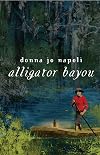
Alligator Bayou
by Donna Jo Napoli
On This Page
Description
Fourteen-year-old Calogero Scalise and his Sicilian uncles and cousin live in small-town Louisiana in 1898, when Jim Crow laws rule and anti-immigration sentiment is strong, so despite his attempts to be polite and to follow American customs, disaster dogs his family at every turn.Tags
Recommendations











Member Reviews
This story is based on real events in Tallulah, Louisiana in 1899. It is generally well known that the 1890’s saw the rise of anti-black backlash in the American South. But what is not such common knowledge is that at the same time, Italian immigration to the U.S. South gave rise to extreme nativist expression, including lynchings.
As a motivation for the hatred expressed against the Italians, which you will read about in the book, the characters point to two factors. One was the tendency of the Italians to treat blacks the same as whites. This practice might have given blacks "ideas" and simply was not to be tolerated. A second problem was commercial rivalry, because of fears that the Italians would siphon off jobs and income. At the show more time in which this story takes place, economic insecurity felt by "natives" was worse than usual: the U.S. was experiencing a severe economic depression that began with the Panic of 1893. Only in mid-1897 did recovery begin. Anger, scapegoating, stereotyping, and mob behavior characterized the hardest-hit regions of the country. In the last decade of the nineteenth century, 1665 persons died at the hands of lynch mobs.
In the story, as in the actual event inspiring the book, the incident that ended in tragedy began when the Italian grocers in Tallulah served a black customer prior to waiting on a white one. Napoli is somewhat faithful to using actual historical figures as characters, but adds a 14-year-old boy, Calogero, recently arrived from Sicily, as a narrator, who comes to live with five cousins already in Tallulah. Calogero, or Calo, also acquires a love interest: a young black girl named Patricia, which helps the author illustrate the fragile scaffolding of race relations in the South at that time. Calo doesn’t know much about the nature of racism in the U.S. prior to his arrival; the other characters are constantly educating him. Some of the information comes straightforwardly as lectures by Calo's white tutor, and some in a slightly more subtle form. For example, when Patricia’s brothers take Calo hunting for alligator at night, he confesses to her his dislike of the gator. Patricia says to Calo:
"‘They’s worse things than ‘gators, Calogero. At least a ‘gator stay in the swamp and don’t get you by surprise. When you dealing with a ‘gator, you know who you dealing with.’”
And perhaps this also serves as the best example for one quibble I have with the book: even the "subtle" teaching moments are a little heavy-handed. The plot device of Calogero needing to learn about real life in America results in a lot of preaching about prejudice, race relations, justice (or the lack thereof) and the means of survival as an “other” in such a society. It sometimes feels more like you are in school than fully absorbed in a story.
Nevertheless, once the author’s message is across and she comes to the denouement, the pages fly by, and knock you flat with the ending. show less
As a motivation for the hatred expressed against the Italians, which you will read about in the book, the characters point to two factors. One was the tendency of the Italians to treat blacks the same as whites. This practice might have given blacks "ideas" and simply was not to be tolerated. A second problem was commercial rivalry, because of fears that the Italians would siphon off jobs and income. At the show more time in which this story takes place, economic insecurity felt by "natives" was worse than usual: the U.S. was experiencing a severe economic depression that began with the Panic of 1893. Only in mid-1897 did recovery begin. Anger, scapegoating, stereotyping, and mob behavior characterized the hardest-hit regions of the country. In the last decade of the nineteenth century, 1665 persons died at the hands of lynch mobs.
In the story, as in the actual event inspiring the book, the incident that ended in tragedy began when the Italian grocers in Tallulah served a black customer prior to waiting on a white one. Napoli is somewhat faithful to using actual historical figures as characters, but adds a 14-year-old boy, Calogero, recently arrived from Sicily, as a narrator, who comes to live with five cousins already in Tallulah. Calogero, or Calo, also acquires a love interest: a young black girl named Patricia, which helps the author illustrate the fragile scaffolding of race relations in the South at that time. Calo doesn’t know much about the nature of racism in the U.S. prior to his arrival; the other characters are constantly educating him. Some of the information comes straightforwardly as lectures by Calo's white tutor, and some in a slightly more subtle form. For example, when Patricia’s brothers take Calo hunting for alligator at night, he confesses to her his dislike of the gator. Patricia says to Calo:
"‘They’s worse things than ‘gators, Calogero. At least a ‘gator stay in the swamp and don’t get you by surprise. When you dealing with a ‘gator, you know who you dealing with.’”
And perhaps this also serves as the best example for one quibble I have with the book: even the "subtle" teaching moments are a little heavy-handed. The plot device of Calogero needing to learn about real life in America results in a lot of preaching about prejudice, race relations, justice (or the lack thereof) and the means of survival as an “other” in such a society. It sometimes feels more like you are in school than fully absorbed in a story.
Nevertheless, once the author’s message is across and she comes to the denouement, the pages fly by, and knock you flat with the ending. show less
I liked this story not only for its historical basis (I love a true story), but also for its theme of tolerance. Tolerance is such a problem with middle school students- I think this would be a great novel for 7-8th graders to discuss prejudice, tolerance and racism in the context of history and as it relates to today's world. Calogero-Calo-is a recent immigrant from Sicily in 1899 Louisiana. He lives with five other male relatives who immigrated earlier and who run a produce business in a small town. Racial tensions are high with the country suffering from the throes of Reconstruction; southern whites don't like blacks or most any other minority- especially immigrants or those who try to act as though they are equal to the whites. Calo show more doesn't understand why he shouldn't have a friendship with Patricia, a pretty black girl in the town, or hang around with her brothers. His white tutor tries to educate him not only in the academic sense, but also in human relations in his new country. Calo grows from a naive boy to one whose eyes are opened to the senseless violence that can happen when bigoted people are allowed to bully others. The racial tensions and prejudice that lead to the climax are shocking, disgusting, and disturbing. As a language arts teacher, I can see many serious class discussions regarding the themes Napoli presents in her book. The reading level is quite low (AR level 3.1), but good for all middle school readers to be able to access its content. show less
Since the book was young adult (closer to middle grades fiction, I would guess), the prose was basic, straightforward, and very easy to read. I could have read this in a few hours, but for some reason it just did not flow like that. Calo is a sweet boy with a heart for family and friends, but I find it difficult to believe that he could migrate to Louisiana and have lived there a little while without having an ounce of knowledge about the Civil War or the hostilities of the South at that time. He asked a lot of questions, and it seemed that these questions were prime opportunity for Napoli to lecture on prevalence of racism and hatred in this time period. Maybe these lectures would be more suitable for the younger audiences reading this show more book, but I think those parts were a bit overdone and dry. I did enjoy learning about how Italians fit into the racial landscape of the post-Civil War south, though, since this is not a topic that receives ample attention.
Without divulging details, the end of this one was hard to swallow. If you are looking for happily ever after, keep looking! If you life coming-of-age stories involving race and social conflict (and don't mind young adult), try this one. Don't expect a sweeping storyline that'll leave you breathless, but I think you can count on learning a little bit and being decently entertained. Since I am not a teacher or parent, I cannot honestly say whether or not a middle grader or young adult would like this one. Pre-ending, I would say, "Sure, go for it," but the ending packs quite a punch! show less
Without divulging details, the end of this one was hard to swallow. If you are looking for happily ever after, keep looking! If you life coming-of-age stories involving race and social conflict (and don't mind young adult), try this one. Don't expect a sweeping storyline that'll leave you breathless, but I think you can count on learning a little bit and being decently entertained. Since I am not a teacher or parent, I cannot honestly say whether or not a middle grader or young adult would like this one. Pre-ending, I would say, "Sure, go for it," but the ending packs quite a punch! show less
Alligator Bayou is a historical novel that is written for readers who are twelve years old and older. This book is a first person account of the experiences of Calogero. Calogero is a fourteen-year-old boy who was born in Sicily. It is the 1890's, and his father disappeared long ago. After Calogero's mother dies, his younger borther Rocco is taken in by neighbors; Calogero is sent to live and work in the United States. In his new country, Calogero lives with his "cousin" and "uncles" who are actually close family friends. The group lives in the small town of Tallulah, Louisiana.
However, life is tough in Louisiana. In this community, racial tensions run high, as black people and Sicilians are treated as second class citizens by the show more town's white people. Adding to the trouble is the fact that some of the Sicilians have little knowledge of English. Moreover, Calogero's girlfriend is a young black girl, and he "fraternizes" with her family and friends. A series of mistakes and misunderstandings causes the white people's suspicions and hatred to rise to the surface as the immigrants face a life or death situation.
This book addresses the realities of life faced by "outsiders" in a small southern town over a hundred years ago. Alligator Bayou expands our ideas of the effects of Jim Crow laws in the South near the turn of the twentieth century. The book contained descriptions of the physical punishment undergone by the victims of racial discrimination. The story was engaging and easy to follow. The author showed the readers that skin color, as well as a person's ethnic heritage and religion, combined to bring out the worst in some people. However, the saving grace of Napoli's story comes when these same qualities bring out the best in others. This novel would be perfect for an American history class to study to learn about Jim Crow laws and racial discrimination. show less
However, life is tough in Louisiana. In this community, racial tensions run high, as black people and Sicilians are treated as second class citizens by the show more town's white people. Adding to the trouble is the fact that some of the Sicilians have little knowledge of English. Moreover, Calogero's girlfriend is a young black girl, and he "fraternizes" with her family and friends. A series of mistakes and misunderstandings causes the white people's suspicions and hatred to rise to the surface as the immigrants face a life or death situation.
This book addresses the realities of life faced by "outsiders" in a small southern town over a hundred years ago. Alligator Bayou expands our ideas of the effects of Jim Crow laws in the South near the turn of the twentieth century. The book contained descriptions of the physical punishment undergone by the victims of racial discrimination. The story was engaging and easy to follow. The author showed the readers that skin color, as well as a person's ethnic heritage and religion, combined to bring out the worst in some people. However, the saving grace of Napoli's story comes when these same qualities bring out the best in others. This novel would be perfect for an American history class to study to learn about Jim Crow laws and racial discrimination. show less
Reviewed by LadyJay for TeensReadToo.com
It is the year 1899. Calogero, a 14-year-old Sicilian immigrant, lives in Tallulah, Louisiana, with his uncles and cousins.
They have all come to America seeking a better life. They do well for themselves, selling fruits and vegetables from a corner grocery store. They do not seek out trouble, but it always has a way of finding them.
Calo and his family do not discriminate between blacks and whites. They sell to anyone who will buy their produce. Members of the town find this behavior reprehensible and disgusting. It is only a matter of time before the white citizens of Tallulah turn their backs on Calo and his family, and destroy every possible hope they had of leading quiet, normal lives.
Donna Jo show more Napoli has done extensive research for this novel. The afterword explains that Napoli came across an article about five Sicilian grocers in Tallulah, Louisiana, who were lynched because they served a black customer before a white one. The article moved Napoli, and she felt a story must be told about these men. Napoli based her characters on those people who testified or were talked about in the testaments taken after the Tallulah lynching.
The time and effort Napoli has put into her research makes the story more genuine, more affecting. It is a tragic story that ends with a glimmer of hope.
Read this novel - it is a horrific reminder of what can happen when prejudice prevails and mob mentality rules over all. show less
It is the year 1899. Calogero, a 14-year-old Sicilian immigrant, lives in Tallulah, Louisiana, with his uncles and cousins.
They have all come to America seeking a better life. They do well for themselves, selling fruits and vegetables from a corner grocery store. They do not seek out trouble, but it always has a way of finding them.
Calo and his family do not discriminate between blacks and whites. They sell to anyone who will buy their produce. Members of the town find this behavior reprehensible and disgusting. It is only a matter of time before the white citizens of Tallulah turn their backs on Calo and his family, and destroy every possible hope they had of leading quiet, normal lives.
Donna Jo show more Napoli has done extensive research for this novel. The afterword explains that Napoli came across an article about five Sicilian grocers in Tallulah, Louisiana, who were lynched because they served a black customer before a white one. The article moved Napoli, and she felt a story must be told about these men. Napoli based her characters on those people who testified or were talked about in the testaments taken after the Tallulah lynching.
The time and effort Napoli has put into her research makes the story more genuine, more affecting. It is a tragic story that ends with a glimmer of hope.
Read this novel - it is a horrific reminder of what can happen when prejudice prevails and mob mentality rules over all. show less
Haunting tale about what happened to some Sicilian immigrants in the late 1800s in southern America.
The book opened my eyes to a tragedy that I had never heard about and it did so in a moving, well-paced way.
The author's note in the back has other article recommendations for further reading.
Definitely recommended and would make a great discussion book in American History classes.
The book opened my eyes to a tragedy that I had never heard about and it did so in a moving, well-paced way.
The author's note in the back has other article recommendations for further reading.
Definitely recommended and would make a great discussion book in American History classes.
Personal response:
An introduction to an unfamiliar situation of a young adult who has little family support and struggles against becomes what is typically around him: poor male role models. He finds a mentor who has been through the same things he faces, and the bond they form transforms them both.
Cirriculum/Progam connection:
I would recommend this to all teens, but would use it in conjunction with a display of noted black authors. I was so impressed with the author that I googled her biography.
An introduction to an unfamiliar situation of a young adult who has little family support and struggles against becomes what is typically around him: poor male role models. He finds a mentor who has been through the same things he faces, and the bond they form transforms them both.
Cirriculum/Progam connection:
I would recommend this to all teens, but would use it in conjunction with a display of noted black authors. I was so impressed with the author that I googled her biography.
Members
- Recently Added By
Author Information

116+ Works 14,505 Members
Donna Jo Napoli was born on February 28, 1948. She received a B.A. in mathematics, an M.A. in Italian literature, and a Ph.D. in general and romance linguistics from Harvard University. She has taught on the university level since 1970, is widely published in scholarly journals, and has received numerous grants and fellowships in the area of show more linguistics. In the area of linguistics, she has authored five books, co-authored six books, edited one book, and co-edited five books. She is also a published poet and co-editor of four volumes of poetry. Her first middle grade novel, Soccer Shock, was published in 1991. Her other novels include the Zel, Beast, The Wager, Lights on the Nile, Skin, Storm, Hidden, and Dark Shimmer. She is also the author of several picture books including Flamingo Dream, The Wishing Club: A Story About Fractions, Corkscrew Counts: A Story About Multiplication, The Crossing, A Single Pearl, and Hands and Hearts. She has received several awards including the New Jersey Reading Association's M. Jerry Weiss Book Award for The Prince of the Pond and the Golden Kite Award for Stones in Water. (Bowker Author Biography) show less
Awards and Honors
Common Knowledge
- Canonical title
- Alligator Bayou
Classifications
- Genres
- Fiction and Literature, Tween, Teen, Young Adult
- DDC/MDS
- 813.0835 — Literature & rhetoric American literature in English American fiction in English By type Genre fiction Realistic fiction
- LCC
- PZ7 .N15 .A — Language and Literature Fiction and juvenile belles lettres Fiction and juvenile belles lettres Juvenile belles lettres
- BISAC
Statistics
- Members
- 238
- Popularity
- 136,053
- Reviews
- 12
- Rating
- (3.98)
- Languages
- English
- Media
- Paper, Ebook
- ISBNs
- 6
- ASINs
- 2