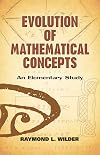
Evolution of Mathematical Concepts
by Raymond L. Wilder
On This Page
Description
A prominent educator offers aunique exploration of the evolutionarydevelopment of modern mathematics.Rather than conducting asurvey of the history or philosophyof mathematics, the author envisions mathematics as abroad cultural phenomenon. His treatment examines andillustrates how such concepts as number and length wereaffected by historic and social events.Reprint of the John Wiley & Sons, New York, 1973 edition.Tags
Recommendations













Member Recommendations

Member Reviews
I read this with a philosophical question in mind: Is mathematics, as you may perhaps consider e.g. physics, like a vast continent waiting to be explored? Or is mathematics a construction of the human mind? Would extraterrestrial intelligent beings – provided they had achieved a comparable level of mathematics including the invention of computers – develop a similar mathematical body (although naturally using different symbols, and of course having not (yet?) developed all the branches of mathematics we are exploring today but perhaps others instead)? The problem of ‘mathematical existence’ has been discussed since ancient Greek times. Wilder writes: “The assumption made in the present work is that the only reality show more mathematical concepts have is as cultural elements or artifacts.” And: “The concept of number is an existing cultural entity whose origin and evolution were induced by cultural stress of environmental and hereditary character. And the concept of an infinite totality of natural numbers is not […] open to argument as regards its existential nature.” The existence of infinite totalities in the physical world is irrelevant. It matters only whether the concepts lead to fruitful mathematical developments. This still leaves the possibility, I think, that extraterrestrial intelligent being, because of similarities in the physical environment and the resulting stress, may develop a similar comparable body of mathematical concepts. However Wilder writes: “Mathematics as we know it, except possibly for the rudiments of counting, has little of inevitability about it; if ‘intelligent’ life is ever contacted on another planet, its mathematics may be quite different from ours.” (xix)
This book is especially recommended for those who shied away from mathematics all their lives but felt that they were missing something. Indeed! (VII-12) show less
This book is especially recommended for those who shied away from mathematics all their lives but felt that they were missing something. Indeed! (VII-12) show less
Members
- Recently Added By
Author Information

5+ Works 96 Members
Classifications
Statistics
- Members
- 23
- Popularity
- 1,078,343
- Reviews
- 1
- Rating
- (5.00)
- Languages
- English
- Media
- Paper
- ISBNs
- 6