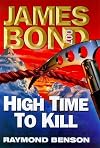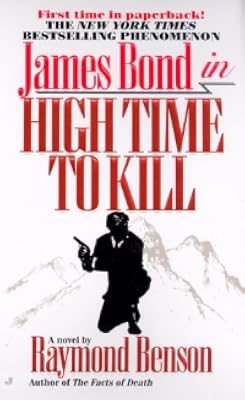
High Time to Kill
by Raymond Benson
The Union Trilogy (1), Raymond Benson's Bond (book 3), James Bond Novels: Continuation Series (37), James Bond Novels (37)
On This Page
Description
The Union is a criminal organization with tentacles throughout the world, specializing in military espionage, theft, intimidation and murder. After one of its agents assassinates James Bond's friend, the Union becomes 007's priority target.Tags
Recommendations





























Member Reviews
Raymond Benson always has solid plots and some of that mystical measure of what can only be referred to as “Flemingesque”. That been said there are some critical flaws in “High Time to Kill” that mar what should have been an enjoyable read. The past few months I have been making my way through the Bond canon while commuting to work (which can often be over an hour one way), and after making my way through the audiobook editions of all the Fleming books and then graduating to Amis and Gardner I settled down to “High Time to Kill” and the problems quickly became apparent.
While few can fault Amis’ solo effort for its plot (“Colonel Sun”) or the prose, Gardner’s efforts to the Bond canon were a mixed bag. I really show more enjoyed “Licence Renewed” (which was read by Jeremy Northam), and the Simon Vance (aka Robert Whitfield) readings of “Icebreaker”, “Role of Honor” and “Scorpius”, but some of Gardner's later 007 novels seemed somewhat tired. That said, Gardner’s prose was measured and sheer perfection. The same cannot be said for Benson whose elementary prose and glaring grammatical errors place all his 007 novels in desperate need of an editor.
How much I desperately wanted to like this novel and how hopeful I was to give it five stars.
As a fan of the movie (and book) of the Clint Eastwood spy movie "The Eiger Sanction" that also covers a spy having to mount an expedition up a notorious mountain, I liked what I had heard about this work. But, whereas the earlier work had a legitimate reason for the spy to make the trip (identify an enemy agent), this effort (by respected 007 fan Benson) is immediately fraught with plot holes, that are not helped by Benson's wooden prose.
I hold the utmost respect for Benson. He knows more about the character of James Bond than I could ever hope to. His reference book "The Bedside Companion" is rated by fans as one of the best, if not the best, piece of non-fiction on the character created by Ian Fleming in 1952's "Casino Royale." A character that became a seminal part of the worlds pop culture a decade later when "Doctor No" exploded onto cinema screens starring a little-known actor named Sean Connery.
The plot involves the theft of a chemical named Skin 17 that has been developed by the British as a means that would allow planes to travel at Mach 7 without falling apart. An interesting MacGuffin surely, a mysterious terrorist group known as the Union (Benson's version of SPECTRE) has stolen the formula and has hidden a microdot with the critical information in the pacemaker of a Chinese national.
All seems to be going to plan until said national crashes into the side of a Nepalese mountain we are informed is the third highest peak in the world. The race is on.
Here lies the major problem. The plane that crashes is a twin propeller plane. We are told that it landed on a fairly level section of the mountain not far from the peak. However instead of sending men up by helicopter (many helicopters out there have flight ceilings higher than the twin-prop used), and wearing pressurized suits to recover the microdot immediately, the British decide to spend a month putting together a team to scale the mountain - why? There is no reason explained. This plot issue was further highlighted when a French pilot (Didier Delsalle) did land a helicopter on the 29,035-foot peak of Mount Everest in 2005 and the fact that a helicopter reached 40,820 feet in 1972. (ref: http://www.nationalgeographic.com/adventure/0509/whats_new/helicopter_everest.ht...
Aside from this principal problem with the very crux of the story, Benson (who in his defense was not a professional writer before being offered the gig by Fleming's estate) commits the cardinal sin by debunking a key piece of Bond lore laid out by Fleming himself.
In the novel "You Only Live Twice" Bond is believed dead and his boss M even writes his obituary. In it Fleming tells us that Bond was kicked out of Eton after two halves (or 2/3rds of the way through a year). However Benson has Bond musing about his two years at Eton in one of the earliest chapters. This lapse struck me as particularly surprising given that Benson is (quite rightly) considered one of the foremost authorities on James Bond 007.
Another continuity error is obvious to even the most casual reader. During the car chase outside Brussels, Bond deploys a remote controlled hovering weapon from the undercarriage of his Bentley called a "scout." Half way through the battle Bond returns it to its position under the car, yet a couple of pages later we are told that it is still hovering 30 feet above the Bentley. It is continuity errors like this, and Benson's troublesome prose and apparent lack of understanding of grammar that has me seriously questioning the ability of his book editor.
A book for which I had high expectations that left me shaking my head at its show of incompetence (on the part of the editor).
Sorry Raymond :( show less
While few can fault Amis’ solo effort for its plot (“Colonel Sun”) or the prose, Gardner’s efforts to the Bond canon were a mixed bag. I really show more enjoyed “Licence Renewed” (which was read by Jeremy Northam), and the Simon Vance (aka Robert Whitfield) readings of “Icebreaker”, “Role of Honor” and “Scorpius”, but some of Gardner's later 007 novels seemed somewhat tired. That said, Gardner’s prose was measured and sheer perfection. The same cannot be said for Benson whose elementary prose and glaring grammatical errors place all his 007 novels in desperate need of an editor.
How much I desperately wanted to like this novel and how hopeful I was to give it five stars.
As a fan of the movie (and book) of the Clint Eastwood spy movie "The Eiger Sanction" that also covers a spy having to mount an expedition up a notorious mountain, I liked what I had heard about this work. But, whereas the earlier work had a legitimate reason for the spy to make the trip (identify an enemy agent), this effort (by respected 007 fan Benson) is immediately fraught with plot holes, that are not helped by Benson's wooden prose.
I hold the utmost respect for Benson. He knows more about the character of James Bond than I could ever hope to. His reference book "The Bedside Companion" is rated by fans as one of the best, if not the best, piece of non-fiction on the character created by Ian Fleming in 1952's "Casino Royale." A character that became a seminal part of the worlds pop culture a decade later when "Doctor No" exploded onto cinema screens starring a little-known actor named Sean Connery.
The plot involves the theft of a chemical named Skin 17 that has been developed by the British as a means that would allow planes to travel at Mach 7 without falling apart. An interesting MacGuffin surely, a mysterious terrorist group known as the Union (Benson's version of SPECTRE) has stolen the formula and has hidden a microdot with the critical information in the pacemaker of a Chinese national.
All seems to be going to plan until said national crashes into the side of a Nepalese mountain we are informed is the third highest peak in the world. The race is on.
Here lies the major problem. The plane that crashes is a twin propeller plane. We are told that it landed on a fairly level section of the mountain not far from the peak. However instead of sending men up by helicopter (many helicopters out there have flight ceilings higher than the twin-prop used), and wearing pressurized suits to recover the microdot immediately, the British decide to spend a month putting together a team to scale the mountain - why? There is no reason explained. This plot issue was further highlighted when a French pilot (Didier Delsalle) did land a helicopter on the 29,035-foot peak of Mount Everest in 2005 and the fact that a helicopter reached 40,820 feet in 1972. (ref: http://www.nationalgeographic.com/adventure/0509/whats_new/helicopter_everest.ht...
Aside from this principal problem with the very crux of the story, Benson (who in his defense was not a professional writer before being offered the gig by Fleming's estate) commits the cardinal sin by debunking a key piece of Bond lore laid out by Fleming himself.
In the novel "You Only Live Twice" Bond is believed dead and his boss M even writes his obituary. In it Fleming tells us that Bond was kicked out of Eton after two halves (or 2/3rds of the way through a year). However Benson has Bond musing about his two years at Eton in one of the earliest chapters. This lapse struck me as particularly surprising given that Benson is (quite rightly) considered one of the foremost authorities on James Bond 007.
Another continuity error is obvious to even the most casual reader. During the car chase outside Brussels, Bond deploys a remote controlled hovering weapon from the undercarriage of his Bentley called a "scout." Half way through the battle Bond returns it to its position under the car, yet a couple of pages later we are told that it is still hovering 30 feet above the Bentley. It is continuity errors like this, and Benson's troublesome prose and apparent lack of understanding of grammar that has me seriously questioning the ability of his book editor.
A book for which I had high expectations that left me shaking my head at its show of incompetence (on the part of the editor).
Sorry Raymond :( show less
I have read Mr. Benson's Bond novels before, and even though I enjoyed them, this one was the most enjoyable. In my opinion, Mr. Benson has captured the essence of book Bond in this novel, not movie Bond. This is a wonderful Bond novel, and I recommend it whole heatedly. This book reads like a book, not an outline for a movie.
Ratings
Members
- Recently Added By
Author Information

70+ Works 2,887 Members
Raymond Benson is the author of Never Dream of Dying, Doubleshot, High Time to Kill, The Facts of Death, and Zero Minus Ten, and the novelizations of The World Is Not Enough and Tomorrow Never Dies. A director of the Ian Fleming Foundation, he lives and works in the Chicago area.
Series


Work Relationships
Is contained in
Common Knowledge
- Canonical title
- High Time to Kill
- People/Characters
- James Bond; M; Q; Miss Moneypenny; Steven Harding; Roland Marquis (show all 9); Le Gerrant; Hope Kendal; Paul Baack
- Important places
- Bahamas; Belgium; Delhi, India; Morocco; Nepal; London, England, UK (show all 9); Buckinghamshire, England, UK; Hampshire, England, UK; Brighton, East Sussex, England, UK
- Dedication
- For my mentors Francis Hodge and Peter Janson-Smith
- First words
- The barracuda surprised them by opening its jaws to an angle of ninety degrees, revealing the sharp rows of teeth that were capable of tearing chunks of flesh in an instant.
- Last words
- (Click to show. Warning: May contain spoilers.)As he took out a cigarette and lit it, Bond wondered what was colder -- the cruel realm of espionage that had victimized and ultimately destroyed Helena Marksbury, the icy summit of Kangchenjunga, or his own hardened heart.
Classifications
- Genres
- Fiction and Literature, Suspense & Thriller, General Fiction
- DDC/MDS
- 813.54 — Literature & rhetoric American literature in English American fiction in English 1900-1999 1945-1999
- LCC
- PS3552 .E547666 .H54 — Language and Literature American literature American literature Individual authors 1961-
- BISAC
Statistics
- Members
- 225
- Popularity
- 145,532
- Reviews
- 2
- Rating
- (3.68)
- Languages
- English
- Media
- Paper, Audiobook, Ebook
- ISBNs
- 14
- ASINs
- 4