On This Page
Description
"Provides the single best example of what tactical and combat studies of our field should do."-Journal of the Civil War Era "An important, well-documented book that provides the first systematic study of the rifle's true impact on the battlefield."-Civil War History "One of Hess's greatest contributions is his discussion of such things as the different types of rifles and ammunition used, target practice, the distribution of ammunition in battle, cleaning the rifle under fire, sharpshooters show more or snipers, rates of fire, accuracy, fire discipline,and much more. Detailed endnotes and numerous tables are quite informative, and the author's skillful use of quotations makes for entertaining reader. ... An excellent book. It is well written and should be read by anyone interested in military history."-The Journal of Southern History "An effective critique of the traditionalist orthodoxy of the rifle musket's revolutionary effect. . . . Provocative, stimulating, . . . will reward patient readers with its insights and will be of interest to anyone concerned with nineteenth-century warfare."-On Point "Hess's arguments are forceful, . . . . [He] has produced an outstanding study of the rifle musket during the Civil War. His research is saturated with primary sources, his writing is lucid, and his arguments are logical. Hess has delivered a mighty blow to the 'rifle revolution' theory."-Journal of Military History "With this book, Hess has only added to his reputation as one of the leading Civil War scholars writing today. All serious students of the Civil War, especially of Civil War tactics and the minutiae of combat 1860s style, will want to own this book. . . . It will [repay ] readers many times in terms of value and knowledge gained. This book is highly recommended!"-TOCWOC-A Civil War Blog "Equipped with careful research, a plethora of examples and statistics, and commendable contextual research on warfare, Hess's work will reshape the debate on the modernity of the Civil War and is an essential read not only for Civil War scholars but also for military historians."-H-Net Reviews. show lessTags
Recommendations



















Member Reviews
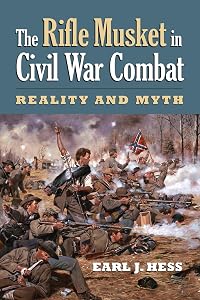
The “myth” in the subtitle of this book is that the rifle musket, which had a theoretical range vastly in excess of the smoothbores it replaced, actually resulted in infantry firing and hitting at that range. The reality was that it didn’t. Ranges at which units opened fire increased by perhaps 50%, but no more. There were a variety of reasons for this. The Civil War rifle musket had a very low muzzle velocity. As a result, bullets fired at long range traveled in a parabolic arc. Enemy troops in the middle of the arc were perfectly safe, with the rounds sailing over (often high over) their heads. At the far end of the arc, the danger zone was truncated as the bullets fell to earth at a steep angle. Hitting enemy troops at long show more range required skilled estimation of range, but Civil War infantrymen did not, with some exceptions, receive the requisite training.
These factors played into artillery and cavalry tactics as well. Artillery was said to have been forced onto the defense by the longer range of the rifle musket. Actually, this is mostly not true, as artillery tactics remained largely unchanged. In the case of cavalry, the author’s conclusions are a little unclear. A case could be made, however, that mounted charges made little sense in the American context because, much more so than Europe, charges were difficult because of terrain (heavy woods and, at least in the North, fenced fields). Add to this the vastly greater expense of cavalry over infantry, and the American choice becomes clear. show less
These factors played into artillery and cavalry tactics as well. Artillery was said to have been forced onto the defense by the longer range of the rifle musket. Actually, this is mostly not true, as artillery tactics remained largely unchanged. In the case of cavalry, the author’s conclusions are a little unclear. A case could be made, however, that mounted charges made little sense in the American context because, much more so than Europe, charges were difficult because of terrain (heavy woods and, at least in the North, fenced fields). Add to this the vastly greater expense of cavalry over infantry, and the American choice becomes clear. show less
Hess has done his research. It seems to him that the increased lethality of the rifled muskets in the Civil War could come from two factors: 1) the use of the Percussion cap as a means of ignition, 2) the rifling of the barrels providing the more accurate shooting necessary. After an examination he comes to the finding that the elimination of the small gap between the striking of the flint and the explosion of the charge behind the bullet, and placing the percussion cap n the nipple raised the rate of fire, these acts reduced the loading time of the muzzle-loading weapons. Therefore they caused more casualties.
The rifling is a more difficult question. The introduction of the rifled musket by the British had led to a new course of show more training in musketry. After the new style of ftraining, the Royal Army fired at much longer ranges, and the training of the soldier in individual aimed fire led to a higher number of casualties among those they were shooting at. When you factor in the higher rate of fire, and the decreased number of misfires rsulting from the percussion cap, the Royal army increased its ability to hurt the enemy forces even more than the US Army did.
The US army had no deliberate training in musketry, and did not often open fire at greater ranges than they had while using the old smooth-bore flintlocks. Therefore, the US Army hadn't profited fully from their new rifles, and the increases they did have resulted from the percussion cap use, not from utilizing the rifled barrels of their new weapons.
It is a very well thought out piece of military analysis. show less
The rifling is a more difficult question. The introduction of the rifled musket by the British had led to a new course of show more training in musketry. After the new style of ftraining, the Royal Army fired at much longer ranges, and the training of the soldier in individual aimed fire led to a higher number of casualties among those they were shooting at. When you factor in the higher rate of fire, and the decreased number of misfires rsulting from the percussion cap, the Royal army increased its ability to hurt the enemy forces even more than the US Army did.
The US army had no deliberate training in musketry, and did not often open fire at greater ranges than they had while using the old smooth-bore flintlocks. Therefore, the US Army hadn't profited fully from their new rifles, and the increases they did have resulted from the percussion cap use, not from utilizing the rifled barrels of their new weapons.
It is a very well thought out piece of military analysis. show less
Very good perspective and a different look at the impact rifles actually had and why reality seems to be so different than what so many have believed for so lon.
Ratings
Members
- Recently Added By
Author Information

38+ Works 1,784 Members
Earl J. Hess holds the Stewart W. McClelland Chair in History at Lincoln Memorial University.
Awards and Honors
Series

Common Knowledge
- Canonical title
- The Rifle Musket in Civil War Combat: Reality and Myth
- Important events
- American Civil War (1861 | 1865)
Classifications
Statistics
- Members
- 107
- Popularity
- 302,870
- Reviews
- 3
- Rating
- (4.20)
- Languages
- English
- Media
- Paper
- ISBNs
- 2