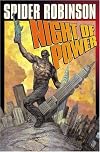
Night of Power
by Spider Robinson
On This Page
Description
Jos aimed straight for the tank ahead, was doing 80 kph by the time he reached it, jogged the wheel and was around it, still accelerating. He was screaming right onto 48th Street before the tank's turret could swivel around to track him. He did not turn south again until he had reached the theater district. All the lights were out on The Great White Way. Things were relatively quiet for half a dozen blocks, then, until they reached Times Square, where a full-scale riot was in progress. show more Broadway was blocked with jammed-together burning cars, so Jos turned left and rocketed up 42nd Street, dodging dead cars and dead people at high speed. Within a few blocks he had hit more than half a dozen people and lost his left headlight. On either side of the street Jennifer saw a parade of clubbings, knifings, shootings. She saw something that had once been a white policeman; she saw a bag lady murder a child her age, only to have her own throat cut by a weeping priest; she saw a white woman in full dominatrix gear running from a pack of black boys, trying to clear her path with her whip. Jennifer put her face in her hands and closed her eyes. Jos warned her before turning right. They were back on Fifth Avenue, and all at once the trouble was, incredibly, behind them. They saw absolutely nothing out of the ordinary all the way down to 33rd Street. There were calmly strolling pedestrians and singing drunks, necking couples and break-dancing kids. At the publisher's request, this title is sold without DRM (Digital Rights Management). show lessTags
Recommendations



















Member Reviews
I've been a fan of Spider Robinson's writing for decades. If I recall correctly I acquired his book Stardance when it was offered through a sf book club to which I belonged (One of the few ways to acquire sf at that time because most chain bookstores didn't carry much). That book was published in 1979. Yet some how I missed reading this book which was written in 1984. Reading it now seems rather fitting though since Spider envisioned black Americans staging a coup to take over New York City as a response to the racism they faced. That seems eerily possible in 2020 the age of #BlackLivesMatter.
The Grants (Russell, Dena and Jennifer) leave their home in Halifax to take up a temporary abode in New York City so that Dena, a dancer, can take show more part in a production by a famed black dance company. Dena is black but Russell and Jennifer are white. When the car has to detour through Harlem the local thugs make a point of attacking the car and trying to kill the occupants. At the last moment they are stopped by a man who is simply called Michael; he is so revered by everyone that even the thugs will step back. Michael gets in the car to escort them safely through Harlem and then walks away when they reach the apartment they will rent. Race relations in New York City are at an all time low and a mixed race couple stands out in all the wrong ways. Russell and Dena separately learn that the Night of Power is going into operation. This is a plan for black folk to take over all the important buildings, communications, transportation, and technology. Russell also learns that the head of a key group is planning to kill Michael, the chief strategist of the plan, so that the insurgency will fail. Russell can pay Michael back by getting this information to him but as a white man he would not be able to gain access to Michael. Enter Jerome, a dancer and former lover of Dena's, who is part of Michael's organization. He came to the apartment to tell Dena about the plan and urge her to leave the city. Russell, Jerome and Dena must team up to warn Michael. Jennifer was away from the apartment for the evening to attend a concert but she is well guarded and should be safe in the apartment. That's one of those "famous last words" statements. A lot happens to all three of the Grants in the course of one night. Pretty gripping stuff.
The time of this book is supposed to be 1996 but no-one has cell phones. I'm surprised that Robinson, who mentions solar powered batteries and a sort of GPS for the car, wasn't prescient enough to envision mobile phones. This is the kind of thing that keeps me reading older science fiction that is set at a time that is now history; I like to see what the authors got right and where they went wrong. show less
The Grants (Russell, Dena and Jennifer) leave their home in Halifax to take up a temporary abode in New York City so that Dena, a dancer, can take show more part in a production by a famed black dance company. Dena is black but Russell and Jennifer are white. When the car has to detour through Harlem the local thugs make a point of attacking the car and trying to kill the occupants. At the last moment they are stopped by a man who is simply called Michael; he is so revered by everyone that even the thugs will step back. Michael gets in the car to escort them safely through Harlem and then walks away when they reach the apartment they will rent. Race relations in New York City are at an all time low and a mixed race couple stands out in all the wrong ways. Russell and Dena separately learn that the Night of Power is going into operation. This is a plan for black folk to take over all the important buildings, communications, transportation, and technology. Russell also learns that the head of a key group is planning to kill Michael, the chief strategist of the plan, so that the insurgency will fail. Russell can pay Michael back by getting this information to him but as a white man he would not be able to gain access to Michael. Enter Jerome, a dancer and former lover of Dena's, who is part of Michael's organization. He came to the apartment to tell Dena about the plan and urge her to leave the city. Russell, Jerome and Dena must team up to warn Michael. Jennifer was away from the apartment for the evening to attend a concert but she is well guarded and should be safe in the apartment. That's one of those "famous last words" statements. A lot happens to all three of the Grants in the course of one night. Pretty gripping stuff.
The time of this book is supposed to be 1996 but no-one has cell phones. I'm surprised that Robinson, who mentions solar powered batteries and a sort of GPS for the car, wasn't prescient enough to envision mobile phones. This is the kind of thing that keeps me reading older science fiction that is set at a time that is now history; I like to see what the authors got right and where they went wrong. show less
I have mixed feelings about this book. Robinson is clearly trying -- he presents the Black people in it as having legitimate grievances -- but it makes me deeply uncomfortable that even a sympathetic White author looked at the deliberately nonviolent struggle for civil rights and saw in it merely the kind of violence described in the book.
Not one of Robinson's best. Unless you're a purist, or feel you have to read everything, you should probably skip this one. It's okay, but it's one of those that made me careful in what I bought with his name on it.
Dated, patronising, and dull.
Anyone got a reason why I should finish this one? Does it get better?
Members
- Recently Added By
Lists

Lesser known books of well known authors
39 works; 17 members
Author Information

111+ Works 18,206 Members
Science fiction author Spider Robinson was born in the Bronx, New York on November 24, 1948. He received a Bachelor of Arts in English from the State University of New York. He began writing professionally in 1972 and has won numerous awards including three Hugos, one Nebula, and the John W. Campbell Award for Best New Writer. He is best known for show more his Callahan stories and for the Stardance Sequence, which he co-wrote with his wife Jeanne Robinson. He was selected by the Heinlein Prize Trust to write Variable Star, a novel based on a 1955 outline created by Robert A. Heinlein. He also worked as a book reviewer for Galaxy, Analog, and New Destinies magazines and his opinion column Future Tense has appeared in The Globe and Mail since 1996. In 2001, he released Belaboring the Obvious, a CD featuring original music. He currently lives in Bowen Island, Brisith Columbia, Canada with his wife. (Bowker Author Biography) show less
Some Editions
Common Knowledge
- Original publication date
- 1985
Classifications
Statistics
- Members
- 309
- Popularity
- 103,734
- Reviews
- 7
- Rating
- (3.25)
- Languages
- English, German
- Media
- Paper, Ebook
- ISBNs
- 5
- ASINs
- 2