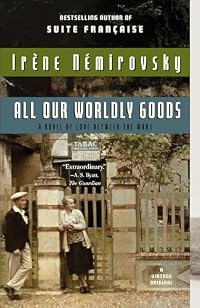
All Our Worldly Goods
by Irène Némirovsky
On This Page
Description
Pierre Hardelot breaks off his engagement to a wealthy heiress to marry Agnes Florent, the daughter of the local brewer, setting off a family feud which lasts for thirty years, as their village is first destroyed by World War I and then threatened again with the coming of World War II.Tags
Recommendations

























Member Recommendations
by Luisali
Member Reviews
I give away the ending. Read this review anyway.
All Our Worldly Goods feels contemporary and Tolstoyesque all at once. The characters are sketched rather than painted in oil, and the humor is gorgeous and easily missed if you read too quickly. For instance:
Sitting comfortably, without her corset, her arms and legs bare and relaxed, out in the fresh air, in the sunshine, she felt extremely peaceful; she felt happy, as if she had everything she could wish for. She had a husband she loved, the best son in the world. The paper factory was flourishing. Her mother-in-law was dead. Pierre was making an excellent marriage.
How gorgeous to slip in that next-to-last item like that.
The same bluntness permeates the book in brilliant gems of show more sentences like this one:
She had reached the age where you recoil at the idea of any kind of change, as if it were an omen of the greatest change of all: death.
I should have loved this book. And I did. But I also had a hard time reading it.
What made this book difficult for me is that it's exactly what its cover claims: "a novel of love between the wars." Nemirovsky writes as if she were simply an exceptionally observant, sharp-witted French woman sketching out the lives of a couple who are required to witness two wars. The novel ends as World War II begins. Germany has just begun to occupy France. And yet the book ends on a beatific note:
She had gathered in all the good things of this world, and all the bitterness, all the sweetness of the earth had borne fruit. They would live out the rest of their days together.
Fair enough. But Nemirovsky was killed in the war she never mentions in her novel, the other war being waged by the Germans: the war against the Jews. She finished this book in 1940; in 1942, she was murdered in Auschwitz.
Nemirovsky saw herself as a French writer. France and Germany saw her as a Jew. She and her husband, far from living out their days together, died separately in the Holocaust. Their two very young daughters narrowly escaped the same fate.
Given how eagerly France worked with the Nazis to murder their own citizens, it was wrenching for to me to read a "French" novel by one of their victims. It's not Nemirovsky's words, but their context, that make this novel strangely terrifying. show less
All Our Worldly Goods feels contemporary and Tolstoyesque all at once. The characters are sketched rather than painted in oil, and the humor is gorgeous and easily missed if you read too quickly. For instance:
Sitting comfortably, without her corset, her arms and legs bare and relaxed, out in the fresh air, in the sunshine, she felt extremely peaceful; she felt happy, as if she had everything she could wish for. She had a husband she loved, the best son in the world. The paper factory was flourishing. Her mother-in-law was dead. Pierre was making an excellent marriage.
How gorgeous to slip in that next-to-last item like that.
The same bluntness permeates the book in brilliant gems of show more sentences like this one:
She had reached the age where you recoil at the idea of any kind of change, as if it were an omen of the greatest change of all: death.
I should have loved this book. And I did. But I also had a hard time reading it.
What made this book difficult for me is that it's exactly what its cover claims: "a novel of love between the wars." Nemirovsky writes as if she were simply an exceptionally observant, sharp-witted French woman sketching out the lives of a couple who are required to witness two wars. The novel ends as World War II begins. Germany has just begun to occupy France. And yet the book ends on a beatific note:
She had gathered in all the good things of this world, and all the bitterness, all the sweetness of the earth had borne fruit. They would live out the rest of their days together.
Fair enough. But Nemirovsky was killed in the war she never mentions in her novel, the other war being waged by the Germans: the war against the Jews. She finished this book in 1940; in 1942, she was murdered in Auschwitz.
Nemirovsky saw herself as a French writer. France and Germany saw her as a Jew. She and her husband, far from living out their days together, died separately in the Holocaust. Their two very young daughters narrowly escaped the same fate.
Given how eagerly France worked with the Nazis to murder their own citizens, it was wrenching for to me to read a "French" novel by one of their victims. It's not Nemirovsky's words, but their context, that make this novel strangely terrifying. show less
This book reads like the cousin of the more famous [Suite Francaise]. The similarities are clear; Nemirovsky writes of a France twice torn apart by war, and a population fleeing before the invading enemy. Although it is inevitable that we compare these two books because of their similarities, I would say that this is a more satisfying read than the more famous work, simply for the fact of being a complete novel; Nemirovsky never finished [Suite Francaise] before being deported to Auschwitz, where she died in 1943. [All Our Worldly Goods] follows a wealthy family through both world wars, and the inter-war period, speaking of love, jealousy and rivalries in a virtually inimitable style.
That Nemirovsky never lived to see the end of this show more war of which she wrote always astounds me; reading seventy years later, I read this as a beautifully-written history, but for her contemporaries, this would have been their reality, a social commentary for their times. Simply a wonderful read. show less
That Nemirovsky never lived to see the end of this show more war of which she wrote always astounds me; reading seventy years later, I read this as a beautifully-written history, but for her contemporaries, this would have been their reality, a social commentary for their times. Simply a wonderful read. show less
This is probably my favorite Nemirovsky so far. The book follows several families from the early 20th century to World War II. Nemirovsky’s prose is beautiful and her insights into both individuals and the population of a small town are sharp, penetrating and occasionally sarcastic. The characters, even those who might be unsympathetic, are well written. Some have compared this book to Suite Francaise (which I haven’t read) but this one is complete. There is a lot of jumping in time – the book is short – and some too-coincidental events but these are minor criticisms.
Pierre Hardelot is from the most prominent family in the provincial town of Saint-Elme. He falls in love with Agnes Florent, whose mother has a suspect past and show more whose family is from a different social class. Pierre breaks his engagement to Simone Renaudin to marry Agnes. The book follows the fortunes of Pierre and Agnes, their parents and children, and Simone’s family through the first half of the 20th century. Nemirovsky’s style here is swift and economical, but the characters are developed and the shifts between big picture overview and individual reactions are skillful. The lengthy time covered in the book allows the author to draw numerous parallels and contrasts between characters. Very well done. show less
Pierre Hardelot is from the most prominent family in the provincial town of Saint-Elme. He falls in love with Agnes Florent, whose mother has a suspect past and show more whose family is from a different social class. Pierre breaks his engagement to Simone Renaudin to marry Agnes. The book follows the fortunes of Pierre and Agnes, their parents and children, and Simone’s family through the first half of the 20th century. Nemirovsky’s style here is swift and economical, but the characters are developed and the shifts between big picture overview and individual reactions are skillful. The lengthy time covered in the book allows the author to draw numerous parallels and contrasts between characters. Very well done. show less
He said nothing more: he was at a loss for words. But he was thinking, ‘All this in spite of what you might think, is what is truly important. The war will end, we will all disappear, but these humble and innocent gifts will remain: the cool air, the sun, a red apple, a fire in winter, a woman, children, the life we lead each day…The crash and din of war all fade away. The rest endures…But will it endure for me, or for others?’ – from All Our Worldly Goods, page 85 -
The Hardelots live in the small French village of Saint-Elme where they own a large paper mill. The Florents also live in Saint-Elme, right next door to the Hardelots, but they are “brewers” and of a lower social class. So although the two families interact show more politely, it is clear they are separate and not the same. In the early part of the the twentieth century, these two families will create a scandal when Pierre Hardelot refuses to marry the woman who has been chosen for him and instead marries the woman he loves: Agnes Florent. In doing so, Pierre goes against the wishes of his parents and his tyrannical grandfather and loses his job at the family factory. Meanwhile, Simone (Pierre’s former fiance) finds herself left behind without a husband.
Irene Nemirovsky’s sweeping novel begins in 1910 and moves through the unsettled years of WWI and WWII. Pierre and Agnes find themselves pulled between the village in which they grew up, and the bustling streets of Paris as WWI descends upon France and sweeps Pierre onto the battlefield.
It was the very beginning of the war, when the heart bleeds for everyone who dies, when tears are shed for each man sent to fight. Sadly, as time goes on, people get used to it all. They think only of one soldier, theirs. But at the start of a war the heart is still tender; it hasn’t hardened yet. – from All Our Worldly Goods, page 55 -
Nemirovsky explores the themes of social class, family feuds, war, and the enduring power of love. Her prose is poignant and creates a character study of two families over several decades. She succinctly captures the fault line between the bourgeoisie and the lower middle classes in early twentieth century France.
Beyond this street lived a few families not related to the Hardelots, but no one paid any attention to them; it was almost as if they didn’t exist. It was like horses and cows, who can live side by side in the same field for their entire lives without seeming to notice each other. – from All Our Worldly Goods, page 23 -
All Our Worldly Goods is aptly titled. Nemirovsky demonstrates the struggle between love of property and the pull of family. Pierre finds himself shunned by his wealthy family when he chooses love over the interests of the family business and yet he is happy in spite of it all. His former fiance, Simone, on the other hand, gains wealth but finds her emotional life in tatters.
The Hardelots had lived for this factory. They had married ugly women; they had skimped and counted every last penny; they had been rich and had enjoyed fewer pleasures than the poor. They had stifled their children’s interests, thwarted their loves. All this for the factory, for their possessions, for something that was, to their eyes, more durable and faithful than love, women or their own children. – from All Our Worldly Goods, page 168 -
The novel is not without its faults. By choosing to cover such a large period of time in less than 300 pages, Nemirovsky’s prose sometimes feels rushed. The reader is catapulted through time through the birth of several babies who grow into adults and through two world wars. There were moments I longed for Nemirovsky to pause and give me time to catch up with the characters before they moved on to the next phase of their lives.
One of the fascinating aspects of this novel has less to do with the story, and more to do with the author. Irene Nemirovsky wrote this book as history was unfolding. The novel was not published until 1947, five years after she was murdered by the Nazis. I found myself wondering how much of the author’s own history was wrapped up in the fiction of her book. I think it takes courage, along with amazing insight, to craft a book set during the author’s own time. And because of this, I found the book to be more heart-wrenching. When Irene Nemirovsky writes about the uncertainty of Pierre and Agnes’ lives, she is also writing about the uncertainty of her own life.
Readers who have read previous novels by this author will find similarities in style and theme. I have read Suite Francaise and Fire in the Blood, both of which I enjoyed. I recommend All Our Worldly Goods to readers of historical fiction and those who enjoy translated literature (this novel was translated from the French by Sandra Smith). show less
The Hardelots live in the small French village of Saint-Elme where they own a large paper mill. The Florents also live in Saint-Elme, right next door to the Hardelots, but they are “brewers” and of a lower social class. So although the two families interact show more politely, it is clear they are separate and not the same. In the early part of the the twentieth century, these two families will create a scandal when Pierre Hardelot refuses to marry the woman who has been chosen for him and instead marries the woman he loves: Agnes Florent. In doing so, Pierre goes against the wishes of his parents and his tyrannical grandfather and loses his job at the family factory. Meanwhile, Simone (Pierre’s former fiance) finds herself left behind without a husband.
Irene Nemirovsky’s sweeping novel begins in 1910 and moves through the unsettled years of WWI and WWII. Pierre and Agnes find themselves pulled between the village in which they grew up, and the bustling streets of Paris as WWI descends upon France and sweeps Pierre onto the battlefield.
It was the very beginning of the war, when the heart bleeds for everyone who dies, when tears are shed for each man sent to fight. Sadly, as time goes on, people get used to it all. They think only of one soldier, theirs. But at the start of a war the heart is still tender; it hasn’t hardened yet. – from All Our Worldly Goods, page 55 -
Nemirovsky explores the themes of social class, family feuds, war, and the enduring power of love. Her prose is poignant and creates a character study of two families over several decades. She succinctly captures the fault line between the bourgeoisie and the lower middle classes in early twentieth century France.
Beyond this street lived a few families not related to the Hardelots, but no one paid any attention to them; it was almost as if they didn’t exist. It was like horses and cows, who can live side by side in the same field for their entire lives without seeming to notice each other. – from All Our Worldly Goods, page 23 -
All Our Worldly Goods is aptly titled. Nemirovsky demonstrates the struggle between love of property and the pull of family. Pierre finds himself shunned by his wealthy family when he chooses love over the interests of the family business and yet he is happy in spite of it all. His former fiance, Simone, on the other hand, gains wealth but finds her emotional life in tatters.
The Hardelots had lived for this factory. They had married ugly women; they had skimped and counted every last penny; they had been rich and had enjoyed fewer pleasures than the poor. They had stifled their children’s interests, thwarted their loves. All this for the factory, for their possessions, for something that was, to their eyes, more durable and faithful than love, women or their own children. – from All Our Worldly Goods, page 168 -
The novel is not without its faults. By choosing to cover such a large period of time in less than 300 pages, Nemirovsky’s prose sometimes feels rushed. The reader is catapulted through time through the birth of several babies who grow into adults and through two world wars. There were moments I longed for Nemirovsky to pause and give me time to catch up with the characters before they moved on to the next phase of their lives.
One of the fascinating aspects of this novel has less to do with the story, and more to do with the author. Irene Nemirovsky wrote this book as history was unfolding. The novel was not published until 1947, five years after she was murdered by the Nazis. I found myself wondering how much of the author’s own history was wrapped up in the fiction of her book. I think it takes courage, along with amazing insight, to craft a book set during the author’s own time. And because of this, I found the book to be more heart-wrenching. When Irene Nemirovsky writes about the uncertainty of Pierre and Agnes’ lives, she is also writing about the uncertainty of her own life.
Readers who have read previous novels by this author will find similarities in style and theme. I have read Suite Francaise and Fire in the Blood, both of which I enjoyed. I recommend All Our Worldly Goods to readers of historical fiction and those who enjoy translated literature (this novel was translated from the French by Sandra Smith). show less
This was a beautifully written novel that managed to be both hopeful and gut-wrenchingly sad at once. It opens with the story of Pierre and Agnes, star-crossed lovers who marry against their families' wishes. The theme of forbidden love reverberates throughout the novel, but a more significant theme is that of the intrusion of war into the lives of ordinary people. The older characters in the novel live through not just one, but two world wars in their lifetime. As the fighting rips the fabric of countries and lives, Nemirovsky's subtle, flawless prose evokes the sense of devastation wrought by war, while also highlighting the strength of the human spirit.
In the first half of the book it was somewhat difficult to connect with the show more characters. This shifted for me in the second half, in which the characters seemed much more developed. As a result the reader becomes deeply connected with their lives; it is impossible not to get emotionally involved with the story. This is a profound novel with great depth. show less
In the first half of the book it was somewhat difficult to connect with the show more characters. This shifted for me in the second half, in which the characters seemed much more developed. As a result the reader becomes deeply connected with their lives; it is impossible not to get emotionally involved with the story. This is a profound novel with great depth. show less
Gli eventi narrati ne “I doni della vita” coprono il periodo da prima della 1° guerra mondiale fino all’invasione dei tedeschi in Francia negli anni ’40.
L’autrice è riuscita a raccontare alcuni grandi eventi della storia tramite gli occhi – e la vita quotidiana – di alcuni abitanti di un villaggio francese.
E protagonista di questo romanzo è la vita quotidiana: fatta di sentimenti ricambiati, di gelosie, di litigi, di svaghi e di doveri. Il lettore osserverà i doni che la vita farà a Agnes e Pierre, capaci di opporsi alle regole della buona società per coronare il loro amore, una vita ricca di ostacoli e non priva di sofferenze.
La vita dei due si incrocerà con quella di altri: i genitori per primi, i figli ma anche show more presenze più ostili; vite che si influenzeranno a vicenda, sempre tentando di mantenere apparenze di cordialità verso l’esterno.
Fa impressione pensare che l’autrice l’abbia scritto mentre la Germania invadeva la Francia e poco tempo prima di essere deportata e morire, una realtà che fa riflettere ancora di più leggendo con che lucidità sono presentate riflessioni sulla guerra, sulla vita e sull’incombenza della morte.
---
The events in “All Our Worldly Goods” cover the period from before the WWI until the German invasion in France during the ’40.
The author was able to tell some important events through the eyes – and the everyday life – of some inhabitants of a French village.
The protagonist of the novel is the everyday life made of reciprocate feelings, of hates, of quarrels, of leisure and duties. The reader will observe the goods life will give to Agnes and Pierre, able to oppose to traditions and rules in order to marry, a life rich in problems and sufferance.
Their life will meet others: their parents, their children and other more hostile; lives crossing and influencing the others, always keeping some appearances to the external world.
The author wrote this novel in the meanwhile of the German invasion and some time before being deported and dying in Auschwitz. Knowing this in advance, it made me reflect on the lucidity the reflections of war, life and the upcoming of death are presented. show less
L’autrice è riuscita a raccontare alcuni grandi eventi della storia tramite gli occhi – e la vita quotidiana – di alcuni abitanti di un villaggio francese.
E protagonista di questo romanzo è la vita quotidiana: fatta di sentimenti ricambiati, di gelosie, di litigi, di svaghi e di doveri. Il lettore osserverà i doni che la vita farà a Agnes e Pierre, capaci di opporsi alle regole della buona società per coronare il loro amore, una vita ricca di ostacoli e non priva di sofferenze.
La vita dei due si incrocerà con quella di altri: i genitori per primi, i figli ma anche show more presenze più ostili; vite che si influenzeranno a vicenda, sempre tentando di mantenere apparenze di cordialità verso l’esterno.
Fa impressione pensare che l’autrice l’abbia scritto mentre la Germania invadeva la Francia e poco tempo prima di essere deportata e morire, una realtà che fa riflettere ancora di più leggendo con che lucidità sono presentate riflessioni sulla guerra, sulla vita e sull’incombenza della morte.
---
The events in “All Our Worldly Goods” cover the period from before the WWI until the German invasion in France during the ’40.
The author was able to tell some important events through the eyes – and the everyday life – of some inhabitants of a French village.
The protagonist of the novel is the everyday life made of reciprocate feelings, of hates, of quarrels, of leisure and duties. The reader will observe the goods life will give to Agnes and Pierre, able to oppose to traditions and rules in order to marry, a life rich in problems and sufferance.
Their life will meet others: their parents, their children and other more hostile; lives crossing and influencing the others, always keeping some appearances to the external world.
The author wrote this novel in the meanwhile of the German invasion and some time before being deported and dying in Auschwitz. Knowing this in advance, it made me reflect on the lucidity the reflections of war, life and the upcoming of death are presented. show less
Anyone who enjoyed Irene Nemirovsky's Suite Française will surely love All Our Worldly Goods just as much. In both books Nemirovsky's writing is incredibly beautiful and gracefully poignant. Though the original French must be even better, these translations by Sandra Smith are wonderful.
Nemirovsky was killed at Auschwitz before she could finish Suite Française, but All Our Worldly Goods is a complete novel. It's set in France from 1911, just before the start of WWI, to 1940, shortly after the beginning of WWII, and it tells the tangled story of three families from a small village. Pierre Hardelot's family owns the village factory and at the opening of the book he is set to do what his family wants and marry Simone Renaudin, an show more orphaned and wealthy heiress. To the shock of all he breaks off this engagement to marry for love. Agnes Florent's family were only brewers, so while the Florents and the Hardelots are friendly no one expected them to be united by a wedding. Pierre's rejection of Simone and devoted love for Agnes start a family feud whose ramifications continue as the world is upended and their village is destroyed by war, painstakingly reconstructed and then razed by war again.
All Nemirovsky's characters are well-drawn rounded individuals, sometimes selfish but deeply loving, neither heroes or villains. They have had to rebuild their lives before, so while the novel ends with WWII still raging the tone of the book is more hopeful than despairing. show less
Nemirovsky was killed at Auschwitz before she could finish Suite Française, but All Our Worldly Goods is a complete novel. It's set in France from 1911, just before the start of WWI, to 1940, shortly after the beginning of WWII, and it tells the tangled story of three families from a small village. Pierre Hardelot's family owns the village factory and at the opening of the book he is set to do what his family wants and marry Simone Renaudin, an show more orphaned and wealthy heiress. To the shock of all he breaks off this engagement to marry for love. Agnes Florent's family were only brewers, so while the Florents and the Hardelots are friendly no one expected them to be united by a wedding. Pierre's rejection of Simone and devoted love for Agnes start a family feud whose ramifications continue as the world is upended and their village is destroyed by war, painstakingly reconstructed and then razed by war again.
All Nemirovsky's characters are well-drawn rounded individuals, sometimes selfish but deeply loving, neither heroes or villains. They have had to rebuild their lives before, so while the novel ends with WWII still raging the tone of the book is more hopeful than despairing. show less
Members
- Recently Added By
Author Information

92+ Works 17,068 Members
Some Editions
Series
Belongs to Publisher Series
Biblioteca Adelphi (536)
Work Relationships
Is contained in
Common Knowledge
- Canonical title
- All Our Worldly Goods
- Original title
- Les biens de ce monde
- Original publication date
- 1947
- People/Characters
- Pierre Hardelot; Agnes Florents
- Important places
- Paris, France; Saint-Elme, Normandy, France; France
- Important events
- World War I (1914 | 1918); World War II (1939 | 1945); World War II, German Occupation of France (1940 | 1944); Great Depression
- First words
- They were together, so they were happy.
- Last words
- (Click to show. Warning: May contain spoilers.)They would live out the rest of their days together.
- Original language*
- Francese
*Some information comes from Common Knowledge in other languages. Click "Edit" for more information.
Classifications
- Genres
- General Fiction, Fiction and Literature, Historical Fiction
- DDC/MDS
- 843.912 — Literature & rhetoric French Literature French fiction 1900- 20th Century 1900-1945
- LCC
- PQ2627 .E4 .B5413 — Language and Literature French, Italian, Spanish and Portuguese literatures French literature Modern literature 1900-1960
- BISAC
Statistics
- Members
- 529
- Popularity
- 56,362
- Reviews
- 29
- Rating
- (3.94)
- Languages
- 6 — English, Finnish, French, German, Italian, Spanish
- Media
- Paper, Audiobook, Ebook
- ISBNs
- 18
- ASINs
- 7