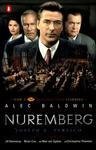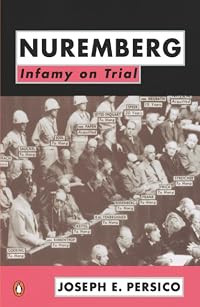
Nuremberg : Infamy on Trial
by Joseph E. Persico
On This Page
Description
Intimate portraits of the most notorious Nazi criminals and the motives, frustrations, compromises, ideals, and political agendas of the men and women who worked to condemn them.Tags
Recommendations














Member Reviews
This book was a natural one to read after I had read a number of books on the Holocaust. I don't consider this to be a very well-crafted book, but I hadn't read much about the Nuremberg trials before, so I did learn a lot from reading it. Some things that stuck in my mind:
(a) The defendants come across as a rather pathetic bunch. I guess this isn't a very original observation, since the phrase "the banality of evil" was coined at the trial of a Nazi war criminal.
(b) The ground rules set at Nuremberg made tu quoque--"so did you"--an inadmissible defense. In the context of a specific trial, I think this makes good sense, but as an overall approach to the acts performed by the various sides in World War II it strikes me as the worst sort show more of hypocritical victors' justice.
(c) In Persico's words, it took some of the defendants an "unconscionable amount of time" to die on the gallows: German Foreign Minister Joachim von Ribbentrop took 17 minutes; Colonel General Alfred Jodl took 18 minutes; Field Marshal Wilhelm Keitel took 28 minutes. I'm glad that Goring was able to commit suicide; the fewer people we put through this sort of torture the better. show less
(a) The defendants come across as a rather pathetic bunch. I guess this isn't a very original observation, since the phrase "the banality of evil" was coined at the trial of a Nazi war criminal.
(b) The ground rules set at Nuremberg made tu quoque--"so did you"--an inadmissible defense. In the context of a specific trial, I think this makes good sense, but as an overall approach to the acts performed by the various sides in World War II it strikes me as the worst sort show more of hypocritical victors' justice.
(c) In Persico's words, it took some of the defendants an "unconscionable amount of time" to die on the gallows: German Foreign Minister Joachim von Ribbentrop took 17 minutes; Colonel General Alfred Jodl took 18 minutes; Field Marshal Wilhelm Keitel took 28 minutes. I'm glad that Goring was able to commit suicide; the fewer people we put through this sort of torture the better. show less
Solid account of the famous war-crimes trial of 1945-1946 in which many of the surviving top leaders of Nazi Germany were tried on a variety of charges. The book isn't sparing of those on the Allied side that made mistakes and did poorly, such as Justice Robert Jackson (the US prosecutor) or Burton Andrus (the chief jailer, who lost a number of prisoners to suicide, most notably Goering). The Russians, interestingly enough, are bit players in this scenario. Then again, you'd rarely see any information by them in the public domain. Recommended.
This book is well written and certainly contains a lot of good historical information. The character sketches and the internal rivalries of the various people are well documented. However, the book is written more as a novel. There is a lot of “filler” included.
For me, it proved a good introduction into the Nuremberg trials. I would recommend it if you are just starting yo explore this event in history.
For me, it proved a good introduction into the Nuremberg trials. I would recommend it if you are just starting yo explore this event in history.
Because I had a marvelous history teacher, in high school, I thought I knew a lot about the Nuremberg Trials. Because of this book I learned so much more.
This book takes you behind the scenes. Introduces you to all the people behind the trial-
The Justices: They wondered if they were putting the cart before the horse-The laws to judge the Nazi's were cemented in stone after the war had ended. Could they do this? Marvelous look into the legalize of those schooled to uphold the law. Could they judge these men, putting aside their own contempt for them?
The Nazi's: I learned their prior lives, how they grew up, how they ended up following a demented evil soul like Hitler. Were some of them "just following orders" as they pleaded? Or was that show more just a cover to absolve them of their guilt in the horrific crimes?
The Lawyers, the aides, the psychologist and psychiatrist, the doctors. Joseph E. Persico's looks at all of them and tells a non-fiction tale that reads so easily. There are, of course, hundreds of people who were involved. The book supplies you with a list of all the main principles to refer to, as you read. I was thankful for that. And of course, as with any great non-fiction, at the end there is follow-up telling you what happened to them all.
Highly Recommended if history is your interest. show less
This book takes you behind the scenes. Introduces you to all the people behind the trial-
The Justices: They wondered if they were putting the cart before the horse-The laws to judge the Nazi's were cemented in stone after the war had ended. Could they do this? Marvelous look into the legalize of those schooled to uphold the law. Could they judge these men, putting aside their own contempt for them?
The Nazi's: I learned their prior lives, how they grew up, how they ended up following a demented evil soul like Hitler. Were some of them "just following orders" as they pleaded? Or was that show more just a cover to absolve them of their guilt in the horrific crimes?
The Lawyers, the aides, the psychologist and psychiatrist, the doctors. Joseph E. Persico's looks at all of them and tells a non-fiction tale that reads so easily. There are, of course, hundreds of people who were involved. The book supplies you with a list of all the main principles to refer to, as you read. I was thankful for that. And of course, as with any great non-fiction, at the end there is follow-up telling you what happened to them all.
Highly Recommended if history is your interest. show less
A very powerful book. I was ignorant about the trials at Nuremberg. The author took an, I am there" approach, that really worked well.
Nuremberg: Infamy on Trial
Joseph E Persico
New York: 1994, Penguin, 520 pages
Justice at Nuremberg
Robert E Conot
New York: 1983, Harper & Row, 593 pages
We filter current events through our reading of history.
At the same time, though, we write history through a lens of current events.
For Joseph Persico, the West’s feeble response to Serbian ethnic cleansing and the Clinton administration’s delicate sidestepping calling Hutu mass-murder of Tutsis genocide, colored his vision of the Nuremberg trial of the surviving Nazi leaders.
For Robert Conot, the rise of Holocaust deniers and historical revisionists demanded precise definition and description of the crimes for which the major Nazis were tried.
Each cover the same ground but draw show more differing inferences from the particulars. Both are valuable.
Some botches were inevitable. International law on war crimes was ill-defined.
On the one hand, some previous war crimes trials had appeared to be victor’s vengeance: after Appomattox, for example, a federal court martial hanged Henry Wirz, commandant of the Confederate prison camp at Andersonville although the perpetrators of the Union’s equally lethal Camp Douglas escaped indictment, let alone punishment.
On the other hand, after World War I, Germans accused by the Allies of war crimes were turned over to German courts, which imposed laughably light sentences.
Some Allied leaders, such as Winston Churchill, recommended summary proceedings against the Nazis: shoot on sight. Others recognized that not only must the obvious crimes (mass murder, looting, devastation) be punished but the world must see that justice had been done.
As Hannah Arendt noted in Eichmann in Jerusalem (1963), “What Justice Jackson failed to point out is that in consequence of this yet unfinished nature of international law it has become the task of ordinary trial judges to render justice without the help of, or beyond the limitation set upon them through positively posited laws.”
If the trials of the major Nazi failed to prevent later atrocity, why study them?
Certainly, each of the prosecuting powers went on to base major policy on willingness and preparedness to commit crimes of greater magnitude.
But the trial of the major Nazis established precedent. Although local tinpots may have drawn courage for their felonies from the major powers' subsequent unwillingness to circumscribe policy by that precedent, the moment four countries spoke for the world and condemned was not thereby diminished.
Shofar December 2009 show less
Joseph E Persico
New York: 1994, Penguin, 520 pages
Justice at Nuremberg
Robert E Conot
New York: 1983, Harper & Row, 593 pages
We filter current events through our reading of history.
At the same time, though, we write history through a lens of current events.
For Joseph Persico, the West’s feeble response to Serbian ethnic cleansing and the Clinton administration’s delicate sidestepping calling Hutu mass-murder of Tutsis genocide, colored his vision of the Nuremberg trial of the surviving Nazi leaders.
For Robert Conot, the rise of Holocaust deniers and historical revisionists demanded precise definition and description of the crimes for which the major Nazis were tried.
Each cover the same ground but draw show more differing inferences from the particulars. Both are valuable.
Some botches were inevitable. International law on war crimes was ill-defined.
On the one hand, some previous war crimes trials had appeared to be victor’s vengeance: after Appomattox, for example, a federal court martial hanged Henry Wirz, commandant of the Confederate prison camp at Andersonville although the perpetrators of the Union’s equally lethal Camp Douglas escaped indictment, let alone punishment.
On the other hand, after World War I, Germans accused by the Allies of war crimes were turned over to German courts, which imposed laughably light sentences.
Some Allied leaders, such as Winston Churchill, recommended summary proceedings against the Nazis: shoot on sight. Others recognized that not only must the obvious crimes (mass murder, looting, devastation) be punished but the world must see that justice had been done.
As Hannah Arendt noted in Eichmann in Jerusalem (1963), “What Justice Jackson failed to point out is that in consequence of this yet unfinished nature of international law it has become the task of ordinary trial judges to render justice without the help of, or beyond the limitation set upon them through positively posited laws.”
If the trials of the major Nazi failed to prevent later atrocity, why study them?
Certainly, each of the prosecuting powers went on to base major policy on willingness and preparedness to commit crimes of greater magnitude.
But the trial of the major Nazis established precedent. Although local tinpots may have drawn courage for their felonies from the major powers' subsequent unwillingness to circumscribe policy by that precedent, the moment four countries spoke for the world and condemned was not thereby diminished.
Shofar December 2009 show less
This was an outstanding book. It did not go into a lot of the horrible details, Persico states he didn't intend to do that in the Introduction. But I still literally had nightmares after reading this book. This book is interesting for contemporary times since the issues of putting War on Terror POWs on trail. They faced many of the same issues at Nuremburg that are discussed today.
Members
- Recently Added By
Author Information

15+ Works 4,670 Members
Was a contributing writer for Colin Powell's My American Journey. He also wrote Piercing the Reich, which is about the penetration of Nazi Germany by American Agents, and Nuremburg, which was made into a major television docudrama. (Publisher Provided) Joseph E. Persico was born in Gloversville, New York on July 19, 1930. He graduated from the New show more York State College for Teachers in 1952 and entered the Navy, serving aboard a minesweeper during the Korean War. Before becoming a speechwriter for Nelson A. Rockefeller, he worked for the United States Information Agency in Rio de Janeiro, Buenos Aires, and Washington. He stopped working for Rockefeller in 1977. During his lifetime, he wrote 12 books including The Imperial Rockefeller, Roosevelt's Secret War: FDR and World War II Espionage, and Franklin and Lucy: President Roosevelt, Mrs. Rutherfurd, and the Other Remarkable Women in His Life. He co-wrote My American Journey: An Autobiography with Colin L. Powell. Nuremberg: Infamy on Trial was adapted into an Emmy-winning TNT mini-series in 2000. He died after a long illness on August 30, 2014 at the age of 84. (Bowker Author Biography) show less
Work Relationships
Has the adaptation
Is abridged in
Common Knowledge
- Important events
- Nuremberg War Crimes Trials (1945-11-14 | 1946-10-01)
- Related movies
- Nuremberg (2000 | IMDb)
- Dedication
- To brother Richard and sister Annabelle
- First words
- Willi Krug cocked an eye at the battered alarm clock he kept within arm's reach on the floor.
- Last words
- (Click to show. Warning: May contain spoilers.)But, history teaches us, not easily.
Classifications
Statistics
- Members
- 416
- Popularity
- 74,351
- Reviews
- 10
- Rating
- (4.03)
- Languages
- Chinese, English
- Media
- Paper
- ISBNs
- 6
- UPCs
- 1
- ASINs
- 5