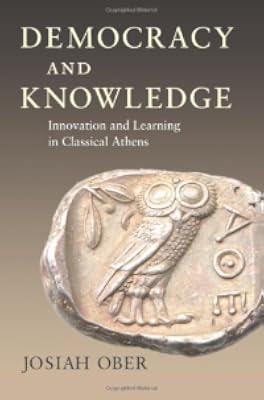
Democracy and Knowledge: Innovation and Learning in Classical Athens
by Josiah Ober
On This Page
Description
When does democracy work well, and why? Is democracy the best form of government? These questions are of supreme importance today as the United States seeks to promote its democratic values abroad. Democracy and Knowledge is the first book to look to ancient Athens to explain how and why directly democratic government by the people produces wealth, power, and security. Combining a history of Athens with contemporary theories of collective action and rational choice developed by economists show more and political scientists, Josiah Ober examines Athenian democracy's unique contribution to the ancient Greek city-state's remarkable success, and demonstrates the valuable lessons Athenian political practices hold for us today. He argues that the key to Athens's success lay in how the city-state managed and organized the aggregation and distribution of knowledge among its citizens. Ober explores the institutional contexts of democratic knowledge management, including the use of social networks for collecting information, publicity for building common knowledge, and open access for lowering transaction costs. He explains why a government's attempt to dam the flow of information makes democracy stumble. Democratic participation and deliberation consume state resources and social energy. Yet as Ober shows, the benefits of a well-designed democracy far outweigh its costs. Understanding how democracy can lead to prosperity and security is among the most pressing political challenges of modern times. Democracy and Knowledge reveals how ancient Greek politics can help us transcend the democratic dilemmas that confront the world today. show lessTags
Recommendations


























Member Reviews
The author presents a competent review of Athenian political institutions. Athens managed to create a unique system of democratic government, but that is of course a familiar story. The author's claim to novelty rests on the extension of Athenian political and economic history to matters of knowledge. He argues that the superior power of democratic Athens (over other Greek city states) is explained by the way its governmental processes utilized the ordinary knowledge of Athenian citizens.
I think the argument misses its mark because the mark is so elusive and inaccessible to historical study. Athens built an empire and its citizens participated in government, that much is clear. But what Athenian citizens may or may not have known about show more any given issue, how their opinions may have interacted and changed in debate, to what extent their decisions were determined by distributed ordinary knowledge rather than specialist knowledge - these seem to be completely speculative questions that historical research simply cannot answer.
Since direct evidence about states of knowledge among Athenian citizens does not exist, the author uses a variety of roundabout approaches to build his case. The results are uneven. The city-state comparisons and the timeline of the historical development of Athenian government in chapter 2 provide an interesting starting point. When the author discusses decision-making in councils, magistrates and assemblies in chapter 4, the argument is to some extent persuasive. These are, after all, manifestations of direct democracy and thereby also of ordinary knowledge. But when he moves on to legal decrees, coinage, monuments, architecture etc. in chapters 5-6, the connection to ordinary knowledge is often lost and the argument is unclear. When he uses modern business literature to draw comparisons between Athens and "knowledge organizations" like Google (p. 105) he is being outright silly.
I think the argument would have been much better if the presentation of political institutions in chapter 4 would have been linked to the chronological account in chapter 2. The biggest flaw with this book is that it supposedly explains Athens' rise but is silent about its decline. If democracy led to success, then what led to failure? Why did Athenian democracy not survive? The author detaches his theory from Athenian history when he begins to stack up increasingly speculative evidence for his circumscribed one-way thesis.
Despite my criticism, I still enjoyed the author's broad understanding and enthusiasm for the subject. I don't think historians are likely to ever know much about how knowledge influenced the development of ancient societies, but this book can still be recommended to readers in democratic theory who don't mind a bit of free speculation. Readers that take Greek history seriously probably won't learn anything significant from this book, except perhaps new tricks for overinterpreting historical evidence. show less
I think the argument misses its mark because the mark is so elusive and inaccessible to historical study. Athens built an empire and its citizens participated in government, that much is clear. But what Athenian citizens may or may not have known about show more any given issue, how their opinions may have interacted and changed in debate, to what extent their decisions were determined by distributed ordinary knowledge rather than specialist knowledge - these seem to be completely speculative questions that historical research simply cannot answer.
Since direct evidence about states of knowledge among Athenian citizens does not exist, the author uses a variety of roundabout approaches to build his case. The results are uneven. The city-state comparisons and the timeline of the historical development of Athenian government in chapter 2 provide an interesting starting point. When the author discusses decision-making in councils, magistrates and assemblies in chapter 4, the argument is to some extent persuasive. These are, after all, manifestations of direct democracy and thereby also of ordinary knowledge. But when he moves on to legal decrees, coinage, monuments, architecture etc. in chapters 5-6, the connection to ordinary knowledge is often lost and the argument is unclear. When he uses modern business literature to draw comparisons between Athens and "knowledge organizations" like Google (p. 105) he is being outright silly.
I think the argument would have been much better if the presentation of political institutions in chapter 4 would have been linked to the chronological account in chapter 2. The biggest flaw with this book is that it supposedly explains Athens' rise but is silent about its decline. If democracy led to success, then what led to failure? Why did Athenian democracy not survive? The author detaches his theory from Athenian history when he begins to stack up increasingly speculative evidence for his circumscribed one-way thesis.
Despite my criticism, I still enjoyed the author's broad understanding and enthusiasm for the subject. I don't think historians are likely to ever know much about how knowledge influenced the development of ancient societies, but this book can still be recommended to readers in democratic theory who don't mind a bit of free speculation. Readers that take Greek history seriously probably won't learn anything significant from this book, except perhaps new tricks for overinterpreting historical evidence. show less
Ratings
Members
- Recently Added By
Lists

Works Cited in The Life and Death of Democracy by John Keane
278 works; 1 member
Author Information

20+ Works 863 Members
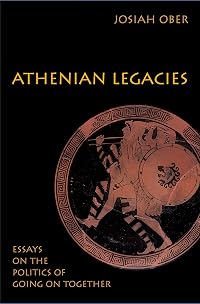
Josiah Ober is the Constantine Mitsotakis Professor of Political Science and Classics at Stanford University. His books include Athenian Legacies, Political Dissent in Democratic Athens, and Mass and Elite in Democratic Athens (all Princeton).
Awards and Honors
Awards
Common Knowledge
- Important places
- Ancient Greece
Classifications
- Genres
- Politics and Government, Nonfiction, History, General Nonfiction, Philosophy
- DDC/MDS
- 320.938 — Society, government, & culture Political science Types of Government Political situation and conditions Ancient World Greece to 323
- LCC
- JC75 .D36 .O25 — Political Science Political theory Political theory. The state. Theories of the state Ancient state
- BISAC
Statistics
- Members
- 64
- Popularity
- 485,351
- Reviews
- 2
- Rating
- (4.50)
- Languages
- English
- Media
- Paper, Ebook
- ISBNs
- 3
- UPCs
- 1
- ASINs
- 2