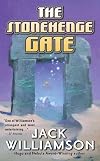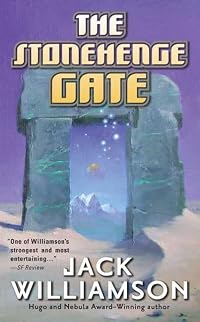
The Stonehenge Gate
by Jack Williamson
On This Page
Description
A dark mystery has been buried beneath the sands of the Sahara for eons. In a basement in New Mexico, four poker buddies find reason to believe that a startling secret is out there, and these four amateur adventurers are about to uncover it. Curiosity propels mild-mannered professor Will and his three friends to the Sahara to excavate a site where radar has detected trilithic stones hidden beneath the sand. There they stumble upon an ancient artifact that will change their lives, and the show more world, forever: a gateway between planets, linking Earth to distant worlds where they will discover wonders and terrors beyond imagining. Now each traveler must play a crucial role in unraveling an ancient mystery, the solution to which may reveal the true origins of the human race, if they can survive the journey back to Earth. show lessTags
Recommendations











Member Reviews
A Bit of Familiar Plot:
They call themselves The Four Horsemen! Four academics hang out at a poker game in Portales, New Mexico after some teaching/researching at the local university. Checking out some satellite images, they find a gate of sorts in the middle of the Sahara Desert and buried under a lot of sand. [Nope, we never go to England and see Stonehenge! Oh well!]
They decide to pool their resources and get there!
Comments:
Similar in some ways to Stargate in plot, except these four people are getting the ride of their lives without help from the military or anything like that. Its very unbelievability is its best protection.
Now, the first half of the book moves a bit slowly as the author develops the characters, mostly narrated show more from the view of Will Stone, teacher and researcher, who is not exactly prepared for a large adventure.
Yes, I’m getting to it: The gate they find is a teleportation device to other planets. It seems these builders built a great civilization and somehow died out in some forgotten war a few millennia ago.
The whole story feels quite familiar with the weak character, the reluctant hero, some light romance and a heavy aspect of racial tension and war between the Whites and the Blacks, who seem to reliving their gods’ myth: A black god and a white woman married and then warred.
Writing Style: The story does not really get to a final conclusion. We learn more about the builders but not much else. The racial storyline is not bad, but does not really get to a conclusion for me that resolves the war. I am happy to report that the slavery issue in that other world does eventually get resolved.
Also, the expression “he grabbed my arm” is used over and over again – kinda annoying!
Ram is the reluctant hero which Williamson builds up nicely. Really, he’s the only character you can really relate to!
Bottom Line: Jack Williamson is part of the Golden Age pulp fiction writers. He wrote The Stonehenge Gate at the tender age of 97. He passed away in 2006, so this was his last novel! A pulpy adventure with aliens, robots and heroes who don’t realize they actually are. Recommended for pulp readers! show less
They call themselves The Four Horsemen! Four academics hang out at a poker game in Portales, New Mexico after some teaching/researching at the local university. Checking out some satellite images, they find a gate of sorts in the middle of the Sahara Desert and buried under a lot of sand. [Nope, we never go to England and see Stonehenge! Oh well!]
They decide to pool their resources and get there!
Comments:
Similar in some ways to Stargate in plot, except these four people are getting the ride of their lives without help from the military or anything like that. Its very unbelievability is its best protection.
Now, the first half of the book moves a bit slowly as the author develops the characters, mostly narrated show more from the view of Will Stone, teacher and researcher, who is not exactly prepared for a large adventure.
Yes, I’m getting to it: The gate they find is a teleportation device to other planets. It seems these builders built a great civilization and somehow died out in some forgotten war a few millennia ago.
The whole story feels quite familiar with the weak character, the reluctant hero, some light romance and a heavy aspect of racial tension and war between the Whites and the Blacks, who seem to reliving their gods’ myth: A black god and a white woman married and then warred.
Writing Style: The story does not really get to a final conclusion. We learn more about the builders but not much else. The racial storyline is not bad, but does not really get to a conclusion for me that resolves the war. I am happy to report that the slavery issue in that other world does eventually get resolved.
Also, the expression “he grabbed my arm” is used over and over again – kinda annoying!
Ram is the reluctant hero which Williamson builds up nicely. Really, he’s the only character you can really relate to!
Bottom Line: Jack Williamson is part of the Golden Age pulp fiction writers. He wrote The Stonehenge Gate at the tender age of 97. He passed away in 2006, so this was his last novel! A pulpy adventure with aliens, robots and heroes who don’t realize they actually are. Recommended for pulp readers! show less
Abandoned December 28, 2010. I was very disappointed. This was another example of a gate (appearing very primitive, despite its power, compared with the gate in "Stargate") transporting people to other places in the universe. This was the first novel by Williamson I've read, so maybe it's just his style, but I was put off by this book's poor plot development. Important details were glossed over. Transitions from one scene or locale to another made it seem like the book itself was going through gates! I had to give up after the first 30 pages. To be fair, it appears that this novel, published a year before Williamson's death in 2006 at the age of 98, was his last. It is likely not representative of the work of this award-winning science show more fiction author. show less
A strange story. The main arc is an adventure travelogue going through a gate and encountering strange worlds. Then the middle half takes place in a slave society thinly veiled the American peribellum south. On of the protagonist's companions then all but accidentally triggers a slave rebellion and runs off with a white "plantation" owner. It's hard to see point -- it's not the character's actions, deed, philosophy or anything that leads to rebellions success; it's not condemning slavery; it's not arguing for slavery.
A Bit of Familiar Plot:
They call themselves The Four Horsemen! Four academics hang out at a poker game in Portales, New Mexico after some teaching/researching at the local university. Checking out some satellite images, they find a gate of sorts in the middle of the Sahara Desert and buried under a lot of sand. [Nope, we never go to England and see Stonehenge! Oh well!]
They decide to pool their resources and get there!
Comments:
Similar in some ways to Stargate in plot, except these four people are getting the ride of their lives without help from the military or anything like that. Its very unbelievability is its best protection.
Now, the first half of the book moves a bit slowly as the author develops the characters, mostly narrated show more from the view of Will Stone, teacher and researcher, who is not exactly prepared for a large adventure.
Yes, I’m getting to it: The gate they find is a teleportation device to other planets. It seems these builders built a great civilization and somehow died out in some forgotten war a few millennia ago.
The whole story feels quite familiar with the weak character, the reluctant hero, some light romance and a heavy aspect of racial tension and war between the Whites and the Blacks, who seem to reliving their gods’ myth: A black god and a white woman married and then warred.
Writing Style: The story does not really get to a final conclusion. We learn more about the builders but not much else. The racial storyline is not bad, but does not really get to a conclusion for me that resolves the war. I am happy to report that the slavery issue in that other world does eventually get resolved.
Also, the expression “he grabbed my arm” is used over and over again – kinda annoying!
Ram is the reluctant hero which Williamson builds up nicely. Really, he’s the only character you can really relate to!
Bottom Line: Jack Williamson is part of the Golden Age pulp fiction writers. He wrote The Stonehenge Gate at the tender age of 97. He passed away in 2006, so this was his last novel! A pulpy adventure with aliens, robots and heroes who don’t realize they actually are. Recommended for pulp readers! show less
They call themselves The Four Horsemen! Four academics hang out at a poker game in Portales, New Mexico after some teaching/researching at the local university. Checking out some satellite images, they find a gate of sorts in the middle of the Sahara Desert and buried under a lot of sand. [Nope, we never go to England and see Stonehenge! Oh well!]
They decide to pool their resources and get there!
Comments:
Similar in some ways to Stargate in plot, except these four people are getting the ride of their lives without help from the military or anything like that. Its very unbelievability is its best protection.
Now, the first half of the book moves a bit slowly as the author develops the characters, mostly narrated show more from the view of Will Stone, teacher and researcher, who is not exactly prepared for a large adventure.
Yes, I’m getting to it: The gate they find is a teleportation device to other planets. It seems these builders built a great civilization and somehow died out in some forgotten war a few millennia ago.
The whole story feels quite familiar with the weak character, the reluctant hero, some light romance and a heavy aspect of racial tension and war between the Whites and the Blacks, who seem to reliving their gods’ myth: A black god and a white woman married and then warred.
Writing Style: The story does not really get to a final conclusion. We learn more about the builders but not much else. The racial storyline is not bad, but does not really get to a conclusion for me that resolves the war. I am happy to report that the slavery issue in that other world does eventually get resolved.
Also, the expression “he grabbed my arm” is used over and over again – kinda annoying!
Ram is the reluctant hero which Williamson builds up nicely. Really, he’s the only character you can really relate to!
Bottom Line: Jack Williamson is part of the Golden Age pulp fiction writers. He wrote The Stonehenge Gate at the tender age of 97. He passed away in 2006, so this was his last novel! A pulpy adventure with aliens, robots and heroes who don’t realize they actually are. Recommended for pulp readers! show less
Interesting but somewhat disappointing. Definitely an amazing creation by a master but most any author would have developed the story idea much farther. The main story line revolves around a trilithon circle in the Sahara that is discovered by a ground penetrating radar survey from Eastern New Mexico University (Williamson lives and teaches there). A group of four professors, an unlikely mix of archaeologist, astronomer, english lit, and a guy from Kenya with a strange birthmark on his forehead (oooooh!), decide to sneak off and investigate the circle over the holiday break and obviously wind up being drawn in to a few alien realms and discovering the origins of man on Earth. There is a large portion of the book set on an unnamed world show more with two continents, one of equatorial jungle blacks and the other of slave owning whites. This seems to set up the moral argument of equality vs. inequality whilst being set against the discovery of man's creation (of one race that has diverged) by an alien race powerful enough to create the gates between worlds. All in all, I really enjoyed the ideas and the writing, and the narration by an English Lit professor that just wants to get home and leaves the thinking up to his astronomer and archaeologist friends, but the grand scope seemed curtailed and left me wishing for a trilogy (or more). Still-Thumbs up! show less
I'm sorry to give this book such a bad rating, but the stereotyped characters, numerous technical errors and erratic plot just ruined it for me. Sadly, there were parts of the book that showed promise, but these were overwhelmed by the implausible action scenes and stilted dialogue. A good developmental edit would have flagged these issues.
This book felt like a touch of Star Gate, a touch of Star Trek. Four college professors from New Mexico travel to the Sahara to investigate a shadow on a satelite image, only to find an unusual artifact that delivers them to another planet. The adventures follow this, with one of the primary story lines trying to get back home to Earth.
The author made too much use of the list factor. Descriptions became lists of things, rather than actually showing us through the actions of the characters. The story could have been pared down by reducing these pieces of writing floatsam. Also the description seemed a touch misleading, as they state that four will travel through the book. This to me says you should have three characters disappear for as show more much as a quarter of the book. The writing flows, but when even a professional actor/book reader like Harlan Ellison has to stop and check his sentence, you have a gramatical snag.
The book was okay. I may see if Mr Williamson has another book that I can check out, so I don't scorn a man based on one book. show less
The author made too much use of the list factor. Descriptions became lists of things, rather than actually showing us through the actions of the characters. The story could have been pared down by reducing these pieces of writing floatsam. Also the description seemed a touch misleading, as they state that four will travel through the book. This to me says you should have three characters disappear for as show more much as a quarter of the book. The writing flows, but when even a professional actor/book reader like Harlan Ellison has to stop and check his sentence, you have a gramatical snag.
The book was okay. I may see if Mr Williamson has another book that I can check out, so I don't scorn a man based on one book. show less
Members
- Recently Added By
Author Information

210+ Works 10,095 Members
Author Jack Williamson was born in Bisbee, Arizona on April 29, 1908. In the 1950's, he received both his BA and MA degress in English from Eastern New Mexico University. After receiving his PhD from the University of Colorado, he taught linguistics, the modern novel and literary criticism at Eastern New Mexico University until he retired in 1977. show more At the age of 20, he published his first story, The Metal Man, in a December 1928 issue of Amazing Stories. Since then he has written more than 50 novels and at least 15 short story collections. Some of his best known works are The Humanoids, The Legion of Time, Manseed, and Lifeburst. He also published numerous collaborations with fellow science fiction author Frederik Pohl. He received numerous awards including the Pilgrim Award from the Science Fiction Research Association, the Hugo Award, and the Nebula Award. He was an inaugural inductee in the Science Fiction and Fantasy Hall of Fame and was named a Grand Master of Science Fiction by the Science Fiction Writers of America in 1976. He died at his home in Portales, New Mexico on November 10, 2006. (Bowker Author Biography) show less
Work Relationships
Is contained in
Common Knowledge
Classifications
Statistics
- Members
- 176
- Popularity
- 185,403
- Reviews
- 12
- Rating
- (2.61)
- Languages
- English, Spanish
- Media
- Paper, Audiobook, Ebook
- ISBNs
- 12
- ASINs
- 3