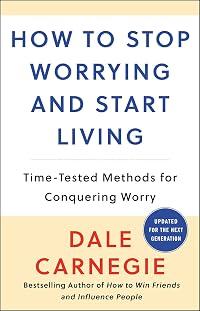
How to Stop Worrying and Start Living
by Dale Carnegie
On This Page
Description
Discover how to: Eliminate 50 percent of business worries immediately; Reduce financial worries; Turn criticism to your advantage; Avoid fatigue and keep looking young; Add one hour a day to your waking life; Find yourself and be yourself. Remember, there is no one on earth like you!.Tags
Recommendations













Member Reviews
Wow this was long! But good. It's actually one of the only anxiety books I've ever read that I'm thinking is worth a re-read at some point.
But first, a little light-hearted critique:
* Dale Carnegie is a Buzzfeed writer before there were such things. ("If you have a worry problem, apply the magic formula of Willis H. Carrier." "Seven Ways to Peace and Happiness", "If You Do This, You Will Never Worry About Ingratitude", "How to Cure Melancholy in Fourteen Days").
* Dale Carnegie is also your mother who knows exactly where you're off base and is talking to you kindly but firmly about how to Straighten Up.
Yeah, it's an interesting tone. It's a bit... folksy? Is that the right word? I think so. You definitely feel as if he knows who he's show more talking to. And it's you.
BUT. In spite of the fact that I chuckled/cringed at some things...
He makes a lot of solid practical points, and he says them in a way that makes me sit up and take notice. I think since he was writing decades before the market was flooded with formulaic self-help books written in a detached clinical voice, his text stands out as truly unique and memorable. And some of his points have actually popped into my head during anxious moments, days after reading about them. I honestly think I will remember and use some of this stuff.
One of my favorite points came early on. And, you guessed it, it's "the magic formula of Willis H. Carrier." ;) Yeah, I'm not crazy about that label. But the chapter is very thought-provoking. We worrywarts spend a lot of time distressed about terrible but vague outcomes. The advice here is to try and define to yourself what is the worst logical outcome in this situation... face up to it, mentally prepare to accept it if you have to, but then calmly proceed to improve upon the worst.
Related to that is another chapter on cooperating with the inevitable. It's exhausting to think you can control the uncontrollable, you know? I have that problem sometimes. Especially in a COVID world. So this chapter is about stopping that mindset. It doesn't mean giving up when there's a chance to make something better. But, if it's truly something that can't be changed... well, as he says, "No one living has enough emotion and vigour to fight the inevitable and, at the same time, enough left over to create a new life." I'm reviewing the chapter now, and I have to say, it's powerful stuff.
Dale Carnegie includes lots of real-life stories that illustrate what he's talking about. Some of them are very poignant, and some of them seem a little over-hyped. And some of them are just a product of their time. Like the short article, "I Was Acting Like an Hysterical Woman," by Cameron Shipp. Whew. Glad he got some help for that. I guess Hysterical Men hadn't been invented yet.
(Note: There are definitely some instances of gender and racial stereotyping that stand out glaringly to a modern reader.)
But all in all, this was a solid, straightforward read for anxious people, and in my opinion, way more engaging (if also occasionally snort-inducing) than most current books on the subject. So much so that I'm considering getting a hard copy so I can review and highlight some things. show less
But first, a little light-hearted critique:
* Dale Carnegie is a Buzzfeed writer before there were such things. ("If you have a worry problem, apply the magic formula of Willis H. Carrier." "Seven Ways to Peace and Happiness", "If You Do This, You Will Never Worry About Ingratitude", "How to Cure Melancholy in Fourteen Days").
* Dale Carnegie is also your mother who knows exactly where you're off base and is talking to you kindly but firmly about how to Straighten Up.
Yeah, it's an interesting tone. It's a bit... folksy? Is that the right word? I think so. You definitely feel as if he knows who he's show more talking to. And it's you.
BUT. In spite of the fact that I chuckled/cringed at some things...
He makes a lot of solid practical points, and he says them in a way that makes me sit up and take notice. I think since he was writing decades before the market was flooded with formulaic self-help books written in a detached clinical voice, his text stands out as truly unique and memorable. And some of his points have actually popped into my head during anxious moments, days after reading about them. I honestly think I will remember and use some of this stuff.
One of my favorite points came early on. And, you guessed it, it's "the magic formula of Willis H. Carrier." ;) Yeah, I'm not crazy about that label. But the chapter is very thought-provoking. We worrywarts spend a lot of time distressed about terrible but vague outcomes. The advice here is to try and define to yourself what is the worst logical outcome in this situation... face up to it, mentally prepare to accept it if you have to, but then calmly proceed to improve upon the worst.
Related to that is another chapter on cooperating with the inevitable. It's exhausting to think you can control the uncontrollable, you know? I have that problem sometimes. Especially in a COVID world. So this chapter is about stopping that mindset. It doesn't mean giving up when there's a chance to make something better. But, if it's truly something that can't be changed... well, as he says, "No one living has enough emotion and vigour to fight the inevitable and, at the same time, enough left over to create a new life." I'm reviewing the chapter now, and I have to say, it's powerful stuff.
Dale Carnegie includes lots of real-life stories that illustrate what he's talking about. Some of them are very poignant, and some of them seem a little over-hyped. And some of them are just a product of their time. Like the short article, "I Was Acting Like an Hysterical Woman," by Cameron Shipp. Whew. Glad he got some help for that. I guess Hysterical Men hadn't been invented yet.
(Note: There are definitely some instances of gender and racial stereotyping that stand out glaringly to a modern reader.)
But all in all, this was a solid, straightforward read for anxious people, and in my opinion, way more engaging (if also occasionally snort-inducing) than most current books on the subject. So much so that I'm considering getting a hard copy so I can review and highlight some things. show less
Hmmm, well, my review on this one is going to be mixed -- on the one hand, I found the reader soothing and some of the stories and philosophies were helpful to me; one the other hand, Dale Carnegie was an adult in 1909 and it shows -- dismissive and patronizing comments about women, foul opinions about "melancholics" (depressed people), dated language and an overdependence on prayer/Christian thought.
There's also a whole chapter convincing the reader why worry is a problem that is pretty stressful for those of us who are worried about the medical effects of stress -- just sayin' -- I'm reading the book to reduce my worry, not increase the possible reasons for it. I also appreciate that as indoctrinated Christian writings go, this is show more relatively neutral -- he's all about the power of prayer no matter what your religion is, but I had to skip at least one chapter completely and when he started praising the founder of Christian Science, it set off a fair few alarm bells for me. Anyway, those are my personal biases, and I have to admit I was charmed and intrigued to hear about what people in earlier America were thinking. I can't tell exactly what decade this book was intended for, but I suspect the 1950s. It's an interesting time capsule.
With regards to the tangible advice portion, I found some of it helpful, and in line with my therapist's suggestions -- break down the problem into manageable chunks, try and redirect your brain when it gets fixated on the problem, find ways to reduce your fear and remove the problem from the influence of overwhelming emotion. I also really respond well to personal anecdotes as a learning tool -- when I have a problem, often I will turn to friends to ask how they have handled things as part of my own process. This book felt very similar -- giving me little road maps to think about and determine whether they are useful to me. show less
There's also a whole chapter convincing the reader why worry is a problem that is pretty stressful for those of us who are worried about the medical effects of stress -- just sayin' -- I'm reading the book to reduce my worry, not increase the possible reasons for it. I also appreciate that as indoctrinated Christian writings go, this is show more relatively neutral -- he's all about the power of prayer no matter what your religion is, but I had to skip at least one chapter completely and when he started praising the founder of Christian Science, it set off a fair few alarm bells for me. Anyway, those are my personal biases, and I have to admit I was charmed and intrigued to hear about what people in earlier America were thinking. I can't tell exactly what decade this book was intended for, but I suspect the 1950s. It's an interesting time capsule.
With regards to the tangible advice portion, I found some of it helpful, and in line with my therapist's suggestions -- break down the problem into manageable chunks, try and redirect your brain when it gets fixated on the problem, find ways to reduce your fear and remove the problem from the influence of overwhelming emotion. I also really respond well to personal anecdotes as a learning tool -- when I have a problem, often I will turn to friends to ask how they have handled things as part of my own process. This book felt very similar -- giving me little road maps to think about and determine whether they are useful to me. show less
I can attest to the value of each of Dale Carnegie's books, although I initially approached them with as much cynicism is possible. Long ago, the bank I was working for sent me, a shy stuttering new manager, to take the Dale Carnegie course. I soon learned what it taught me was plain commonsense. For instance, if you're worried about something, think about the worst possible thing that might happen, learn to accept it, and think about how you would deal with the consequences. Once you have done that, you can stop worrying about it. And you should never worry about things that probably won't happen at all. What a waste of time that is! I often recommend this book to friends I see who are down in the dumps and overcome by worries. It is a show more masterpiece. show less
I can attest to the value of each of Dale Carnegie's books, although I initially approached them with as much cynicism is possible. Long ago, the bank I was working for sent me, a shy stuttering new manager, to take the Dale Carnegie course. I soon learned what it taught me was plain commonsense. For instance, if you're worried about something, think about the worst possible thing that might happen, learn to accept it, and think about how you would deal with the consequences. Once you have done that, you can stop worrying about it. And you should never worry about things that probably won't happen at all. What a waste of time that is! I often recommend this book to friends I see who are down in the dumps and overcome by worries. It is a show more masterpiece. show less
I'm done. No more. 40 % is good enough for this book. I don't get how anyone can read 300 pages of this. It's the same idea in every chapter and it gets incredibly boring to read. Every story mentionend, reads exactly the same, because it's always in his "I'm a motivational speaker style". Reminds me too much of those shitty buzzfeed lists "YOU WON'T BELIEVE WHAT HE DID NEXT!". It didn't expext it to be based in scientific fact, but a few more practical tips would've been nice.
What I liked the most were the 10 things you should do "Just for Today".
"A man can be concerned about his serious problems and still walk with his chin up and a carnation in his buttonhole."
Funniest part of the book.
From now on I'll consider this book read.
I've long been a fan of Dale Carnegie and has wisdom, and like the other books I've read of his, I enjoyed this one very much as well. His book did indeed allow me to stop worrying and start living. Some of his advice has stuck with me over time and re-emerged during my day-to-day struggles. In that way, I know that his words of wisdom have truly infiltrated my mind and impacted my life in a positive way.
The chapter that proved most beneficial to me was the one on "How to Keep from Worrying about Insomnia." For as long as I can remember, I've always had trouble sleeping. I would wake up tired, drained and worry about not having enough energy to get through the day. This was always a source of pain and suffering for me, until I read show more this book. Everything he pointed out regarding this topic rang so true to me and allowed me to relax into my circumstance. I learned how to look at my situation differently and how to build a different relationship with my difficult sleep pattern. Over time, I eradicated my sleeping problem altogether, simply because I employed his methodology of thinking. For this fact alone, I am so grateful for having read this. What a gem of a book. For anyone who worries and often overthinks, this book is for you! show less
The chapter that proved most beneficial to me was the one on "How to Keep from Worrying about Insomnia." For as long as I can remember, I've always had trouble sleeping. I would wake up tired, drained and worry about not having enough energy to get through the day. This was always a source of pain and suffering for me, until I read show more this book. Everything he pointed out regarding this topic rang so true to me and allowed me to relax into my circumstance. I learned how to look at my situation differently and how to build a different relationship with my difficult sleep pattern. Over time, I eradicated my sleeping problem altogether, simply because I employed his methodology of thinking. For this fact alone, I am so grateful for having read this. What a gem of a book. For anyone who worries and often overthinks, this book is for you! show less
Using platitudes and testimonials, Dale Carnegie attempts to tell you how to free yourself from worry. It's well written, but it was written in the 1940's, and it shows; mostly in how it treats women. All of the advice is useful and applicable though.
Members
- Recently Added By
Published Reviews
ThingScore 100
Key takeaways
1. Worrying never solves the problem. It only adds onto it
As human beings, we are bound to worry. We worry about countless things. How do I speak in front of 100 people tomorrow!? I haven’t studied for my tomorrow’s exams, what to do now!? I wasn’t aware that I spent 4 hours on social media!! It’s already 4 AM, yet I cannot sleep. Panic! Panic! Panic!!!
These were a few show more worry traps that you may have experienced. Think about your own situations when you had worried a lot. Has worry ever solved your problem? Worry only expanded your problem, didn’t it?
Carnegie argues that we waste a lot of time thinking about our problems. We think of all the terrible consequences we could face in our problems. We rarely think about the solution part.
When faced with insomnia, we check our clock constantly. We then think all the bad things that could happen the following day due to lack of sleep. At that moment, we all know that forgetting about everything and falling asleep is the most crucial task to do. Yet, we fail to do that.
To read more, Please visit https://proinvestivity.com/2020/08/15/... show less
1. Worrying never solves the problem. It only adds onto it
As human beings, we are bound to worry. We worry about countless things. How do I speak in front of 100 people tomorrow!? I haven’t studied for my tomorrow’s exams, what to do now!? I wasn’t aware that I spent 4 hours on social media!! It’s already 4 AM, yet I cannot sleep. Panic! Panic! Panic!!!
These were a few show more worry traps that you may have experienced. Think about your own situations when you had worried a lot. Has worry ever solved your problem? Worry only expanded your problem, didn’t it?
Carnegie argues that we waste a lot of time thinking about our problems. We think of all the terrible consequences we could face in our problems. We rarely think about the solution part.
When faced with insomnia, we check our clock constantly. We then think all the bad things that could happen the following day due to lack of sleep. At that moment, we all know that forgetting about everything and falling asleep is the most crucial task to do. Yet, we fail to do that.
To read more, Please visit https://proinvestivity.com/2020/08/15/... show less
added by Jenesh_Lal_Shrestha
Lists

Best Self Help Books
87 works; 18 members

2022
17 works; 1 member

r/GetMotivated's Recommended Books
27 works; 1 member

Publisher's Weekly NON-Fiction list - 1912 - 1975
486 works; 4 members

Healing resources for women
588 works; 1 member
Author Information

310+ Works 26,676 Members
Dale Breckenridge Carnegie (spelled Carnagey until 1922) was born on November 24, 1888 in Maryville, Missouri. He was the son of a poor farmer but he managed to get an education at the State Teacher's College in Warrensburg. After school he became a successful salesman and then began pursuing his dream of becoming a lecturer. At one point, he show more lived, penniless, at the YMCA on 125th street in New York City. There he persuaded the "Y" manager to allow him to give courses on public speaking. His technique included making students speak about something that made them angry -- this technique made them unafraid to address an audience. From this beginning, the Dale Carnegie Course developed. (Dale also changed the spelling of his last name from Carnagey to Carnegie due to the widely recognized name of Andrew Carnegie.) Carnegie wrote Public Speaking: a Practical Course for Business Men (1926), but his greatest written achievement was How to Win Friends and Influence People (1936). The book has still made it on to the bestsellers' list in 2014. Carnegie died at his home in Forest Hills, New York on November 1, 1955. He was buried in the Belton, Cass County, Missouri, cemetery. The official biography from Dale Carnegie & Associates, Inc. states that he died of Hodgkin's disease. (Bowker Author Biography) show less
Some Editions
Awards and Honors
Distinctions
Work Relationships
Common Knowledge
- Canonical title*
- Come vincere lo stress e cominciare a vivere
- Original title
- How to Stop Worrying and Start Living
- Alternate titles*
- Come vincere ansia e preoccupazioni
- Original publication date
- 1944; 1948
- People/Characters
- Dale Carnegie
- Dedication
- This book is dedicated to a man who doesn't need to read it - Lowell Thomas
Thirty five years ago, I was one of the unhappiest lads in New York. - First words
- In the spring of 1871, a young man picked up a book and read twenty-one words that had a profound effect on his future.
- Quotations
- Our main business is not to see what lies dimly at a distance, but to do what lies clearly at hand. - Thomas Carlyle
- Last words
- (Click to show. Warning: May contain spoilers.)For this is not a "reading book" in the ordinary sense; it is written as a "guidebook"-to a new way of life!
- Original language*
- English
- Canonical DDC/MDS
- 158'.1; 158.1; 158
- Canonical LCC
- BF575.W8C3
*Some information comes from Common Knowledge in other languages. Click "Edit" for more information.
Classifications
Statistics
- Members
- 3,656
- Popularity
- 4,446
- Reviews
- 42
- Rating
- (3.97)
- Languages
- 25 — Bengali, Bulgarian, Chinese, Czech, Dutch, English, Estonian, Finnish, French, German, Gujarati, Hindi, Hungarian, Italian, Japanese, Lithuanian, Malay, Norwegian (Bokmål), Russian, Serbian, Spanish, Swedish, Turkish, Portuguese (Portugal), Portuguese (Brazil)
- Media
- Paper, Audiobook, Ebook
- ISBNs
- 164
- ASINs
- 76