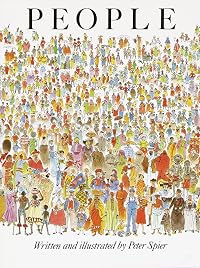
People
by Peter Spier
On This Page
Description
Emphasizes the differences among the four billion people on earth.Tags
Recommendations














Member Reviews
I couldn't have predicted that my 9-year-old son would love this as much as he did. This was a read-aloud (more like an examination & exploration than reading) that spanned a week, and those moments were some that I will cherish more than anything else this summer so far. He has never been more engrossed in anything than this simplistic but brilliantly detailed presentation of "people": how we ARE. Spier shows us how people around the world vary in dress, ideas, systems (my son was amazed at different systems of rank), religions, travel and communication methods, food choice, etc. I feel that this book served as a virtual field trip that may have been comparable to a brief world tour. It was that good. The conversations these pictures show more ignited! show less
Caldecott Medal-winning children's author/illustrator Peter Spier highlights and celebrates human diversity in this 1980 picture book tour of the world's people. Emphasizing the uniqueness of each human being, he describes the many ways that people are alike—people need to work, they love to play, they require homes and food, they celebrate religious and cultural festivals—while also highlighting the variation in these commonalities. He highlights how they are different—some like calm, others noise; some like to be alone, others like groups—but shows how even these differences are located along spectrums (such as social needs) that tie people together. The book concludes with a statement about how dull the world would be if all show more people were alike, and a celebration of each individual human's uniqueness...
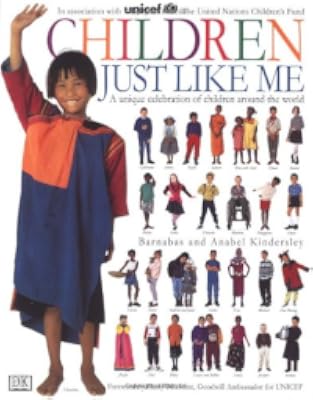
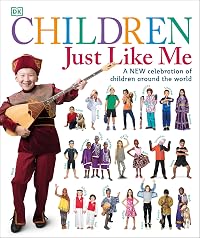
People is the sixth of Spier's picture books that I have read, and it put me strongly in mind of similar titles, such as the 1995 Children Just Like Me: A Unique Celebration of Children Around the World, which depicts the life of children from thirty-one countries, offering a similar sampling of the world's diversity. As always with this creator's books, I enjoyed the artwork immensely, appreciating both the expressiveness and humor in each individual painting, and the sheer wealth of paintings and images on each page. This is the kind of book a child could pore over for hours! All that being said, despite my enjoyment of this one, I'm not sure I'd truly recommend it as a book for classroom social studies, as it is quite dated. In fact, I think it was dated even when first created in 1980, with many of the depictions showing clothing and dwellings that would not have been in common use, even at that time. Its opening premise moreover, that the world has slightly more than four billion people, is obviously no longer true. I do think this is still enjoyable, as a celebration of global diversity—I particularly liked the two-page spread showing some of the many writing systems in use around the world!—as long as one is aware that it doesn't give accurate, current information. show less
People is the sixth of Spier's picture books that I have read, and it put me strongly in mind of similar titles, such as the 1995 Children Just Like Me: A Unique Celebration of Children Around the World, which depicts the life of children from thirty-one countries, offering a similar sampling of the world's diversity. As always with this creator's books, I enjoyed the artwork immensely, appreciating both the expressiveness and humor in each individual painting, and the sheer wealth of paintings and images on each page. This is the kind of book a child could pore over for hours! All that being said, despite my enjoyment of this one, I'm not sure I'd truly recommend it as a book for classroom social studies, as it is quite dated. In fact, I think it was dated even when first created in 1980, with many of the depictions showing clothing and dwellings that would not have been in common use, even at that time. Its opening premise moreover, that the world has slightly more than four billion people, is obviously no longer true. I do think this is still enjoyable, as a celebration of global diversity—I particularly liked the two-page spread showing some of the many writing systems in use around the world!—as long as one is aware that it doesn't give accurate, current information. show less
I loved this book as a child; I had it checked out of the public library at least once a month. I haven't been in that library in more than a decade, but I have no doubt that I could still walk directly to the spot where it was shelved. I finally broke down and bought my own copy - and it's every bit as wonderful as I remember it. The illustrations are colorful and detailed and charming in their variety. The book's basic message is one of tolerance without coming across as patronizing. There are more than 6 billion people in the world, and the book starts with individual physical differences and goes all the way through dress, food preferences, games, dwellings, religion, writing, holidays, etc., giving a world-wide sampling of each, show more each with a little illustration... the point being: you might think what other people are doing is weird, but they think what you're doing is weird, and in the end, we're all still people. Maybe I'm generalizing from my own childhood love of the book, but I think this should be read to every child out there. show less
A book dedicated to the beautiful and wonderful diversity of people across the world. Spier hilights the great variety of ways we dress, play, live, work, and celebrate while also showing what unites us. This book is larger than the normal picture book because how many illustrations are packed onto every page - the cover is a good example! I really enjoyed this celebration of the uniqueness of human beings.
I thought this book as absolutely amazing. It did an amazing job at highlighting the different of people in a very funny way. The language used was very blunt. For example, Spier says “most people work hard but others are lazy a. And a lot of people who want to work, cannot find a job,” He also says very bluntly, “And in the end we all must die.” I think there is a good balance of humor and blatant truth in the book. I also really liked the illustrations and how they were used to further emphasize the differences between people. The book pushes readers to understand that everyone comes from different walks of life, but we are all human as well.
A picture book celebrating the diversity of people that exist in our world. Considers everything from diversity of skin color and face shape, to diversity of religion, of sports and games played, of languages spoken and types of alphabets used, of clothing worn, of perspectives on beauty, etc. Wonderfully informative and inspiring, both in concept and in the illustrations, which bear hours of study by young children.
People by Peter Spier points out that we come in many colors, with different-looking features; that we dress in different ways, enjoy different things, have different personalities, live in different homes, speak (and write) different languages. We all keep different pets, celebrate different holidays and worship in different ways; that "some of us excel at things others could never do, that there are more different ways of earning a living than you would believe. Yet, he quietly observes, without a single exception, we all began quite small and in the end we all must die.
I loved this book because it deals with diversity and learning to accept cultural differences. The illustrations were my favorite part because it gives kids a visual show more instead of just words. It is very important in today’s society to incorporate differences in a positive manner instead of always pointing out racism and prejudice. This way kids development respect for different cultures and beliefs.
I would use this book as a tool to teach diversity in a classroom. Then have the kids’ research and discuss different countries and cultures. Giving them hands on activity is an effective way for them to learn and discover the world around them; they are sure not to forget this experience. show less
I loved this book because it deals with diversity and learning to accept cultural differences. The illustrations were my favorite part because it gives kids a visual show more instead of just words. It is very important in today’s society to incorporate differences in a positive manner instead of always pointing out racism and prejudice. This way kids development respect for different cultures and beliefs.
I would use this book as a tool to teach diversity in a classroom. Then have the kids’ research and discuss different countries and cultures. Giving them hands on activity is an effective way for them to learn and discover the world around them; they are sure not to forget this experience. show less
Members
- Recently Added By
Lists

Sonlight Books
1,487 works; 25 members

Honey For a Child's Heart
1,152 works; 25 members

Under The Chinaberry Tree
194 works; 1 member
Author Information

66+ Works 12,684 Members
Peter Edward Spier was born in Amsterdam on June 6, 1927. His formal education ended in his early teens, about a year after the Nazis invaded the Netherlands in 1940. His father was imprisoned by the Nazis for an illustration of Hitler that speculated about what would have happened had he stayed a painter. Since the family was Jewish, they were show more all sent to the Theresienstadt concentration camp in Czechoslovakia. They were liberated by the Soviet Red Army in May 1945. Spier returned to the Netherlands after the war and served in the Royal Netherlands Navy for four years before immigrating to the United States in 1951. He worked in advertising before he began to write and illustrate children's books. His books included The Cow Who Fell in the Canal by Phyllis Krasilovsky, The Fox Went Out on a Chilly Night, Of Dikes and Windmills, and Circus! He received the Caldecott Medal for Noah's Ark. He died of congestive heart failure on April 27, 2017 at the age of 89. (Bowker Author Biography) show less
Awards and Honors
Common Knowledge
- Original title
- People
- Original publication date
- 1980
- First words
- We all know that there are lots and lots of people in the world--and many more millions each year.
- Last words
- (Click to show. Warning: May contain spoilers.)Now, isn't it wonderful that each and every one of us is unlike any other?
Classifications
Statistics
- Members
- 2,296
- Popularity
- 8,733
- Reviews
- 43
- Rating
- (4.28)
- Languages
- 8 — Chinese, Dutch, English, Finnish, French, German, Korean, Spanish
- Media
- Paper, Ebook
- ISBNs
- 31
- ASINs
- 9