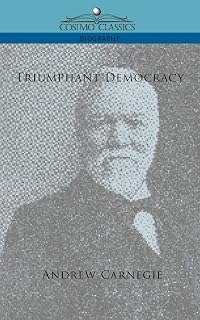
Triumphant Democracy
by Andrew Carnegie
On This Page
Description
The influence of free and universal education, together with that of political institutions which at every point inculcate self-respect and stimulate ambition, must be accorded much weight in keeping the Republic the freest of all civilized nations from pauperism and crime. -from "Pauperism and Crime" Subtitled "Fifty Years' March of the Republic," this is steel tycoon Andrew Carnegie's love letter to America, first published in 1886, an impassioned celebration of the American success story, show more and a call for other nations to follow in America's footsteps. Through simple, direct discussions of the nature of the American character and her jobs and education, religion, industry, art and literature, foreign affairs, and more, Carnegie sets out a case for a brand of conservative democracy for the world to emulate. Ironies aside-the United States of today is no longer the nation Carnegie was extolling-this is a stirring portrait of an America of the past... and one that could be again. Also available from Cosimo Classics: Carnegie's An American Four-in-Hand in Britain, Round the World, and Autobiography. Entrepreneur and philanthropist ANDREW CARNEGIE (1835-1919) was born in Scotland and emigrated to America as a teenager. His Carnegie Steel Company launched the steel industry in Pittsburgh, and after its sale to J.P. Morgan, he devoted his life to philanthropic causes. His charitable organizations built more than 2,500 public libraries around the world, and gave away more than $350 million during his lifetime. show lessTags
Members
- Recently Added By
Author Information

40+ Works 707 Members
Andrew Carnegie was a nineteenth-century steel tycoon who became one of the twentieth century's most famous philanthropists. His life story is a rags-to-riches account matched by few in United States history. After his retirement he became a philanthropist who donated hundreds of millions of dollars and created more than 20 organizations dedicated show more to improving the human condition. He also created Carnegie Corporation of New York, endowing it with the largest single philanthropic trust ever established up to that time in order to support benefactions after his death. He died in 1919 at Shadowbrook, his estate in the Berkshire Hills of Massachusetts. show less
Classifications
Statistics
- Members
- 11
- Popularity
- 1,777,984
- Languages
- English
- Media
- Paper
- ISBNs
- 7