Rich Like Them: My Door-to-Door Search for the Secrets of Wealth in America's Richest Neighborhoods
by Ryan D'Agostino
On This Page
Description
Ryan D'Agostino wanted to know how the extremely wealthy in America got that way. So he asked. Knocking on 500 doors in twenty neighborhoods in the most affluent ZIP codes in America, D'Agostino met with fifty regular (but very rich) men and women who welcomed him in and shared some of their most difficult financial decisions, toughest setbacks, greatest strategies, most triumphant moments, and deepest insights into what it means to have money. D'Agostino covers a range of businesses, from show more real estate, flower selling, and credit card processing to art dealing, advertising, and even bookselling, gleaning lessons from which everyone can benefit.In Rich Like Them, D'Agostino weaves together what he learned and organizes the text with maxims for achieving wealth, including "Never let pride get in the way of profit" and "When you fail miserably, rejoice." Filled with inspiring stories and straight-up advice, Rich Like Them is a lively and practical get-rich guide that any reader can follow. show lessTags
Recommendations

Member Reviews
Rich Like Them is not a self-help book, unless you're securely placed in upper-middle class or higher, and are financially secure. In the author's door-to-door search to find the secrets of wealth is America (paraphrase of the subtitle), the true secret is "already be wealthy."
Of 500 houses in several cities across the top 100 richest zip codes, D'Agostino went door to door knocking/ringing doorbells to find out the secrets to everybody's wealth. He managed to snag 50 interviews.
While I respect the goal of the book, the execution of it was flawed. About a third of the advice on making it big would appeal to many of the readers of the book.
The people who made it big in this book were either already wealthy, married into wealth, started a show more business appealing to the wealthy, were from wealthy families, or made continual sacrifices to their families to get wealthy, by either burning the midnight oil ("Hey, it's Uncle Dad!"), or by continually relocating a family to keep getting better and better homes and by making a killing off the previous one. Oh, or you could work hard your entire life, scrimping and saving so that you could live luxuriously in your golden years (and by then, could you really enjoy it? What's the point of having an Olympic-sized swimming pool if all you can do is wade in the shallow end because of your arthritis?).
Sure, there were some innovators, like the author's friend who revolutionized the credit card/shop interface, but it seemed everybody else put everything in their lives to the side except for success (granted, a better goal than money), and all we see is the good: their giant house with a wonderful view of some body of water, but we don't see their neglected families (well, one of the guys, we see, doesn't have any furniture in his multi-million dollar home).
An interesting book if you liked the show Lifestyles of the Rich and Famous, or Cribs, but not really any more helpful than listening to the financial talk radio shows on the AM ("act your wage" and so forth). About the only thing it brings to the table is to be a risk taker. Here, though, "risk" is a carefully calculated thing that would put you in the poor house if it fails.
Additionally, the author spends as much time interpolating his own agenda on getting rich as he does listening to the rich talk about their methods of getting rich. Oh, and he sickeningly describes every single overpriced meal he has and every lush hotel he visits as he does this project.
All in all, I wouldn't recommend this book unless you have loads of money lying around and would like some tips on how to invest it. Unless you're prepared to sacrifice and work really hard, this book will give you nothing more than a little warmth on the inside. That warmth is called "heartburn." show less
Of 500 houses in several cities across the top 100 richest zip codes, D'Agostino went door to door knocking/ringing doorbells to find out the secrets to everybody's wealth. He managed to snag 50 interviews.
While I respect the goal of the book, the execution of it was flawed. About a third of the advice on making it big would appeal to many of the readers of the book.
The people who made it big in this book were either already wealthy, married into wealth, started a show more business appealing to the wealthy, were from wealthy families, or made continual sacrifices to their families to get wealthy, by either burning the midnight oil ("Hey, it's Uncle Dad!"), or by continually relocating a family to keep getting better and better homes and by making a killing off the previous one. Oh, or you could work hard your entire life, scrimping and saving so that you could live luxuriously in your golden years (and by then, could you really enjoy it? What's the point of having an Olympic-sized swimming pool if all you can do is wade in the shallow end because of your arthritis?).
Sure, there were some innovators, like the author's friend who revolutionized the credit card/shop interface, but it seemed everybody else put everything in their lives to the side except for success (granted, a better goal than money), and all we see is the good: their giant house with a wonderful view of some body of water, but we don't see their neglected families (well, one of the guys, we see, doesn't have any furniture in his multi-million dollar home).
An interesting book if you liked the show Lifestyles of the Rich and Famous, or Cribs, but not really any more helpful than listening to the financial talk radio shows on the AM ("act your wage" and so forth). About the only thing it brings to the table is to be a risk taker. Here, though, "risk" is a carefully calculated thing that would put you in the poor house if it fails.
Additionally, the author spends as much time interpolating his own agenda on getting rich as he does listening to the rich talk about their methods of getting rich. Oh, and he sickeningly describes every single overpriced meal he has and every lush hotel he visits as he does this project.
All in all, I wouldn't recommend this book unless you have loads of money lying around and would like some tips on how to invest it. Unless you're prepared to sacrifice and work really hard, this book will give you nothing more than a little warmth on the inside. That warmth is called "heartburn." show less
 This review was written for LibraryThing Early Reviewers.
I'll be honest: I'm not quite sure what to think of this book. The premise is interesting enough -- the author went door to door in some of the country's richest neighborhoods and got at least 50 of these rich folks to tell him the secret of their success in life. The book then provides brief anecdotes describing some sketchy details of these people's lives and careers and how they got to live in fancy homes.
The book's "wisdom" culled from these interviews is then offered in a general way as some things that anyone could theoretically do to also achieve financial success. The devil, as always, is in the details: how exactly can the average (presumably middle class) reader translate these vague platitudes into specific actions that will show more lead them down a path to financial success? Ah, therein lies the rub. I've just read the book and I still have no idea how to do that. As a sample: you should be willing to take risks to get ahead, but you should do your homework and know as much about what you're gambling on to minimize that risk. Well, duh.
I also question the applicability of many of these folks' experiences. Many of them married into a wealthy family or had high-paying jobs I don't have and don't want to have (physician, lawyer, high-end IT consultant, etc.). At least some began with considerably more capital than most of us have at our disposal. And many others made their fortunes through real estate investment. While I admit that real estate has been the best investment I ever made, I also acknowledge that I got in and got out at just the right time. I now wonder how many of the people who D'Agostino interviewed would recommend real estate investment in today's market? The book's premise was specifically about how people ended up in their fancy homes, so the focus was clearly on the acquisition of material wealth, but I do wonder how many of the interviewees have great family and home life. I can't imagine that it's easy being married to someone who has spent decades slaving away at the office twelve+ hours a day or who spends all evening working on additional work-related tasks, as many of the interviewees have. While D'Agostino never addresses the issue, I certainly got the impression that financial success must often come at a cost.
In a way, I'm being unkind here, because the author is an engaging writer and the book is a quick read, I just don't feel like I got much out of it. It's the stereotypical "Chinese food" book: I read it an hour ago and I'm already hungry for more. All in all, the book's content and value are thin. I didn't get much out of the book -- other than a very mild sense of inspiration which, let's be honest, will quickly fade -- but I also don't regret the couple hours I spent reading it because the author has a charming tone.
I'd have rated the book at least a half star higher if it had contained a final chapter that at least attempted to synthesize the book's findings and assemble them into some useful lessons learned for the average reader. Without that, all the book really offers are some mildly interesting anecdotes about rich people and their job histories.
Review copyright 2009 J. Andrew Byers show less
The book's "wisdom" culled from these interviews is then offered in a general way as some things that anyone could theoretically do to also achieve financial success. The devil, as always, is in the details: how exactly can the average (presumably middle class) reader translate these vague platitudes into specific actions that will show more lead them down a path to financial success? Ah, therein lies the rub. I've just read the book and I still have no idea how to do that. As a sample: you should be willing to take risks to get ahead, but you should do your homework and know as much about what you're gambling on to minimize that risk. Well, duh.
I also question the applicability of many of these folks' experiences. Many of them married into a wealthy family or had high-paying jobs I don't have and don't want to have (physician, lawyer, high-end IT consultant, etc.). At least some began with considerably more capital than most of us have at our disposal. And many others made their fortunes through real estate investment. While I admit that real estate has been the best investment I ever made, I also acknowledge that I got in and got out at just the right time. I now wonder how many of the people who D'Agostino interviewed would recommend real estate investment in today's market? The book's premise was specifically about how people ended up in their fancy homes, so the focus was clearly on the acquisition of material wealth, but I do wonder how many of the interviewees have great family and home life. I can't imagine that it's easy being married to someone who has spent decades slaving away at the office twelve+ hours a day or who spends all evening working on additional work-related tasks, as many of the interviewees have. While D'Agostino never addresses the issue, I certainly got the impression that financial success must often come at a cost.
In a way, I'm being unkind here, because the author is an engaging writer and the book is a quick read, I just don't feel like I got much out of it. It's the stereotypical "Chinese food" book: I read it an hour ago and I'm already hungry for more. All in all, the book's content and value are thin. I didn't get much out of the book -- other than a very mild sense of inspiration which, let's be honest, will quickly fade -- but I also don't regret the couple hours I spent reading it because the author has a charming tone.
I'd have rated the book at least a half star higher if it had contained a final chapter that at least attempted to synthesize the book's findings and assemble them into some useful lessons learned for the average reader. Without that, all the book really offers are some mildly interesting anecdotes about rich people and their job histories.
Review copyright 2009 J. Andrew Byers show less
This review was written for LibraryThing Early Reviewers.This is an interesting book. It's basically a collection of interviews with rich people, gathered by a guy who went door to door in the richest neighborhoods in the US, knocking on doors and asking people their secrets. He broke down what he learned into five basic lessons, each with its own chapter: open your eyes, luck doesn't exist, the economics of obsession, the myth of risk, and humility. I liked it, but mostly what I got out of it is that I probably don't have enough drive at the right things to make it rich. You have to get really, really obsessed to make a lot of money, and the things I'm obsessed with aren't things that pay. That was a useful lesson, though -- I'd rather stick to the things I love and work at an ok job to show more support my hobbies than try to find something I love that will pay and do it 70 hours a week. I just don't want to be rich badly enough. And that's ok. show less
This review was written for LibraryThing Early Reviewers.For someone who doesn’t work in a very lucrative field (I work as a librarian), I have a high interest in personal finance. I read Money magazine, never miss an episode of the Suze Orman show, and budget to the penny. So I thought that this book, Rich Like Them, looked really interesting. The author, Ryan D’Agostino, decided to travel to some of the neighborhoods in the 100 richest zip codes in the U.S., knock on the doors of impressive homes, and ask how the owners managed to acquired such riches. Amazingly, people actually talked to him, among them an actor turned rare book store owner, a produce distributor who traded up his homes until he found himself in Beverly Hills, and a hefty spattering of CEO’s and entrepreneurs. The show more advice the home owners gave was not very earth shattering, but still good advice.
As I was reading it, I started to feel inspired – but I also started to feel dissatisfied. Suddenly my pretty, safe neighborhood seemed shabby and pedestrian; my career non-impressive and its salary slightly pathetic. Dissatisfaction can be a great motivator, and if it works for you, then buy this book. Maybe you’ll become rich like them. But I’m going to keep budgeting and watching Suze.
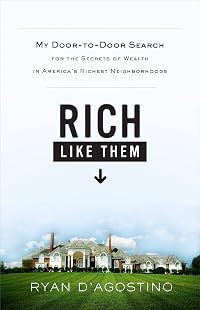
Interesting tidbit - the house on the cover is the same house on the cover of another book in my library - Present Value by Sabin Willett show less
As I was reading it, I started to feel inspired – but I also started to feel dissatisfied. Suddenly my pretty, safe neighborhood seemed shabby and pedestrian; my career non-impressive and its salary slightly pathetic. Dissatisfaction can be a great motivator, and if it works for you, then buy this book. Maybe you’ll become rich like them. But I’m going to keep budgeting and watching Suze.
Interesting tidbit - the house on the cover is the same house on the cover of another book in my library - Present Value by Sabin Willett show less
This review was written for LibraryThing Early Reviewers.D'Agostino's premise is solid and instantly relatable - to visit those that actually live in the houses we pass in wealthy neighborhoods and to simply ask them how they got there. So he looked up neighborhoods in the 100 wealthiest zip codes, threw in three neighborhoods for good measure and went knocking on doors.
From there, the book is probably woefully mis-titled. This is actually not a book on getting wealthy per se. If anything, this is a book on the mindset and characteristics most of these individuals shared. It is a fast read, and if you approach it asking yourself, "how should I be thinking?" this is a decent start.
Notably, D'Agostino heavily quotes and goes back to Carol Dweck and Jason Zweig's works to bolster the nuggets he show more was able to gather from interviews. At times, this can feel as if he read Dweck's work on having an open-mindset mentality and Zweig's on how your brain and money interact and he merely looked to connect the dots. Then again, this was how a number of the individuals managed to make their money - not by any earth-shattering revolutionary invention or innovation - but by merely connecting dots.
The other frustration that can easily arise from this book is that there's nothing "ah-ha!" to be had in the advice you get. In fact, it's actually not at all about making money - the vast majority were never in this to make money. Most of them just wanted to be happy in what they did. Yes, these are folks that sometimes come from money, which can seem like a cheat until you realize that most are all to aware of the ease of losing easy money. The number of individuals that made money from real estate is almost unnerving with the current state of the market, but one can't help but wonder if his interviewees are the types that knew which way to head when everything started to turn. Then there's the obsession and seemingly singular-focus that can seem like a "lack of fun" until you realize that this is fun for them. Yes, ophthalmology can seem like an odd thing to obsess over, but if your passion can net you a successful career, why not? (Everyone who is a book lover should note one of his 90210 interviews involved a used book dealer who found a way to combine his love of books and movies, so it's not all medical school.) In all of this, it can seem like you're being told, "go, obsess on something and come from money you don't have to get wealthy" if you're not interested in much of what these folks do for a living. But what they do isn't the point...it's all in the attitude and caring about what drives you.
For those not looking to strike out on their own, there's still plenty to take for application in general day-to-day business. This is perhaps where D'Agostino missed out - in concentrating so much on the entrepreneurial aspect of his subjects and their success, the fact that so much of this could be applied to improving your existing career is harder to unearth (but it's there). show less
From there, the book is probably woefully mis-titled. This is actually not a book on getting wealthy per se. If anything, this is a book on the mindset and characteristics most of these individuals shared. It is a fast read, and if you approach it asking yourself, "how should I be thinking?" this is a decent start.
Notably, D'Agostino heavily quotes and goes back to Carol Dweck and Jason Zweig's works to bolster the nuggets he show more was able to gather from interviews. At times, this can feel as if he read Dweck's work on having an open-mindset mentality and Zweig's on how your brain and money interact and he merely looked to connect the dots. Then again, this was how a number of the individuals managed to make their money - not by any earth-shattering revolutionary invention or innovation - but by merely connecting dots.
The other frustration that can easily arise from this book is that there's nothing "ah-ha!" to be had in the advice you get. In fact, it's actually not at all about making money - the vast majority were never in this to make money. Most of them just wanted to be happy in what they did. Yes, these are folks that sometimes come from money, which can seem like a cheat until you realize that most are all to aware of the ease of losing easy money. The number of individuals that made money from real estate is almost unnerving with the current state of the market, but one can't help but wonder if his interviewees are the types that knew which way to head when everything started to turn. Then there's the obsession and seemingly singular-focus that can seem like a "lack of fun" until you realize that this is fun for them. Yes, ophthalmology can seem like an odd thing to obsess over, but if your passion can net you a successful career, why not? (Everyone who is a book lover should note one of his 90210 interviews involved a used book dealer who found a way to combine his love of books and movies, so it's not all medical school.) In all of this, it can seem like you're being told, "go, obsess on something and come from money you don't have to get wealthy" if you're not interested in much of what these folks do for a living. But what they do isn't the point...it's all in the attitude and caring about what drives you.
For those not looking to strike out on their own, there's still plenty to take for application in general day-to-day business. This is perhaps where D'Agostino missed out - in concentrating so much on the entrepreneurial aspect of his subjects and their success, the fact that so much of this could be applied to improving your existing career is harder to unearth (but it's there). show less
This review was written for LibraryThing Early Reviewers.I had to wait a bit after I finished "Rich Like Them" by Ryan D'Agostino to get my thoughts together. I was surprised by how different the book was from the ideas I got after after reading the cover blurbs. One of my pet peeves is a book that is very different from the information provided to pique my interest in reading. This book is NOT a how-to guide. When the front cover says "...the Secrets of Wealth in America's Richest Neighborhoods", I had no idea I was going to get a series of advice articles. But that's how I think of the book now.
The author's idea was to isolate the wealthiest zip codes and then just go door-to-door asking to speak to the owners. Now that takes some cojones! But amazingly enough, he was successful about ten show more percent of the time and this book is his recounting of the advice he was given by those living the 'high life'. These aren't movie stars...they are (mostly) normal folks who earned their money (although a few did inherit). They view opportunity a bit differently and aren't afraid of risk or hard work. They were also (mostly) quite down to earth in terms of day-to-day living and seemed surprisingly willing to talk to a stranger who showed up on their doorstep...who knew?
So if you're looking for a book that will give you a step-by-step primer on how to get rich...don't look here. But if you're looking for a book that will help you adjust your thinking and learn the work habits and ethics of the uber-wealthy...then this might be the book for you. show less
The author's idea was to isolate the wealthiest zip codes and then just go door-to-door asking to speak to the owners. Now that takes some cojones! But amazingly enough, he was successful about ten show more percent of the time and this book is his recounting of the advice he was given by those living the 'high life'. These aren't movie stars...they are (mostly) normal folks who earned their money (although a few did inherit). They view opportunity a bit differently and aren't afraid of risk or hard work. They were also (mostly) quite down to earth in terms of day-to-day living and seemed surprisingly willing to talk to a stranger who showed up on their doorstep...who knew?
So if you're looking for a book that will give you a step-by-step primer on how to get rich...don't look here. But if you're looking for a book that will help you adjust your thinking and learn the work habits and ethics of the uber-wealthy...then this might be the book for you. show less
This review was written for LibraryThing Early Reviewers.I'm a big fan of Dave Ramsey--I've used his advice to really get a handle on my family's finances. One of the things he recommends for people who want to build wealth is to talk to wealthy people and find out what their attitude toward money is. This seems to be good advice, and, according to Dave, it is advice that he followed when he went bankrupt years ago and was starting over again. I read D'Agostino's book with Ramsey's advice in the back of my mind. On the surface, it seems that was what D'Agostino was doing: finding rich people and pumping them for information about how they got rich.
I have to admit that I was a little disappointed in his results. D'Agostino spent a great deal of time going from door-to-door in some of the show more wealthiest neighborhoods in the country, hoping to be able to talk to the people who lived in these fabulous homes in these fabulous neighborhoods and ask ho they got there. Basically, what he got was a lot of personal stories that he tried to boil down to simple lessons for those of us who want to live in these neighborhoods. These lessons include basic advice such as "keep your eyes open", and "work hard to make your own luck." Things I already knew (o at least suspected).
What D'Agostino doesn't stress, however, and this seems to be true of nearly every story, is that you have to start with some money. No one started out flat broke--they moved from a position where they were making a lot of money to where they were making a whole lot of money. For the average middle-class wage earner, there is no path to fabulous wealth that doesn't include winning the lotto or borrowing lots of money.
It is interesting that this book came out just as the stock market and real estate markets were heading down the toilet. I would like to see a follow up on these wealthy people, and see how they are weathering the current economic downturn.
D'Agostino's style makes Rich Like Them a riveting story--it truly is fascinating hearing his tale of traveling an knocking on doors, and the people he meets are worth reading about--I'm not sure I would recommend this book to someone wanting information how to get rich like them. show less
I have to admit that I was a little disappointed in his results. D'Agostino spent a great deal of time going from door-to-door in some of the show more wealthiest neighborhoods in the country, hoping to be able to talk to the people who lived in these fabulous homes in these fabulous neighborhoods and ask ho they got there. Basically, what he got was a lot of personal stories that he tried to boil down to simple lessons for those of us who want to live in these neighborhoods. These lessons include basic advice such as "keep your eyes open", and "work hard to make your own luck." Things I already knew (o at least suspected).
What D'Agostino doesn't stress, however, and this seems to be true of nearly every story, is that you have to start with some money. No one started out flat broke--they moved from a position where they were making a lot of money to where they were making a whole lot of money. For the average middle-class wage earner, there is no path to fabulous wealth that doesn't include winning the lotto or borrowing lots of money.
It is interesting that this book came out just as the stock market and real estate markets were heading down the toilet. I would like to see a follow up on these wealthy people, and see how they are weathering the current economic downturn.
D'Agostino's style makes Rich Like Them a riveting story--it truly is fascinating hearing his tale of traveling an knocking on doors, and the people he meets are worth reading about--I'm not sure I would recommend this book to someone wanting information how to get rich like them. show less
This review was written for LibraryThing Early Reviewers.Members
- Recently Added By
Published Reviews
ThingScore 75
The book is also very much about D'Agostino and all the (mis)adventures he had along his journey, which makes the book a funny read.
added by stephmo
Lists

Books Read in 2009
464 works; 11 members
Author Information
16 Works 300 Members
Common Knowledge
- Canonical title
- Rich Like Them: My Door-to-Door Search for the Secrets of Wealth in America's Richest Neighborhoods
- Original publication date
- 2009-01-05
- People/Characters
- Ryan D'Agostino; Arthur Tauck; Bob Grosnoff; Rena Holman; Heidi Roizen; Rich Miletic (show all 41); Carole Reichhelm; Mark Banta; Harvey Jason; Roxy Stutzman; Sohail Anjum; Bob Grosnoff; Mimi Johnson; Scott Zdanis; Frank Heurich; Edith Caldwell; David Frederickson; Ruth Frederickson; Art Dwyer; Helen Layton; Charles Marsala; Dave Dolinger; Harland Young; Robin Schachat; Jeff Weisfeld; Nadine Weisfeld; Ron Irvine; Rich Miletic; Vivek Ranadivé; Joseph Gorman; Mary Hulitar; Jerry Turbett; Richard Sander; Marilyn Fite; Ted Kaplan; Don Cook; Gary Munch; Liz Munch; Mike Amerson; Peter Greisinger; Joanne Greisinger
- Important places
- Atherton, California, USA; Austin, Texas, USA; Bedford, New York, USA; Beverly Hills, California, USA; Briarcliff Manor, New York, USA; Chappaqua, New York, USA (show all 19); Gates Mills, Ohio, USA; Lake Forest, Illinois, USA; Las Vegas, Nevada, USA; Medina, Washington, USA; New York, New York, USA; Pacific Palisades, Los Angeles, California, USA; Palm Beach, Florida, USA; Paradise Valley, Arizona, USA; Sandy Springs, Georgia, USA; Sausalito, California, USA; Seattle, Washington, USA; Shaker Heights, Ohio, USA; Westport, Connecticut, USA
- Dedication
- For Sarah
- First words
- The woman stared at me, eyebrows raised, waiting. (Introduction)
Awe, then confusion, then elation. - Last words
- (Click to show. Warning: May contain spoilers.)And they've had too many good ideas, worked too hard, and taken enough risks to ever let complacency get in the way of their success and happiness.
- Blurbers
- Jacobs, A.J.; Chatzky, Jean; Frankel, Lois P.
- Original language
- English
Classifications
Statistics
- Members
- 94
- Popularity
- 342,861
- Reviews
- 14
- Rating
- (3.07)
- Languages
- English
- Media
- Paper, Audiobook, Ebook
- ISBNs
- 6
- ASINs
- 1