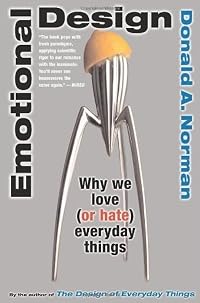
Emotional Design: Why We Love (or Hate) Everyday Things
by Donald A. Norman
On This Page
Description
Why attractive things work better and other crucial insights into human-centered design. Emotions are inseparable from how we humans think, choose, and act. In Emotional Design, cognitive scientist Don Norman shows how the principles of human psychology apply to the invention and design of new technologies and products. In "The Design of Everyday Things", Norman made the definitive case for human-centered design, showing that good design demanded that the user's must take precedence over a show more designer's aesthetic if anything, from light switches to airplanes, was going to work as the user needed. In this book, he takes his thinking several steps farther, showing that successful design must incorporate not just what users need, but must address our minds by attending to our visceral reactions, to our behavioral choices, and to the stories we want the things in our lives to tell others about ourselves. Good human-centered design isn't just about making effective tools that are straightforward to use; it's about making affective tools that mesh well with our emotions and help us express our identities and support our social lives. From roller coasters to robots, sports cars to smart phones, attractive things work better. Whether designer or consumer, user or inventor, this book is the definitive guide to making Norman's insights work for you. show lessTags
Recommendations












Member Reviews
This book was interesting but disappointing.
The first half was a fascinating addendum to The Design of Everyday Things. This part of the book talked about the role of emotions in design and usability. Things that are more pleasurable to use are easier to use than something with the same basic design that is not a pleasure to use. The psychological basis for this claim is that when people are enjoying what they are using, they can take a more creative view at any problems they encounter during the interaction. Furthermore, when you enjoy using something, you may be more willing to forgive problems. Delightful design cannot rescue an unusable design, but all else being equal, the delightful design will seem easier to use and cause show more greater attachment.
Another reason that emotion is important in design is that users' relationships to objects are built on more than just the perceived usability and pleasure in using the items. Emotion is important because it taps into higher level human concerns such as image and status.
The second part of the book felt out of place. It discussed robots and why they need to have some equivalent of emotions. The discussion was interesting, but it did not seem to really fit with the description given by the title ("why we love (or hate) everyday things). It felt like the second part of the book was bolted on because the first part was not long enough to be a book on its own. Because it went so contrary to my expectations for the rest of the book, I just could not enjoy it, even though it may have been interesting on its own.
Overall, I would say that the first first of the book should be considered required reading if you have read The Design of Everyday Things. The second half you can take or leave depending on how interested you are in robots. show less
The first half was a fascinating addendum to The Design of Everyday Things. This part of the book talked about the role of emotions in design and usability. Things that are more pleasurable to use are easier to use than something with the same basic design that is not a pleasure to use. The psychological basis for this claim is that when people are enjoying what they are using, they can take a more creative view at any problems they encounter during the interaction. Furthermore, when you enjoy using something, you may be more willing to forgive problems. Delightful design cannot rescue an unusable design, but all else being equal, the delightful design will seem easier to use and cause show more greater attachment.
Another reason that emotion is important in design is that users' relationships to objects are built on more than just the perceived usability and pleasure in using the items. Emotion is important because it taps into higher level human concerns such as image and status.
The second part of the book felt out of place. It discussed robots and why they need to have some equivalent of emotions. The discussion was interesting, but it did not seem to really fit with the description given by the title ("why we love (or hate) everyday things). It felt like the second part of the book was bolted on because the first part was not long enough to be a book on its own. Because it went so contrary to my expectations for the rest of the book, I just could not enjoy it, even though it may have been interesting on its own.
Overall, I would say that the first first of the book should be considered required reading if you have read The Design of Everyday Things. The second half you can take or leave depending on how interested you are in robots. show less
Interesting thoughts and meanderings, but less concrete or cohesive than The Design of Everyday Things.
Norman's title asks an interesting question. Why do we love or hate things? Unfortunately, the book does not even hint at answering that question.
Instead, the author painfully rambles on topics well beyond his expertise (text messages, console games, ...). Norman rediscovers the basic facts of marketing and reiterates its tired textbook examples. Only pointy-haired bosses will be enlightened. Why did I not like this book? Because it promised expertise but contained pomposity and banalities.
Your time is better spent (re-)reading Norman's classic The Design of Everyday Things.
Instead, the author painfully rambles on topics well beyond his expertise (text messages, console games, ...). Norman rediscovers the basic facts of marketing and reiterates its tired textbook examples. Only pointy-haired bosses will be enlightened. Why did I not like this book? Because it promised expertise but contained pomposity and banalities.
Your time is better spent (re-)reading Norman's classic The Design of Everyday Things.
In the epilogue of this book, Don Norman expresses his gratitude to a myriad of people who helped him organize many years worth of disparate notes into a cohesive book. For me, ‘Emotional Design’ remained rather disconnected. Not in an altogether bad way, the book reads like the (slightly rambling) classroom lecture from a venerable guru …with the reader left to pull it all together.
Norman offers an illuminating model - distinguishing between 3 layers of design: visceral, behavioral and reflective - to understand why people like the objects they do. And like ‘Design of Everyday Things’ he explores this model with numerous fun and apropos examples. But soon the book wanders from discussion of this cognitive model to pondering show more on the future of design.
According to Norman this future will be marked by our increased dependence on smart robots in every facet of life, where the more we grow to depend on these servants of our own making – functionally and emotionally - the more the line between man and robot will become less and less clear. All this talk of material stuff and robotic servitude makes ‘Emotional Design’ a testament to American consumerism and I was moderately disappointed by the lack of freshness here.
A worthwhile read from the man who brought us ‘The Design of Everyday Things’, but ultimately one that falls in the category of ‘plane book’. That is, the type of book I read on a plane because I know I’ll have no other escape. show less
Norman offers an illuminating model - distinguishing between 3 layers of design: visceral, behavioral and reflective - to understand why people like the objects they do. And like ‘Design of Everyday Things’ he explores this model with numerous fun and apropos examples. But soon the book wanders from discussion of this cognitive model to pondering show more on the future of design.
According to Norman this future will be marked by our increased dependence on smart robots in every facet of life, where the more we grow to depend on these servants of our own making – functionally and emotionally - the more the line between man and robot will become less and less clear. All this talk of material stuff and robotic servitude makes ‘Emotional Design’ a testament to American consumerism and I was moderately disappointed by the lack of freshness here.
A worthwhile read from the man who brought us ‘The Design of Everyday Things’, but ultimately one that falls in the category of ‘plane book’. That is, the type of book I read on a plane because I know I’ll have no other escape. show less
This book, a follow up from Norman's earlier work 'The Design of Everyday Things' talks about why some unusable things are well loved despite our frustrations -- because in some way they manage to inspire warm feelings. Normal again illustrates with examples of things that have a wow factor but are completely unusable, and with examples of functional-but-dull things.
Most of this book is excellent, but the three chapters where Norman speculates about how robots having emotion is going to change the world really didn't interest me; unless you are especially interested in artificial intelligence, robots and robot theory, I recommend skipping those chapters.
Most of this book is excellent, but the three chapters where Norman speculates about how robots having emotion is going to change the world really didn't interest me; unless you are especially interested in artificial intelligence, robots and robot theory, I recommend skipping those chapters.
Serious waste of my time. I did love The Design of Everyday Things though, but generally do not like these practical books. They always seem to have a few pages of useful information that are then expanded to fill the book. Emotional Design does not have exactly the same problem. Instead, there is only one line of information, then a lot of small useless stories and ideas. In some ways that is better, but either way is not worth my time.
Here is what you need to know:
There are three levels of design: visceral (objective look), behavioral (touch and performance), and reflective (thoughts or feelings).
Here is what you need to know:
There are three levels of design: visceral (objective look), behavioral (touch and performance), and reflective (thoughts or feelings).
Norman is perhaps best known for his 1988 book The psychology of everyday things (later republished as The design of everyday things) in which he lays out a cognitive science foundation for understanding usability. Since then, he has been a prolific and much appreciated contributor to the field of HCI. In this book, the aim is to go beyond ease-of-use and fitness-for-purpose based on recent developments in cognitive science on the role of affect and emotion. Norman outlines three levels of human processing in the first chapter: the visceral, the behavioral and the reflective. The main part of the book is then a rather introductory discussion of themes that follow from the new theoretical foundations, including branding, sensuous feel, show more fun and pleasure, games, storytelling and social communication. The themes are not exactly news to the design world, but the book may serve as a useful introduction to readers with a background in HCI. show less
Members
- Recently Added By
Author Information

20 Works 7,952 Members
Donald A. Norman is professor of computer science and psychology at Northwestern University and co-founder of the Nielsen Norman Group, a consulting firm that promotes human-centered products and services.
Common Knowledge
Classifications
- Genres
- Art & Design, Nonfiction, General Nonfiction, Technology
- DDC/MDS
- 745.2019 — Arts & recreation Drawing & decorative arts Decorations & Handicrafts / Calligraphy Industrial Design Philosophy And Psychology
- LCC
- BF531 .N67 — Philosophy, Psychology and Religion Psychology Psychology Affection. Feeling. Emotion
- BISAC
Statistics
- Members
- 1,219
- Popularity
- 20,347
- Reviews
- 16
- Rating
- (3.59)
- Languages
- 6 — English, French, Italian, Japanese, Portuguese, Spanish
- Media
- Paper, Audiobook, Ebook
- ISBNs
- 11
- ASINs
- 4