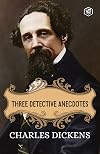
Three Detective Anecdotes
by Charles Dickens
On This Page
Description
Three Detective Anecdotes is a short story by Charles Dickens.Charles John Huffam Dickens (7 February 1812 - 9 June 1870) was an English writer and social critic. He created some of the world's best-known fictional characters and is regarded by many as the greatest novelist of the Victorian era. His works enjoyed unprecedented popularity during his lifetime, and by the twentieth century critics and scholars had recognised him as a literary genius. His novels and short stories enjoy lasting show more popularity.Born in Portsmouth, Dickens left school to work in a factory when his father was incarcerated in a debtors' prison. Despite his lack of formal education, he edited a weekly journal for 20 years, wrote 15 novels, five novellas, hundreds of short stories and non-fiction articles, lectured and performed extensively, was an indefatigable letter writer, and campaigned vigorously for children's rights, education, and other social reforms.Dickens's literary success began with the 1836 serial publication of The Pickwick Papers. Within a few years he had become an international literary celebrity, famous for his humour, satire, and keen observation of character and society. His novels, most published in monthly or weekly instalments, pioneered the serial publication of narrative fiction, which became the dominant Victorian mode for novel publication. The instalment format allowed Dickens to evaluate his audience's reaction, and he often modified his plot and character development based on such feedback. For example, when his wife's chiropodist expressed distress at the way Miss Mowcher in David Copperfield seemed to reflect her disabilities, Dickens improved the character with positive features. His plots were carefully constructed, and he often wove elements from topical events into his narratives. Masses of the illiterate poor chipped in ha'pennies to have each new monthly episode read to them, opening up and inspiring a new class of readers.Dickens was regarded as the literary colossus of his age. His 1843 novella, A Christmas Carol, remains popular and continues to inspire adaptations in every artistic genre. Oliver Twist and Great Expectations are also frequently adapted, and, like many of his novels, evoke images of early Victorian London. His 1859 novel, A Tale of Two Cities, set in London and Paris, is his best-known work of historical fiction. Dickens's creative genius has been praised by fellow writers-from Leo Tolstoy to George Orwell and G. K. Chesterton-for its realism, comedy, prose style, unique characterisations, and social criticism. On the other hand, Oscar Wilde, Henry James, and Virginia Woolf complained of a lack of psychological depth, loose writing, and a vein of saccharine sentimentalism. The term Dickensian is used to describe something that is reminiscent of Dickens and his writings, such as poor social conditions or comically repulsive characters. show lessTags
Member Reviews
Three detective stories that appeared in Charles Dickens' periodical Household Words. Dickens wrote these pieces to try to influence the public feeling toward the newly established Metropolitan Police. The Three Detective Anecdotes, consisted of The Pair of Gloves, The Artful Touch and The Sofa; referred to by Dickens as “conversation starters”. Clearly, Dickens’ intent with these tales is to establish his own respect and support of the newly established Criminal Investigation Department of Scotland Yard. His writings are credited with helping to secure a more favorable public opinion of the police, and altering the overall public concept of the police from one of general suspicion to one of helpfulness and heroism.
Maybe I just got lost somewhere but I just didn't get this one
Members
- Recently Added By
Author Information

2,578+ Works 313,139 Members
Charles Dickens, perhaps the best British novelist of the Victorian era, was born in Portsmouth, Hampshire, England on February 7, 1812. His happy early childhood was interrupted when his father was sent to debtors' prison, and young Dickens had to go to work in a factory at age twelve. Later, he took jobs as an office boy and journalist before show more publishing essays and stories in the 1830s. His first novel, The Pickwick Papers, made him a famous and popular author at the age of twenty-five. Subsequent works were published serially in periodicals and cemented his reputation as a master of colorful characterization, and as a harsh critic of social evils and corrupt institutions. His many books include Oliver Twist, David Copperfield, Bleak House, Great Expectations, Little Dorrit, A Christmas Carol, and A Tale of Two Cities. Dickens married Catherine Hogarth in 1836, and the couple had nine children before separating in 1858 when he began a long affair with Ellen Ternan, a young actress. Despite the scandal, Dickens remained a public figure, appearing often to read his fiction. He died in 1870, leaving his final novel, The Mystery of Edwin Drood, unfinished. (Bowker Author Biography) show less
Work Relationships
Classifications
- Genres
- General Fiction, Fantasy, Fiction and Literature
- BISAC
Statistics
- Members
- 4
- Popularity
- 3,962,846
- Reviews
- 2
- Rating
- (2.50)
- Languages
- English
- Media
- Paper, Ebook
- ISBNs
- 1
- ASINs
- 1