On This Page
Description
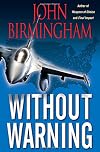
BONUS: This edition contains an excerpt from John Birmingham's After America.In Kuwait, American forces are locked and loaded for the invasion of Iraq. In Paris, a covert agent is close to cracking a terrorist cell. And just north of the equator, a sailboat manned by a drug runner and a pirate is witness to the unspeakable. In one instant, all around the world, everything will change. A wave of inexplicable energy slams into the continental United States. America as we know it vanishes. show more From a Texas lawyer who happens to be in the right place at the right time to an engineer in Seattle who becomes his city's only hope, from a combat journalist trapped in the Middle East to a drug runner off the Mexican coast, Without Warning tells a fast, furious story of survival, violence, and a new, soul-shattering reality.
. show less
Tags
Recommendations




Member Reviews
John Birmingham has himself an interesting little premise. Rumor has it, one day he overheard someone remark that the world would be a better place if the U.S. fell off the face of it. And that's basically where Without Warning starts.
Birmingham once again presents us with a very real, very human, and very believable "alternate" world. This time, instead of 21st century battle fleets being thrown back through time to win World War Two, the premise of this tale is what would happen if the United States suddenly - and Without Warning - simply went away?
In the blink of an eye, some unexplainable event causes every human being in the US (and in most of both Canada and Mexico) to simply cease to exist. The surviving Americans are stunned. show more The rest of world is either stunned or celebrating - at least for the moment. Then the real meat of the tale is served up - what would happen in the rest of the world if the biggest military power and the biggest economic power was gone?
Chaos, collapse, disorder, violence and suffering - among other things - is the answer. The detailing of which is where this book excels. And it's not just the detailing of the technical aspects - though there is that aplenty.
Some have said that John Birmingham delivers up a "Clancy-esque" thriller. I disagree. It would have been to easy for Birmingham to have simply spewed reams of precise militaristic sounding facts and figures into page after page (after page) and call that fiction writing, as does Clancy. What John Birmingham has done instead is to strike a far better balance by keeping the tech-level present but not overwhelming while he sticks to telling his tale about the people involved. Not the machines, not the functioning of the machines but of what happens to the people in this scenario. That's what makes this tale engaging and keeps it compelling. show less
Birmingham once again presents us with a very real, very human, and very believable "alternate" world. This time, instead of 21st century battle fleets being thrown back through time to win World War Two, the premise of this tale is what would happen if the United States suddenly - and Without Warning - simply went away?
In the blink of an eye, some unexplainable event causes every human being in the US (and in most of both Canada and Mexico) to simply cease to exist. The surviving Americans are stunned. show more The rest of world is either stunned or celebrating - at least for the moment. Then the real meat of the tale is served up - what would happen in the rest of the world if the biggest military power and the biggest economic power was gone?
Chaos, collapse, disorder, violence and suffering - among other things - is the answer. The detailing of which is where this book excels. And it's not just the detailing of the technical aspects - though there is that aplenty.
Some have said that John Birmingham delivers up a "Clancy-esque" thriller. I disagree. It would have been to easy for Birmingham to have simply spewed reams of precise militaristic sounding facts and figures into page after page (after page) and call that fiction writing, as does Clancy. What John Birmingham has done instead is to strike a far better balance by keeping the tech-level present but not overwhelming while he sticks to telling his tale about the people involved. Not the machines, not the functioning of the machines but of what happens to the people in this scenario. That's what makes this tale engaging and keeps it compelling. show less
John Birmingham’s latest novel wastes no time launching its premise: on March 14, 2003, as the world awaits the impending start of the Iraq War, a massive energy bubble appears in North America, instantly wiping out every lifeform within it. In the weeks that follow, the world faces the consequences of the loss of the world’s sole superpower. The military attempt to preserve order in the unaffected remnants of the United States, Saddam launches an attack on the now-stranded American forces, and a cloud of pollution created by the burning of hundreds of U.S. cities wreaks untold environmental damage.
The unfolding story makes for a sharp contrast with Birmingham’s previous work. His “Axis of Time” trilogy told of the story of a show more near-future battlefleet suddenly transported into the midst of the Second World War with a tinge of levity. As in the earlier series, he tells of events through a collection of strongly defined characters: a spy, a civil engineer, a pair of military commanders, a smuggler, and a reporter. Unlike his earlier works, however, the humor is absent as he takes an appropriately grimmer tone in detailing the unfolding horror of a world facing disorder and collapse.
The events that follow make for a gripping read. Birmingham’s novel develops a fresh premise in the alternate history genre into a well-realized tale of people caught up in the chaos of disaster. The global response he envisions is both well-reasoned and plausible, embodying the old adage of being careful of what one wishes for. He ends the novel with an appropriately dramatic revelation, one that offers great promise for a follow-up volume. If his last series is any guide, readers can expect it to be a promise fulfilled. show less
The unfolding story makes for a sharp contrast with Birmingham’s previous work. His “Axis of Time” trilogy told of the story of a show more near-future battlefleet suddenly transported into the midst of the Second World War with a tinge of levity. As in the earlier series, he tells of events through a collection of strongly defined characters: a spy, a civil engineer, a pair of military commanders, a smuggler, and a reporter. Unlike his earlier works, however, the humor is absent as he takes an appropriately grimmer tone in detailing the unfolding horror of a world facing disorder and collapse.
The events that follow make for a gripping read. Birmingham’s novel develops a fresh premise in the alternate history genre into a well-realized tale of people caught up in the chaos of disaster. The global response he envisions is both well-reasoned and plausible, embodying the old adage of being careful of what one wishes for. He ends the novel with an appropriately dramatic revelation, one that offers great promise for a follow-up volume. If his last series is any guide, readers can expect it to be a promise fulfilled. show less
Wow! Until Without Warning, I had never read John Birmingham. Now that I have, there is no question that I will add more of his books to my collection.
Without Warning mixes a thriller (think Tom Clancy or Clive Cussler) with a sci-fi premise (think Michael Crichton or Peter Watts) and a dose of end-of-the world horror (think The Stand or Swan Song) thrown in for good measure. Really, its the thriller genre that prevails and keeps you turning pages. Within the first 50 pages, a mysterious "Wave" engulfs much of North America, reducing the United States to a few rag-tag citizens scattered in Seattle, Hawaii, Alaska, and Guantanamo Bay. And if destroying the sole remaining super power and only ballast against world anarchy weren't enough, show more Birmingham does it on the eve of the US invasion of Iraq, leaving a good part of the American military in tact but deployed and exposed, and minus a civilian chain of command.
From there the narrative splits time between a number of fascinating and well crafted scenarios. There is the undercover assassin hunting a terrorist recruiter. What is her mission, if her controllers are all dead? There is the ex-ranger cum reporter, embedded with troops in Kuwait. With his employers gone and his family dead, who is he writing for? There are the light-hearted smugglers Peter, Jules, and Fifi, who discover a deserted luxury boat emerging from the Wave with no humans left on board. But in the new world order, is such a boat a prize or a target? Or, is the boat a burden of responsibility as civil order in Acapulco disintegrates, and American refugees seeking transport appear at their door? Responsibility weighs heavily on the shoulder of city engineer James Kipper, asked to cooperate with an oppressive martial law to keep food and critical service functioning in Seattle. How far can the military go to keep civilians from rioting over food?
Speaking of responsibility, what is expected of the remaining American Marines watching over prisoners at Guantanamo Bay? And what about the ultimate responsibility: the need of the surviving military to protect the remaining Americans, and the world, from the anarchy that fills in the vacuum left by the "Disappearance" of America. How far can they go without a civilian chain of command?
Birmingham poses these questions and does not back down in letting his scenarios play out. Sometimes the results are more horrifying than any of today's headlines, and sometimes they offer great hope in the American spirit.
Caution: spoiler alert! Answering these questions could spoil the book, so I'll leave that to the author. I will provide one note about which this reader is very excited: Birmingham is working on the sequel. And I can't wait to get my hands on it! show less
Without Warning mixes a thriller (think Tom Clancy or Clive Cussler) with a sci-fi premise (think Michael Crichton or Peter Watts) and a dose of end-of-the world horror (think The Stand or Swan Song) thrown in for good measure. Really, its the thriller genre that prevails and keeps you turning pages. Within the first 50 pages, a mysterious "Wave" engulfs much of North America, reducing the United States to a few rag-tag citizens scattered in Seattle, Hawaii, Alaska, and Guantanamo Bay. And if destroying the sole remaining super power and only ballast against world anarchy weren't enough, show more Birmingham does it on the eve of the US invasion of Iraq, leaving a good part of the American military in tact but deployed and exposed, and minus a civilian chain of command.
From there the narrative splits time between a number of fascinating and well crafted scenarios. There is the undercover assassin hunting a terrorist recruiter. What is her mission, if her controllers are all dead? There is the ex-ranger cum reporter, embedded with troops in Kuwait. With his employers gone and his family dead, who is he writing for? There are the light-hearted smugglers Peter, Jules, and Fifi, who discover a deserted luxury boat emerging from the Wave with no humans left on board. But in the new world order, is such a boat a prize or a target? Or, is the boat a burden of responsibility as civil order in Acapulco disintegrates, and American refugees seeking transport appear at their door? Responsibility weighs heavily on the shoulder of city engineer James Kipper, asked to cooperate with an oppressive martial law to keep food and critical service functioning in Seattle. How far can the military go to keep civilians from rioting over food?
Speaking of responsibility, what is expected of the remaining American Marines watching over prisoners at Guantanamo Bay? And what about the ultimate responsibility: the need of the surviving military to protect the remaining Americans, and the world, from the anarchy that fills in the vacuum left by the "Disappearance" of America. How far can they go without a civilian chain of command?
Birmingham poses these questions and does not back down in letting his scenarios play out. Sometimes the results are more horrifying than any of today's headlines, and sometimes they offer great hope in the American spirit.
Caution: spoiler alert! Answering these questions could spoil the book, so I'll leave that to the author. I will provide one note about which this reader is very excited: Birmingham is working on the sequel. And I can't wait to get my hands on it! show less
 This review was written for LibraryThing Early Reviewers.
Disturbing and thought-provoking, I did not expect to think about this book as much as I have. It is a very interesting read - what would happen to the planet if the United States effectively ceased to exist one day in 2003? If only Hawaii, Alaska, a shaving of Washington State and, say, Gitmo were all that was left. What happens to the people there? But more shockingly, what happens to Europe, Mexico and the Middle East. You guessed it - chaos. To me, this was a fascinating book. It is flawed, being reported through the eyes of several people in Mexico, Hawaii, Guantanamo Bay, Iraq, France and Seattle. The character development is only modest, the action is choppy and at times hard to follow and the story leaves you with more questions show more than answers. But somehow, it remained compelling because of job the author did depicting the sheer magnitude of the disaster and the amount of thinking it made me do. Big questions are raised....does the world understand the stabilizing force that the United States really is? Despite all of the blunders, political gaffes, military miscalculations and disproportionate allocation of wealth, the US actually is a big, plodding stabilizer that pumps a huge amount of food into the world and oils the world economy (mostly by paying off debts). If you simply remove the US from the equation, it is no longer an equation, but a disaster - full of riots, food panic, nuclear showdowns and belligerency. I found myself thinking on the events in this book and talking about them with friends. I think it is worth a read, for sure. show less
This review was written for LibraryThing Early Reviewers."Without Warning" is a science fiction/military fiction hybrid in the "kicking over anthills" school of thought (see also "Dies the Fire" by S.M. Stirling), where the author make some enormous change to the world and then lets things plays out as they may. It is not strictly alternate history, although some may categorize it as such. The premise is very simple: an energy field of unknown origin wipes out all life - and makes impenetrable - the majority of North America. In one fell swoop, the United States is no more. What happens to the rest of the world, including the remnants of the USA (mostly the military, ex-pats, and citizens of Hawaii, Alaska, and Seattle, which are outside the field)?
The book follows several groups of people as show more they make their way in this new world, including portions of the military, an ex-war reporter working for the BBC, the Seattle city engineer, a group of opportunistic pirates (almost, but not quite, with hearts of gold, of course!)and other various dramatis personae from around the world. Most fiction of this type doesn't deal with the in-depth motives of the players or deep character development, preferring to focus on the nitty-gritty of "what happens" and of course, action sequences. Rest assured, there is plenty of both -- excellent scenes of military activity, fighting, and general "weapons and warfare" goodness, but also a nice attention to some of the wider geo-political consequences of the excision of America from the globe (including the internal political struggles in what is left of the USA).
In short, everything goes to hell (what else did you expect) but the specific descriptions and vignettes of various disasters, such as the descent into madness in Acapulco, the initial "day after" in Paris, and a horrifying series of events in the Middle East right out of some "end of days" preacher's fantasy should give pause to nearly any reader, and certainly had me alternating between deep thought and plain old chills.
This is a damn good book, and anyone who enjoys military science fiction ought to enjoy it. There wasn't much I didn't like, although I would have liked perhaps a little more description of the wave itself, and its actual causes and effects, beyond a few early vignettes. This isn't a deal-killer by a long shot, the book isn't about the energy wave itself, except as a plot device -- the story is what happens to the rest of the world (and I suspect the wave itself will get further attention in future books in the series).
"Without Warning" is highly recommended. show less
The book follows several groups of people as show more they make their way in this new world, including portions of the military, an ex-war reporter working for the BBC, the Seattle city engineer, a group of opportunistic pirates (almost, but not quite, with hearts of gold, of course!)and other various dramatis personae from around the world. Most fiction of this type doesn't deal with the in-depth motives of the players or deep character development, preferring to focus on the nitty-gritty of "what happens" and of course, action sequences. Rest assured, there is plenty of both -- excellent scenes of military activity, fighting, and general "weapons and warfare" goodness, but also a nice attention to some of the wider geo-political consequences of the excision of America from the globe (including the internal political struggles in what is left of the USA).
In short, everything goes to hell (what else did you expect) but the specific descriptions and vignettes of various disasters, such as the descent into madness in Acapulco, the initial "day after" in Paris, and a horrifying series of events in the Middle East right out of some "end of days" preacher's fantasy should give pause to nearly any reader, and certainly had me alternating between deep thought and plain old chills.
This is a damn good book, and anyone who enjoys military science fiction ought to enjoy it. There wasn't much I didn't like, although I would have liked perhaps a little more description of the wave itself, and its actual causes and effects, beyond a few early vignettes. This isn't a deal-killer by a long shot, the book isn't about the energy wave itself, except as a plot device -- the story is what happens to the rest of the world (and I suspect the wave itself will get further attention in future books in the series).
"Without Warning" is highly recommended. show less
This review was written for LibraryThing Early Reviewers.I received this book as part of the Early Reviewers program and I have to say this is by far the best book I have gotten from the program. Being an ARC I am going to hope and assume that all the spelling mistakes will be caught and taken care of before the final release. Moving on, the book is about an energy wave wiping out most of North America (The first Chapter so not a spoiler). All the continental US except for a sliver of Washington State, most of populated Canada and almost all of Mexico where completely wiped of human and possibly all animal life behind the wave. This happened in 2003 on the eve of the second Iraqi war. We follow the lives of 6-8 people as they try to deal with their new reality sans America.
This was a good show more fast paced book that kept the action coming. Most of the situations and political fallout in the disappearance of the world cop/financial powerhouse was reasonable, though there were definitely a couple manufactured or exaggerated for the story. The biggest problem is since this is the first book in a series, several things were left open and unexplained or even ignored. Canada? No mention what so ever of Canada or the Canadians, nor any talks between Canadians and the US, a possibility of talks joining governments and resources. I thought overall it was well told and I recommend this book. I would say it is the best of a cross between Micheal Crichton and Tom Clancy. show less
This was a good show more fast paced book that kept the action coming. Most of the situations and political fallout in the disappearance of the world cop/financial powerhouse was reasonable, though there were definitely a couple manufactured or exaggerated for the story. The biggest problem is since this is the first book in a series, several things were left open and unexplained or even ignored. Canada? No mention what so ever of Canada or the Canadians, nor any talks between Canadians and the US, a possibility of talks joining governments and resources. I thought overall it was well told and I recommend this book. I would say it is the best of a cross between Micheal Crichton and Tom Clancy. show less
This review was written for LibraryThing Early Reviewers.It's been a while since I read this book. I usually try to do a review immediately after finishing, so my thoughts and emotions are fresh. Still, I feel the need to put in my two cents about this story, primarily because even months after finishing the book, it is still with me.
The premise hooked me from the beginning. I'm a disaster story junkie and while this isn't a disaster in the typical sense, it is certainly an event with stunningly disasterous consequences. The idea of the vast majority of the population of American simply vanishing into thin air is both frightening and thought-provoking. As I read, I found that I could completely believe the events that this disappearance triggered. From the celebrations in Europe to the show more reaction of Israel finding it's greatest and most powerful ally suddenly gone and the global upheaval and chaos that sets in after the initial reactions die down, it all seemed quite plausible. The panicked scrambling of the remaining military to prop up someone, almost anyone, as a new "civilian" leader so that at least the semblance of the American democracy could be maintained was also believable to me.
I went into the book knowing that it was part of a series and so didn't expect any sort of real "closure" at the end. I was still both annoyed and caught by the fact that to the very last page, there isn't any real explanation for the cause of the event. Part of what kept me reading was the hope that some hint of how it had happened might be revealed. I'm the inquisitive sort, so the hows of a disaster interest me just as much as the drama and emotion of it all. It is hard for me to believe that I still haven't gotten around to reading the second book in the series just to see what sort of questions about the event might have been answered. Generally, I saw this book as a better than average story that caught and held my interest from start to finish. Since it isn't a particularly new series, some of the politics are a bit outdated, but that's easy enough to overlook. It was an enjoyable read that left me wanting more and wanting to talk about the book with others. That's more than I get with a sad majority of the books I read. show less
The premise hooked me from the beginning. I'm a disaster story junkie and while this isn't a disaster in the typical sense, it is certainly an event with stunningly disasterous consequences. The idea of the vast majority of the population of American simply vanishing into thin air is both frightening and thought-provoking. As I read, I found that I could completely believe the events that this disappearance triggered. From the celebrations in Europe to the show more reaction of Israel finding it's greatest and most powerful ally suddenly gone and the global upheaval and chaos that sets in after the initial reactions die down, it all seemed quite plausible. The panicked scrambling of the remaining military to prop up someone, almost anyone, as a new "civilian" leader so that at least the semblance of the American democracy could be maintained was also believable to me.
I went into the book knowing that it was part of a series and so didn't expect any sort of real "closure" at the end. I was still both annoyed and caught by the fact that to the very last page, there isn't any real explanation for the cause of the event. Part of what kept me reading was the hope that some hint of how it had happened might be revealed. I'm the inquisitive sort, so the hows of a disaster interest me just as much as the drama and emotion of it all. It is hard for me to believe that I still haven't gotten around to reading the second book in the series just to see what sort of questions about the event might have been answered. Generally, I saw this book as a better than average story that caught and held my interest from start to finish. Since it isn't a particularly new series, some of the politics are a bit outdated, but that's easy enough to overlook. It was an enjoyable read that left me wanting more and wanting to talk about the book with others. That's more than I get with a sad majority of the books I read. show less
Members
- Recently Added By
Author Information

49+ Works 5,830 Members
John Birmingham was born in Liverpool, England on August 7, 1964. He migrated with his parents to Australia in 1970. He attended St. Edmunds Christian Brother's College and the University of Queensland in Brisbane. He holds a degree in international relations. He has written numerous fiction and nonfiction books including The Axis of Time Trilogy, show more Without Warning, He Died with a Felafel in His Hand, and How to Be a Man. Leviathan won the National Award for Nonfiction at Australia's Adelaide Festival of the Arts. He has also written for numerous magazine including The Sydney Morning Herald, Rolling Stone, Penthouse, and Playboy. (Bowker Author Biography) show less
Series

Common Knowledge
- Canonical title
- Without Warning
- Original publication date
- 2009-02-03 (USA) (USA); 2008-10-01 (Australia) (Australia)
- People/Characters
- Caitlin Monroe; James Kipper; James Ritchie; Jed Culver
- Important places
- Seattle, Washington, USA; Hawai'i, USA; Paris, France
- Important events
- Iraq War (2003- )
- First words
- The killer awoke, surrounded by strangers.
- Last words
- (Click to show. Warning: May contain spoilers.)"It's the Wave, sir," cried Ronnie. "It's gone."
Classifications
Statistics
- Members
- 603
- Popularity
- 48,264
- Reviews
- 58
- Rating
- (3.48)
- Languages
- English, French, German
- Media
- Paper, Audiobook, Ebook
- ISBNs
- 30
- ASINs
- 7