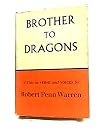
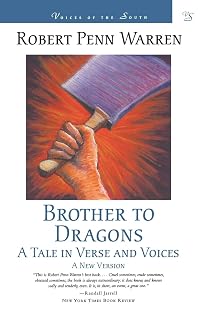
Brother to Dragons: A Tale in Verse and Voices
by Robert Penn Warren
On This Page
Tags
Recommendations





















Member Reviews
It might sound to some like damning with faint praise to say that I am almost inclined to call it a great poem: but you are a critic as well as a poet and will understand that this is about as far as one could sanely go about a work which one has only read once. But I have good hopes that my first impression will turn out to have been correct.
For one thing, the long poem is rather my special subject - I'd trust my own criticism on that Form more than on any other... I think the form (in the largest sense) is a wonderful invention: I mean, having the story told thro' the actors, still chewing it over. I suppose this might be called an adaptation of the Ring and the Book technique. But having it told in Sheol adds a particular sense of show more unchangeableness - the eternity of the past. And how do you manage to use this device without for one moment raising (even in so theological an imagination as mine) the least interest in anyone's beliefs about the actual status of the dead? which of course wd. be a ruinous distraction.
Another most brilliant success is the utterly unexpected addition of rhyme on p. 121, which, coming against the vast metrical background of unrhymed verse, is as if a Bell began to toll. And another is the intrusion of [the author] among the speakers (you have noticed how, on a tiny scale and with predominantly comic effect, this is anticipated by Henryson in some of the Fables?
...One or two bits seemed to have a certain (purely verbal) suggestion of our Charles Williams. Is there any influence?
The next English edtn. shd. have a Glossary. Only one of my colleagues knew what a 'painter' means in American. I got it right myself, but it was by guessing...
With many thanks for a profoundly moving and (without this, to be 'moved' is nothing) satisfying experience.
- from an 8 May 1954 letter to the author, in The collected letters of C.S. Lewis, volume III show less
For one thing, the long poem is rather my special subject - I'd trust my own criticism on that Form more than on any other... I think the form (in the largest sense) is a wonderful invention: I mean, having the story told thro' the actors, still chewing it over. I suppose this might be called an adaptation of the Ring and the Book technique. But having it told in Sheol adds a particular sense of show more unchangeableness - the eternity of the past. And how do you manage to use this device without for one moment raising (even in so theological an imagination as mine) the least interest in anyone's beliefs about the actual status of the dead? which of course wd. be a ruinous distraction.
Another most brilliant success is the utterly unexpected addition of rhyme on p. 121, which, coming against the vast metrical background of unrhymed verse, is as if a Bell began to toll. And another is the intrusion of [the author] among the speakers (you have noticed how, on a tiny scale and with predominantly comic effect, this is anticipated by Henryson in some of the Fables?
...One or two bits seemed to have a certain (purely verbal) suggestion of our Charles Williams. Is there any influence?
The next English edtn. shd. have a Glossary. Only one of my colleagues knew what a 'painter' means in American. I got it right myself, but it was by guessing...
With many thanks for a profoundly moving and (without this, to be 'moved' is nothing) satisfying experience.
- from an 8 May 1954 letter to the author, in The collected letters of C.S. Lewis, volume III show less
Ratings
Members
- Recently Added By
Author Information

138+ Works 14,453 Members
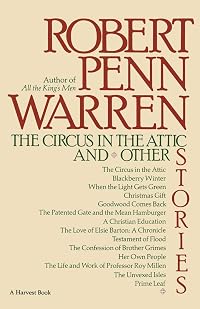
Robert Penn Warren, the first Poet Laureate of the United States, was an unusually versatile writer who tried his hand at almost every kind of literature. In all of these forms, he achieved recognition and distinction, but it is as a poet, critic, and novelist that he was most widely known. Writing almost always about his native South, Warren show more produced 10 novels and a collection of short stories, The Circus in the Attic and Other Stories (1948). By far the most successful of his novels is All the King's Men (1946), the story of a southern politician and demagogue named Willie Stark, which Warren based on the rise and fall of Huey Long. Warren was considered one of the most influential of the New Critics, whose influence on the teaching of literature in American schools and universities during the late 1940s and 1950s could scarcely be overestimated. Because All the King's Men seemed to be the very epitome of what a good work of literature should be in New Critical terms---a complicated but highly readable narrative filled with irony and ambiguity---the novel came to be used widely in courses on modern fiction. It won both the Pulitzer Prize and the Southern Authors Award in 1947. Warren's other novels are disappointing by comparison. Following the success of All the King's Men, however, Warren seemed to turn to more loosely told stories about dramatic and romantic subjects, such as the interracial theme of Band of Angels (1955) or the natural catastrophes that serve as the crisis background for The Cave (1959) and Flood: A Romance of Our Time (1964). Wilderness: A Tale of the Civil War (1961) is an allegory of a man's spiritual quest for truth about himself and the world. Meet Me in the Green Glen (1971), the story of a tragic love affair, seemed to mark a return to the tighter structure and more complex artistry of Warren's earlier novels, but A Place to Come To (1977), his last novel, in which an elderly and renowned scholar who seems to owe much to Warren himself looks back on his family's past in an effort to find the meaning of his life, struck some reviewers as a confused and tired work. Sometime midway through his career as a novelist it is as if Warren stopped thinking of himself as a southern writer in the tradition of William Faulkner and turned instead to Thomas Wolfe for inspiration. Although in retrospect that switch must be regretted, no one can deny the immense influence of Robert Penn Warren on modern letters. Warren's poetry is intellectual, rich in powerful images, and has its roots in the pre-Civil War South. He continued to write impressive poetry almost until the time of his death. (Bowker Author Biography) show less
Work Relationships
Has as a study
Common Knowledge
- Canonical title
- Brother to Dragons: A Tale in Verse and Voices
- Original publication date
- 1953
- Important places
- Smithland, Kentucky, USA; Natchez Trace, Mississippi, USA
- Disambiguation notice
- Please distinguish between this original (1953) edition of Robert Penn Warren's Brother to Dragons: A Tale in Verse and Voices and the "New Version" (1979). Thank you.
Classifications
Statistics
- Members
- 27
- Popularity
- 1,012,627
- Reviews
- 1
- Rating
- (5.00)
- Languages
- English
- Media
- Paper
- ASINs
- 3