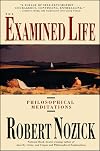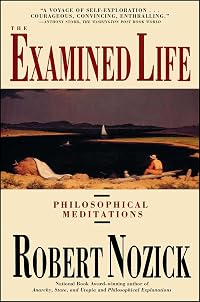
The Examined Life: Philosophical Meditations
by Robert Nozick
On This Page
Description
Philosophical essays on "happiness, dying, immortality, creativity, religious faith, sexuality, good and evil, wisdom, and the gap between the ideal and the actual."Tags
Recommendations



Member Reviews
Of all of Robert Nozick's books that I have read this is the one to which I return most frequently. He displays a depth of thought, references to other thinkers, and a prose style which I find inviting. That is I am spurred to think about how and why I agree or disagree with the author, but more importantly find the process of reading him a catalyst for my own thinking.
Happiness is just one of the subjects essayed in this book but it is a good example as when you encounter Nozick saying:"And although it might be best of all to be Socrates satisfied, having both happiness and depth, we would give up some happiness in order to gain the depth."(p 102) And I would add parenthetically, of an examined life. The breadth of the book is show more astounding, from death to love to meaning and value in life, and more. The discussion of "great spiritual teachers" in the essay "Giving Everything Its Due"(p 253-266) is a good example of thinking beyond the typical teacher as example by contrasting the value of leading a comparatively more "balanced life" as compared to the singularity of the great teachers. I continue to find further stimulus to thought, just as in other great books, when I return to this collection of imaginative and analytical essays that both explore and examine of what it means to aspire to live a humane life.
He discusses the view of Socrates that the examined life is not worth living in the introduction and concludes:
"I do not say with Socrates that the unexamined life is not worth living--that is unnecessarily harsh. However, when we guide our lives by our own pondered thoughts, it is then our life that we are living, not someone else's. In this sense, the unexamined life is not lived as fully."(p 15) show less
Happiness is just one of the subjects essayed in this book but it is a good example as when you encounter Nozick saying:"And although it might be best of all to be Socrates satisfied, having both happiness and depth, we would give up some happiness in order to gain the depth."(p 102) And I would add parenthetically, of an examined life. The breadth of the book is show more astounding, from death to love to meaning and value in life, and more. The discussion of "great spiritual teachers" in the essay "Giving Everything Its Due"(p 253-266) is a good example of thinking beyond the typical teacher as example by contrasting the value of leading a comparatively more "balanced life" as compared to the singularity of the great teachers. I continue to find further stimulus to thought, just as in other great books, when I return to this collection of imaginative and analytical essays that both explore and examine of what it means to aspire to live a humane life.
He discusses the view of Socrates that the examined life is not worth living in the introduction and concludes:
"I do not say with Socrates that the unexamined life is not worth living--that is unnecessarily harsh. However, when we guide our lives by our own pondered thoughts, it is then our life that we are living, not someone else's. In this sense, the unexamined life is not lived as fully."(p 15) show less
E' possibile pensare la vita? C'è chi lo fa giorno per giorno, con grande sofferenza e partecipazione. Chi invece non sa cosa pensare. A dire il vero, non ci pensa proprio a come vive. Il più delle volte, addirittura, molti non sanno nemmeno che stanno vivendo e, se lo sanno, vivono come se non dovessero mai morire.
Robert Nozick, professore alla prestigiosa Harvard University a soli trent'anni, ne "La vita pensata" (1989) affronta le questioni più familiari e importanti della nostra vita con il rigore, la lucidità e la chiarezza propri della tradizione analitica.
Ci parla della morte, del rapporto tra genitori e figli, della santità della vita quotidiana, dell'amore, dell'amicizia, dell'attività sessuale, delle emozioni, del modo show more in cui possiamo essere più reali - dotati di uno spessore e di un peso più elevati e molto altro ancora.
La profondità dei suoi pensieri, la raffinatezza del suo stile argomentativo e della sua scrittura, il personalissimo ritratto di vita che propone ci restituiscono tutta la vitalità e la bellezza della filosofia come esercizio di riflessione su noi stessi. Un esercizio che non ha mai fine.
Il libro cerca di rispondere a interrogativi quali: Perché la felicità non è l'unica cosa che conta? Come potrebbe essere l'immortalità, e che senso avrebbe? I beni ereditari dovrebbero passare di generazione in generazione? Le dottrine orientali dell'illuminazione sono valide? Che cos'è la creatività. Perché la gente indugia nell'affrontare progetti promettenti? Che cosa perderemmo se non provassimo mai alcuna emozione ma potessimo comunque avere sensazioni piacevoli? In che modo l'Olocausto ha cambiato l'umanità? Che cosa non torna, quando si pensa soprattutto alla ricchezza e al potere?
Una persona religiosa può spiegare perché Dio permette che ci sia il male? Che cosa c'è di particolarmente pregevole nel modo in cui l'amore passionale altera una persona? Che cos'è la saggezza, e perché i filosofi la amano tanto? Che dire del divario tra ideali e fatti? Esistono cose più reali di altre, e possiamo noi stessi diventare più reali? Ho letto questo libro impegnativo nell'edizione inglese, e devo dire che non è stata una cosa facile anche se la prosa del professore è lucida e scorrevole.
Qualche anno fa è passato, ancora giovane, a miglior vita e ho ripreso in mano questo suo libro decidendomi a scrivere qualcosa, spinto anche da una lettura convergente ed inaspettata di una breve poesia del cardinale inglese J.H. Newman. Nozick, scrivendo il suo libro, forse ambiva a stilare un progetto di vita per sè e per gli altri. In 27 capitoli egli tenta di "esaminare" la vita pensandola in tutte le sfaccettature possibili. Con filosofia e anche tanto pragmatismo tipicamente anglosassone.
Il cardinale, invece, affrontava la questione da un altro punto di vista, totalmente diverso. Nozick lo ipotizza, lo costruisce, lo erige sulla sua esperienza culturale ed esistenziale. Newman il suo progetto di vita lo intuisce già pensato e proposto da chi solo può e sa progettare come nessuno, erigendo la sua costruzione sulle tavole della legge, i suoi Comandamenti. Tutta la filosofia di Nozick e del mondo scompaiono in pochi semplici versi che non tormentano l'animo dell'uomo, ma si liberano verso l'alto profferendo un semplice "sì". Esso sta ad indicare l'accettazione dell'uomo al suo Creatore a realizzare un progetto misterioso e straordinario che trova la sua ragione d'essere nella sua infinita bontà.
IL MIO SI'
"Io sono creato
per realizzare un progetto
per cui nessun altro è creato.
Io occupo un posto mio
nei consigli di Dio,
nel mondo di Dio:
un posto da nessun altro occupato.
Poco importa che io sia ricco,
povero, disprezzato o stimato
dagli uomini:
Dio mi conosce
e mi chiama per nome.
Egli mi ha affidato un lavoro
che non ha affidato a nessun altro.
Io ho la mia missione,
in qualche modo
sono necessario ai suoi intenti.
Dio non mi ha creato inutilmente.
Io farò del bene, farò il Suo lavoro:
sarò un angelo di pace
un predicatore della verità
nel posto che Dio mi ha assegnato
anche senza che io lo sappia
purchè io segua
i Suoi comandamenti
e Lo serva nella mia vocazione"
(Cardinale J. H. Newman). show less
Robert Nozick, professore alla prestigiosa Harvard University a soli trent'anni, ne "La vita pensata" (1989) affronta le questioni più familiari e importanti della nostra vita con il rigore, la lucidità e la chiarezza propri della tradizione analitica.
Ci parla della morte, del rapporto tra genitori e figli, della santità della vita quotidiana, dell'amore, dell'amicizia, dell'attività sessuale, delle emozioni, del modo show more in cui possiamo essere più reali - dotati di uno spessore e di un peso più elevati e molto altro ancora.
La profondità dei suoi pensieri, la raffinatezza del suo stile argomentativo e della sua scrittura, il personalissimo ritratto di vita che propone ci restituiscono tutta la vitalità e la bellezza della filosofia come esercizio di riflessione su noi stessi. Un esercizio che non ha mai fine.
Il libro cerca di rispondere a interrogativi quali: Perché la felicità non è l'unica cosa che conta? Come potrebbe essere l'immortalità, e che senso avrebbe? I beni ereditari dovrebbero passare di generazione in generazione? Le dottrine orientali dell'illuminazione sono valide? Che cos'è la creatività. Perché la gente indugia nell'affrontare progetti promettenti? Che cosa perderemmo se non provassimo mai alcuna emozione ma potessimo comunque avere sensazioni piacevoli? In che modo l'Olocausto ha cambiato l'umanità? Che cosa non torna, quando si pensa soprattutto alla ricchezza e al potere?
Una persona religiosa può spiegare perché Dio permette che ci sia il male? Che cosa c'è di particolarmente pregevole nel modo in cui l'amore passionale altera una persona? Che cos'è la saggezza, e perché i filosofi la amano tanto? Che dire del divario tra ideali e fatti? Esistono cose più reali di altre, e possiamo noi stessi diventare più reali? Ho letto questo libro impegnativo nell'edizione inglese, e devo dire che non è stata una cosa facile anche se la prosa del professore è lucida e scorrevole.
Qualche anno fa è passato, ancora giovane, a miglior vita e ho ripreso in mano questo suo libro decidendomi a scrivere qualcosa, spinto anche da una lettura convergente ed inaspettata di una breve poesia del cardinale inglese J.H. Newman. Nozick, scrivendo il suo libro, forse ambiva a stilare un progetto di vita per sè e per gli altri. In 27 capitoli egli tenta di "esaminare" la vita pensandola in tutte le sfaccettature possibili. Con filosofia e anche tanto pragmatismo tipicamente anglosassone.
Il cardinale, invece, affrontava la questione da un altro punto di vista, totalmente diverso. Nozick lo ipotizza, lo costruisce, lo erige sulla sua esperienza culturale ed esistenziale. Newman il suo progetto di vita lo intuisce già pensato e proposto da chi solo può e sa progettare come nessuno, erigendo la sua costruzione sulle tavole della legge, i suoi Comandamenti. Tutta la filosofia di Nozick e del mondo scompaiono in pochi semplici versi che non tormentano l'animo dell'uomo, ma si liberano verso l'alto profferendo un semplice "sì". Esso sta ad indicare l'accettazione dell'uomo al suo Creatore a realizzare un progetto misterioso e straordinario che trova la sua ragione d'essere nella sua infinita bontà.
IL MIO SI'
"Io sono creato
per realizzare un progetto
per cui nessun altro è creato.
Io occupo un posto mio
nei consigli di Dio,
nel mondo di Dio:
un posto da nessun altro occupato.
Poco importa che io sia ricco,
povero, disprezzato o stimato
dagli uomini:
Dio mi conosce
e mi chiama per nome.
Egli mi ha affidato un lavoro
che non ha affidato a nessun altro.
Io ho la mia missione,
in qualche modo
sono necessario ai suoi intenti.
Dio non mi ha creato inutilmente.
Io farò del bene, farò il Suo lavoro:
sarò un angelo di pace
un predicatore della verità
nel posto che Dio mi ha assegnato
anche senza che io lo sappia
purchè io segua
i Suoi comandamenti
e Lo serva nella mia vocazione"
(Cardinale J. H. Newman). show less
Nozick is most famous for his defense of libertarianism in Anarchy, State and Utopia. I consider myself a libertarian, but ultimately found myself unsatisfied with it. People spoke of how original it was and how rigorous. But it was like that old saw, what was good wasn't original; what wasn't original wasn't good. I had found far better arguments for liberty. And far more accessible to the layman than the academic talk and symbolic logic filling Anarchy, State and Utopia.
The Examined Life is a collection of essays concerning various topics from "Dying" to "The Matrix of Reality." I did find some interesting ideas and insights sprinkled throughout those parts I read, but I found him often too frustrating. Not in the sense of Anarchy, show more State and Utopia that it seemed abstruse, but I just didn't resonate with the philosophy he presented. So much seemed incoherent and wrong-headed to me. I disagreed with his delineation of romantic love in "Love's Bond." It made me think of Ayn Rand's parody of someone insisting they wanted to be loved for themself--but not for anything about them. If love means stripping the loved one of their identity, if you can't love a characteristic about them, what's left to love? Nozick tries to develop this idea of a unique constellation of characteristics but I didn't find the distinction helpful. Then there's "The Zig Zag of Politics" where he tried to walk back his argument for libertarianism. If I found his argument for libertarianism unconvincing, I found his argument against it incoherent and sloppy. His argument is that doing things through government, such as the welfare state "marks" those issues for importance. OK, so Sadaam Hussein was torturing his countrymen and perpetuating a police state. Does that mean that's an argument for us to make war? Anyone noticed how that worked out? Or our intervention in Vietnam? Or Libya. Of all the arguments I've heard for the welfare state, this was the lamest. Finally, one of the essays that made the biggest impression on me was "The Holocaust" where he states it "would not be a special tragedy if humankind ended." WTF? The whole reason the Holocaust was a tragedy was because of what it did to human beings. And sadly, I can't say I see it as a particular break with history. Larger in scope perhaps. But to claim for it more than that is to be sadly ignorant of history. And that argument to me felt like a slap at the victims even more than the perpetrators.
I suppose it could be said from the above that at least here Nozick engages the mind and forces you to think. Which is more than I can have said for his magnum opus. But too much here that wasn't thought-provoking just plain dragged. show less
The Examined Life is a collection of essays concerning various topics from "Dying" to "The Matrix of Reality." I did find some interesting ideas and insights sprinkled throughout those parts I read, but I found him often too frustrating. Not in the sense of Anarchy, show more State and Utopia that it seemed abstruse, but I just didn't resonate with the philosophy he presented. So much seemed incoherent and wrong-headed to me. I disagreed with his delineation of romantic love in "Love's Bond." It made me think of Ayn Rand's parody of someone insisting they wanted to be loved for themself--but not for anything about them. If love means stripping the loved one of their identity, if you can't love a characteristic about them, what's left to love? Nozick tries to develop this idea of a unique constellation of characteristics but I didn't find the distinction helpful. Then there's "The Zig Zag of Politics" where he tried to walk back his argument for libertarianism. If I found his argument for libertarianism unconvincing, I found his argument against it incoherent and sloppy. His argument is that doing things through government, such as the welfare state "marks" those issues for importance. OK, so Sadaam Hussein was torturing his countrymen and perpetuating a police state. Does that mean that's an argument for us to make war? Anyone noticed how that worked out? Or our intervention in Vietnam? Or Libya. Of all the arguments I've heard for the welfare state, this was the lamest. Finally, one of the essays that made the biggest impression on me was "The Holocaust" where he states it "would not be a special tragedy if humankind ended." WTF? The whole reason the Holocaust was a tragedy was because of what it did to human beings. And sadly, I can't say I see it as a particular break with history. Larger in scope perhaps. But to claim for it more than that is to be sadly ignorant of history. And that argument to me felt like a slap at the victims even more than the perpetrators.
I suppose it could be said from the above that at least here Nozick engages the mind and forces you to think. Which is more than I can have said for his magnum opus. But too much here that wasn't thought-provoking just plain dragged. show less
This is a strange book, and what you get out of it will depend largely on what you were looking for in picking it up. If you were expecting rigorous analytical philosophy, this at first will not seem like the place to go. Gradually, however, Nozick's rambling armchair philosophies about life and love evolve into something more closely resembling the analytic tradition. If, on the other hand, you are interested in what goes on in the inner workings of a mind like Nozick's as it contemplates living and dying, this book will be largely appealing out of the gate, but as it morphs into something more, you might find that it's not what you're looking for at all.
Nozick begins flitting from topic to topic as each enters the realm of his show more thought, drawing loose connections and interesting parallels. Some sections drag (I found his discussion of creativity particularly droll), while others really provide unique and profound insight into the human condition. As the book evolves into a more rigorous philosophical examination, however, I found my interest lagging. This is decent nightstand reading, but not appropriate for either pure forays into the world of armchair philosophy nor robust philosophical investigation, which gives it a small audience indeed. show less
Nozick begins flitting from topic to topic as each enters the realm of his show more thought, drawing loose connections and interesting parallels. Some sections drag (I found his discussion of creativity particularly droll), while others really provide unique and profound insight into the human condition. As the book evolves into a more rigorous philosophical examination, however, I found my interest lagging. This is decent nightstand reading, but not appropriate for either pure forays into the world of armchair philosophy nor robust philosophical investigation, which gives it a small audience indeed. show less
One of this century’s most original philosophical thinkers, Nozick brilliantly renews Socrates’s quest to uncover the life that is worth living. In brave and moving meditations on love, creativity, happiness, sexuality, parents and children, the Holocaust, religious faith, politics, and wisdom, The Examined Life brings philosophy back to its preeminent subject, the things that matter most.
We join in Nozick’s reflections, weighing our experiences and judgments alongside those of past thinkers, to embark upon our own voyages of understanding and change. - from the publisher
We join in Nozick’s reflections, weighing our experiences and judgments alongside those of past thinkers, to embark upon our own voyages of understanding and change. - from the publisher
Nozick beatufilly applies the methods of analytical philosophy to everyday subjects like love, meaning of life, creativity and so on.
Quotes
"Freud tellingly depicted the strong and lingering effects of an even younger age, how the child's passionate desires, inadequate understanding, restricted emotional environment, constricted opportunities, and limited coping devices become fixed upon his own adult emotional life and reactions and continue to affect them. This situation is (to say the least) unseemly-- would you design an intelligent species so continuingly shaped by its childhood, one whose emotions had no half-life and where statutes of limitations could be invoked only with great difficulty?"
"..when all other things are equal, the more concentrated thought goes into making something, the more it is shaped, enriched, and laden with significance. So to with living show more a life."
"There are very few books that set out what a mature person can believe-- someone fully grown up, I mean. Aristotle's Ethics, Marcus Aurelius's Meditations, Montaigne's Essays, and the essays of Samuel Johnson come to mind. Even with these, we do not simply accept everything that is said. The author's voice is never our own, exactly; the author's life is never our own. It would be disconcerting, anyway, to find that another person holds precisely our views, responds with our particular sensibility, and thinks exactly the same things important. Still, we can gain from these books, weighing and pondering ourselves in their light. These books-- and also some less evidently grown-up ones, Thoreau's Walden and Nietzsche's writings, for example-- invite or urge us to think along with them, branching in our own directions. We are not identical with the books we read, but neither would we be the same without them."
"They say no one is able to take seriously the possibility of his or her own death, but this does not get it exactly right. (Does everyone take seriously the possibility of his or her own life?) A person's own death does become real to him after the death of both parents. Until then, there was someone else who was "supposed to" die before him; now that no one stands between him and death, it becomes his "turn." (Is it presumed that death will honor a queue?)"
"How unwilling someone is to die should depend, I think, upon what he has left undone, and also upon his remaining capacity to do things. The more what he considered important has been done, and the less capacity that remains, the more willing he should be to face death." (...having done everything you considered important, mightn't you set yourself a new goal?)
"Under any alternative, no doubt, we would welcome an additional chance (at life)-- it would be ironic if we did get one, but, not realizing it was a second chance, squandered it just like the first."
"Nonsurvival is somber, but immortality too fits darker visions. Here is one that at present sounds like science fiction. One day, computer programs will be able to capture a person's intellectual mode, personality pattern, and character structure so that later generations can retrieve these. Thus would be realized one of immortality's two facets: continuing to exist as a coherent pattern of individual personality that another can experience. And the other facet, continuing to experience things and act, might be gained in part if the program encapsulating a person were made to govern a computer that acted in the world. Such immortality need not be wholly a blessing, however. Just as a person's ideas can be misused or vulgarized, so too could later civilizations exploit or misuse someone's individual personality, calling it up to serve projects and purposes the person never would have chosen to cooperate with when alive in the flesh."
"I understand the urge to cling to life until the very end, yet I find another course more appealing. After an ample life, a person who still possesses energy, acuity, and decisiveness might choose to seriously risk his life or lay it down for another person or for some noble and decent cause. Not that this should be done lightly or too soon, but some time before the nature end-- current health levels might suggest an age between seventy and seventy-five-- a person might direct his or her mind and energy toward helping others in a more dramatic and risky fashion than younger, more prudent folk would venture. These activities might involve great health risks in order to serve the sick, risks of physical harm in interposing oneself between oppressors and their victims-- I have in mind the kind of peaceful activities and nonviolent resistance that Gandhi and Martin Luther King engaged in, not a vigilante pursuit of wrongdoers-- or in aiding people within violence-ridden areas... such a path will not be for everyone, but some might seriously weigh spending their penultimate years in a brave and noble endeavor to benefit others, and andventure to advance the cause of truth, goodness, beauty, or holiness-- not going gentle into that good night or raging against the dying of the light but, near the end, shining their light most brightly."
"Being grown-up is a way of no longer being a child, hence a way of relating to one's parents, not just by acting as their parent but by stopping needing or expecting them to act as yours; and this includes stopping expecting the world to be a symbolic parent, too."
"The process of shaping and crafting an artistic work has, as an important part of its impulse, the reshaping and integration of parts of the self. Important and needed work on the self is modeled in the process of artistic creation, and symbolized there. (Might that work on the self also actually be andvanced through the creative work that models it?)"
"Others' explorings, respondings, and creatings enlarge us. In Chaucer's time, people did not know of Shakespeare yet were not conscious of missing anything. It is difficult now to imagine a world in which Shakespeare, Buddha, Jesus, or Einstein are absent, in which their absence goes unnoticed. What comparable voids exist now, waiting to be filled?"
"We are least separate from the world in eating. The world enters into us; it becomes us. We are constituted by portions of the world."
"Seeing everyday life as holy is in part seeing the world and its contents as infinitely receptive to our activities of exploring, responding, relating and creating, as an arena that would richly repay these activities no matter how far they are taken, whether by an individual or by all of humanity together throughout its time."
"I see people descended from a long sequence of human and animal forebears in an unnumbered train of chance events, accidental encounters, brutal takings, lucky escapes, sustained efforts, migrations, survivings of wars and disease. An intricate and improbable concatenation of events was needed to yield each of us, an immense history that gives each person the sacredness of a redwood, each child the whimsy of a secret."
"We want nothing other than to live in a spiral of activities and enhance others' doing so, deepening our own reality as we come into contact and relation with the rest, exploring the dimensions of reality, embodying them in ourselves, creating, responding to the full range of the reality we can discern with the fullest reality we possess, becoming a vehicle for truth, beauty, goodness, and holiness, adding our own characteristic bit to reality's eternal processes. And that wanting of nothing else, along with its attendant emotion, is-- by the way-- what constitutes happiness and joy."
"If we reach adulthood by becoming the parent of our parents, and we reach maturity by finding a fit substitute for parents' love, then by becoming our ideal parent ourselves finally the circle is closed and we reach completeness." show less
"Freud tellingly depicted the strong and lingering effects of an even younger age, how the child's passionate desires, inadequate understanding, restricted emotional environment, constricted opportunities, and limited coping devices become fixed upon his own adult emotional life and reactions and continue to affect them. This situation is (to say the least) unseemly-- would you design an intelligent species so continuingly shaped by its childhood, one whose emotions had no half-life and where statutes of limitations could be invoked only with great difficulty?"
"..when all other things are equal, the more concentrated thought goes into making something, the more it is shaped, enriched, and laden with significance. So to with living show more a life."
"There are very few books that set out what a mature person can believe-- someone fully grown up, I mean. Aristotle's Ethics, Marcus Aurelius's Meditations, Montaigne's Essays, and the essays of Samuel Johnson come to mind. Even with these, we do not simply accept everything that is said. The author's voice is never our own, exactly; the author's life is never our own. It would be disconcerting, anyway, to find that another person holds precisely our views, responds with our particular sensibility, and thinks exactly the same things important. Still, we can gain from these books, weighing and pondering ourselves in their light. These books-- and also some less evidently grown-up ones, Thoreau's Walden and Nietzsche's writings, for example-- invite or urge us to think along with them, branching in our own directions. We are not identical with the books we read, but neither would we be the same without them."
"They say no one is able to take seriously the possibility of his or her own death, but this does not get it exactly right. (Does everyone take seriously the possibility of his or her own life?) A person's own death does become real to him after the death of both parents. Until then, there was someone else who was "supposed to" die before him; now that no one stands between him and death, it becomes his "turn." (Is it presumed that death will honor a queue?)"
"How unwilling someone is to die should depend, I think, upon what he has left undone, and also upon his remaining capacity to do things. The more what he considered important has been done, and the less capacity that remains, the more willing he should be to face death." (...having done everything you considered important, mightn't you set yourself a new goal?)
"Under any alternative, no doubt, we would welcome an additional chance (at life)-- it would be ironic if we did get one, but, not realizing it was a second chance, squandered it just like the first."
"Nonsurvival is somber, but immortality too fits darker visions. Here is one that at present sounds like science fiction. One day, computer programs will be able to capture a person's intellectual mode, personality pattern, and character structure so that later generations can retrieve these. Thus would be realized one of immortality's two facets: continuing to exist as a coherent pattern of individual personality that another can experience. And the other facet, continuing to experience things and act, might be gained in part if the program encapsulating a person were made to govern a computer that acted in the world. Such immortality need not be wholly a blessing, however. Just as a person's ideas can be misused or vulgarized, so too could later civilizations exploit or misuse someone's individual personality, calling it up to serve projects and purposes the person never would have chosen to cooperate with when alive in the flesh."
"I understand the urge to cling to life until the very end, yet I find another course more appealing. After an ample life, a person who still possesses energy, acuity, and decisiveness might choose to seriously risk his life or lay it down for another person or for some noble and decent cause. Not that this should be done lightly or too soon, but some time before the nature end-- current health levels might suggest an age between seventy and seventy-five-- a person might direct his or her mind and energy toward helping others in a more dramatic and risky fashion than younger, more prudent folk would venture. These activities might involve great health risks in order to serve the sick, risks of physical harm in interposing oneself between oppressors and their victims-- I have in mind the kind of peaceful activities and nonviolent resistance that Gandhi and Martin Luther King engaged in, not a vigilante pursuit of wrongdoers-- or in aiding people within violence-ridden areas... such a path will not be for everyone, but some might seriously weigh spending their penultimate years in a brave and noble endeavor to benefit others, and andventure to advance the cause of truth, goodness, beauty, or holiness-- not going gentle into that good night or raging against the dying of the light but, near the end, shining their light most brightly."
"Being grown-up is a way of no longer being a child, hence a way of relating to one's parents, not just by acting as their parent but by stopping needing or expecting them to act as yours; and this includes stopping expecting the world to be a symbolic parent, too."
"The process of shaping and crafting an artistic work has, as an important part of its impulse, the reshaping and integration of parts of the self. Important and needed work on the self is modeled in the process of artistic creation, and symbolized there. (Might that work on the self also actually be andvanced through the creative work that models it?)"
"Others' explorings, respondings, and creatings enlarge us. In Chaucer's time, people did not know of Shakespeare yet were not conscious of missing anything. It is difficult now to imagine a world in which Shakespeare, Buddha, Jesus, or Einstein are absent, in which their absence goes unnoticed. What comparable voids exist now, waiting to be filled?"
"We are least separate from the world in eating. The world enters into us; it becomes us. We are constituted by portions of the world."
"Seeing everyday life as holy is in part seeing the world and its contents as infinitely receptive to our activities of exploring, responding, relating and creating, as an arena that would richly repay these activities no matter how far they are taken, whether by an individual or by all of humanity together throughout its time."
"I see people descended from a long sequence of human and animal forebears in an unnumbered train of chance events, accidental encounters, brutal takings, lucky escapes, sustained efforts, migrations, survivings of wars and disease. An intricate and improbable concatenation of events was needed to yield each of us, an immense history that gives each person the sacredness of a redwood, each child the whimsy of a secret."
"We want nothing other than to live in a spiral of activities and enhance others' doing so, deepening our own reality as we come into contact and relation with the rest, exploring the dimensions of reality, embodying them in ourselves, creating, responding to the full range of the reality we can discern with the fullest reality we possess, becoming a vehicle for truth, beauty, goodness, and holiness, adding our own characteristic bit to reality's eternal processes. And that wanting of nothing else, along with its attendant emotion, is-- by the way-- what constitutes happiness and joy."
"If we reach adulthood by becoming the parent of our parents, and we reach maturity by finding a fit substitute for parents' love, then by becoming our ideal parent ourselves finally the circle is closed and we reach completeness." show less
Members
- Recently Added By
Author Information

9+ Works 3,830 Members
Educated at Columbia and Princeton universities, Robert Nozick is Arthur Kingsley Porter Professor of Philosophy at Harvard University. He rose to eminence in the last quarter of the twentieth century as a creative philosopher who has expressed philosophical truths beyond the reach of analytic argumentation. Honed in the technical intricacies of show more analytic philosophy, he has nonetheless restored meditation to its proper place in the philosophical canon. Nozick's first book, Anarchy, State and Utopia (initially published in 1974), won the National Book Award in 1975 and became the fundamental text of the Libertarian movement. Nozick's second book, Philosophical Explanations, was given the Ralph Waldo Emerson Award of Phi Beta Kappa in 1982. It covers a wide range of basic philosophical topics: the question why there is something rather than nothing, the identity of the self, knowledge and skepticism, free will, the foundation of ethnics, and the meaning of life. Nozick abandons philosophical proof or argumentation as too coercive and opts instead for methods of explanation that promote understanding. This approach has culminated in his third book, The Examined Life. (Bowker Author Biography) show less
Common Knowledge
- Original title
- The Examined Life: Philosophical Meditations
- Original publication date
- 1989
- First words
- I want to think about living and what is important in life, to clarify my thinking-and also my life.
- Last words
- (Click to show. Warning: May contain spoilers.)If we reach adulthood by becoming the parent of our parents, and we reach maturity by finding a fit substitute for parent's love, then by becoming our ideal parent ourselves finally the circle is closed and we reach completeness.
Classifications
Statistics
- Members
- 661
- Popularity
- 43,708
- Reviews
- 9
- Rating
- (3.45)
- Languages
- 6 — English, French, German, Italian, Japanese, Spanish
- Media
- Paper
- ISBNs
- 11
- ASINs
- 3