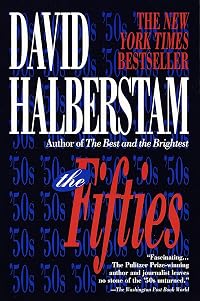
The Fifties
by David Halberstam
On This Page
Description
Exuberant and ambitious, The Fifties delves into a decade that remains a monumental and lasting turning point in American history Joe McCarthy. Marilyn Monroe. The H-bomb. Ozzie and Harriet. Elvis. Civil rights. It's undeniable: The fifties were a defining decade for America, complete with sweeping cultural change and political upheaval. This decade is also the focus of David Halberstam's triumphant The Fifties, which stands as an enduring classic and was an instant New York Times bestseller show more upon its publication. More than a survey of the decade, it is a masterfully woven examination of far-reaching change, from the unexpected popularity of Holiday Inn to the marketing savvy behind McDonald's expansion. show lessTags
Recommendations
















Member Reviews
The practice of using decades as a units of history seems to be popular in the US but not elsewhere. Appropriately, The Fifties is primarily about the United States; its topics may seem as insular as some of the individuals who figure in the story.. Another characteristic of the decade as an American historical unit is that it is probably more of a popular rather than an academic way to think about the past. The Fifties is popular not academic history.
CONS: Ends rather abruptly. Tend to lose track of the year being covered; since a lot of the biographical sketches naturally pre-date the period under consideration. Noteworthy gaps in coverage: general financial history, infrastructure and the economy, and taxes. Feminist history lacks show more nuance. Focusing on Betty Friedan limits scope to college-educated women’s careers. LGBT history barely touched on. Nothing on the environment although to be fair, the book was written before it became a big topic. Maybe too much attention paid to what I would consider relatively trivial popular culture topics: basketball, rock and roll, quiz shows. The juxtaposition with the themes of race relations and the development of the birth control pill (and the hydrogen bomb) with lengthy coverage of the passion of Charles Van Doren or the adventures of Allen Ginsberg at Columbia made me a little uncomfortable.
PROS. Highly readable. The biographies and the details of the topics the author chooses to cover are skillful and on point. The technique is not all that different from pre-modern histories except the biographies aren’t about kings, emperors, generals and clerics. History as a series of interesting lives can be a little misleading, on the other hand. Some items I found interesting:
Theme. The triumph of the Midwest. The image of the family, the family car, and the interaction of family and car on TV, all come out of the Midwest.
Biography. Pat Nixon meets Gloria Steinem. Pat Nixon did not have a Betty Friedan childhood. While, understandably, the author emphasizes the growth of the economy in the 50s, one wonders what portion of the population was not able to float with the rising tide.
The ironies of US foreign policy. Eisenhower, a former general, was nevertheless a fiscal conservative. His objection to the military industrial complex was that its minions spent too much taxpayer money. The trump card for the MI complex was the conventional wisdom that the Soviets were devoting most of their economy to weapons development. The U2 spyplane showed that the size and power of the Soviet arsenal was highly exaggerated. Eisenhower and his staff knew this, but the thinking was that making this common knowledge would be admitting that the US was flying over Soviet airspace and would, in addition, undermine the CIA, so the information had to be classified. So during the Eisenhower presidency the Democrats and the Republicans out of the classified loop constantly attacked the administration for not keeping up with the Soviets because the government was not spending enough on weapons development. This also resulted in the administration considering nuclear weapons as the first resort in times of crisis because they were seen as the cheaper alternative to conventional weapons development.
Detail: the pill. Gregory (Goody) Pincus was denied tenure at Harvard (possibly because he was Jewish). With financing via Margaret Sanger, he put together a laboratory and staff that isolated the steroid that would be used to regulate ovulation. The big pharma company Searle controlled the patent on progesterone, the basis of the oral contraceptive, and did not pay out royalties to Pincus, his widow, and his staff, but Searle generously donated a half million dollars to Harvard research! Related detail: during the 20s it was apparently against Roman Catholic doctrine to perform a Caesarean section (logically as unnatural as condoms and the pill, after all). John Rock, instrumental in the development of the pill, was Roman Catholic (devout, not nominal) and was nearly denied the sacrament because he performed Caesareans in his practice.
Detail. In segregated Alabama, African-Americans paid fare to the bus driver, but were then required to exit from the front and enter through the back door of the bus. Some bus drivers did not open the back door and simply drove off. Many more details about life as it was lived by African Americans in the decade. Micro and macro aggression squared. Eisenhower’s racism (see the anecdote about Ralph Bunche) and how it allowed the Little Rock crisis to expand. show less
CONS: Ends rather abruptly. Tend to lose track of the year being covered; since a lot of the biographical sketches naturally pre-date the period under consideration. Noteworthy gaps in coverage: general financial history, infrastructure and the economy, and taxes. Feminist history lacks show more nuance. Focusing on Betty Friedan limits scope to college-educated women’s careers. LGBT history barely touched on. Nothing on the environment although to be fair, the book was written before it became a big topic. Maybe too much attention paid to what I would consider relatively trivial popular culture topics: basketball, rock and roll, quiz shows. The juxtaposition with the themes of race relations and the development of the birth control pill (and the hydrogen bomb) with lengthy coverage of the passion of Charles Van Doren or the adventures of Allen Ginsberg at Columbia made me a little uncomfortable.
PROS. Highly readable. The biographies and the details of the topics the author chooses to cover are skillful and on point. The technique is not all that different from pre-modern histories except the biographies aren’t about kings, emperors, generals and clerics. History as a series of interesting lives can be a little misleading, on the other hand. Some items I found interesting:
Theme. The triumph of the Midwest. The image of the family, the family car, and the interaction of family and car on TV, all come out of the Midwest.
Biography. Pat Nixon meets Gloria Steinem. Pat Nixon did not have a Betty Friedan childhood. While, understandably, the author emphasizes the growth of the economy in the 50s, one wonders what portion of the population was not able to float with the rising tide.
The ironies of US foreign policy. Eisenhower, a former general, was nevertheless a fiscal conservative. His objection to the military industrial complex was that its minions spent too much taxpayer money. The trump card for the MI complex was the conventional wisdom that the Soviets were devoting most of their economy to weapons development. The U2 spyplane showed that the size and power of the Soviet arsenal was highly exaggerated. Eisenhower and his staff knew this, but the thinking was that making this common knowledge would be admitting that the US was flying over Soviet airspace and would, in addition, undermine the CIA, so the information had to be classified. So during the Eisenhower presidency the Democrats and the Republicans out of the classified loop constantly attacked the administration for not keeping up with the Soviets because the government was not spending enough on weapons development. This also resulted in the administration considering nuclear weapons as the first resort in times of crisis because they were seen as the cheaper alternative to conventional weapons development.
Detail: the pill. Gregory (Goody) Pincus was denied tenure at Harvard (possibly because he was Jewish). With financing via Margaret Sanger, he put together a laboratory and staff that isolated the steroid that would be used to regulate ovulation. The big pharma company Searle controlled the patent on progesterone, the basis of the oral contraceptive, and did not pay out royalties to Pincus, his widow, and his staff, but Searle generously donated a half million dollars to Harvard research! Related detail: during the 20s it was apparently against Roman Catholic doctrine to perform a Caesarean section (logically as unnatural as condoms and the pill, after all). John Rock, instrumental in the development of the pill, was Roman Catholic (devout, not nominal) and was nearly denied the sacrament because he performed Caesareans in his practice.
Detail. In segregated Alabama, African-Americans paid fare to the bus driver, but were then required to exit from the front and enter through the back door of the bus. Some bus drivers did not open the back door and simply drove off. Many more details about life as it was lived by African Americans in the decade. Micro and macro aggression squared. Eisenhower’s racism (see the anecdote about Ralph Bunche) and how it allowed the Little Rock crisis to expand. show less
Halberstam is of my parents generation and the 1950s were when they came of age, graduating high school and college, entering the work force. They were the "Silent Generation" because it is overshadowed by the larger Greatest and Boomer generations. The 50s tend to get short attention compared to the exciting 1940s (WWII) and the 1960s. Nevertheless, Halberstam makes a good case the decade was just as important. This simplistic thesis almost goes without saying (why else write the book?), but shows how dominate the narrative of the 1950s has become as a sort of gentle calm between the storms - rather The Fifties shows it was a time of great change. When it was published I don't believe it received the critical attention it deserved, show more fittingly for the Silents. It was ahead of its time, during the early 90s at the end of the Cold War, America sought to put that period behind it and move into a new global consensus. But nearly 30 years later interest in the 50s is starting to come around again, this book should see a lot more attention over the next decade or so. It is improved with age. show less
Wonderfully readable for a 600‑plus page history book or, really, for any type of book at all. Halberstam's clear writing is a big part of the reason why, but I also think it’s because of how well this is organized. It consists of 46 chapters in rough chronological order that focus on a particular topic related to the decade. These topics range from the Cold War of the nuclear age to Elvis Presley’s impact on popular culture and include the emerging civil rights movement, the pill, Korea, Cuba, and the televised presidential debate that cast the die for the following decade, among many others. My only complaint is that he didn't write a follow-up book about the ‘60s.
An eerie moment while reading The Fifties: A day ago, towards the end of the book, I finished the chapter on Charles Van Doren and the quiz show scandals of the 1950s. I almost immediately fell asleep thereafter. About eight hours later, I woke up and decided to look up Van Doren and see where he was these days, knowing he must be in his nineties. And the first thing I saw? Van Doren had just died. Eight hours previously. Just as I was finishing the chapter on him. I suppose with a world population closing in on eight billion people that a coincidence like that was inevitable. But it also goes to show you how far back in time, now, were the 1950s and the people who headlined those years. They are all succumbing to age and show more mortality.
David Halberstam's book remains a nice contribution to understanding the decade. In the past, I've used it almost like a reference book. But this time, I decided to read it through cover to cover. And doing so reveals his method along with his strengths and weaknesses.
The chapters of The Fifites are built around biographical sketches of leading figures from politics, science, art, film, television, journalism, business, and literature. And if you read Halberstam's most famous work, which is about the background to the men who led the US into Vietnam, The Best and the Brightest, you will recognize the same technique at work, here. Like that volume, The Fifties relies upon Halberstam's skill as a journalist and an interviewer, especially someone with access to the then still living people who were among the 1950s most significant cultural and political icons.
The Best and the Brightest is Halberstam's best work and has kept its place as one of the most important studies of the Vietnam War. And that is because Halberstam is at his most formidable when he is taking a skeptical attitude towards his subjects and questioning the everyday presentation of social and governmental propaganda that surrounds them. The same approach cannot be said entirely of The Fifties.
In this book, Halberstam has divided his focus onto saints and evildoers. And the result is likely unintentional. That is, the people Halberstam obviously disapprove of are far more interesting than the semi-divine figures he often comes close to worshiping. A few examples: I'm far more interested in reading about the tumultuous background and motivations of Edward Teller, the father of the H-bomb, than I am of the prim and proper Robert Oppenheimer, on whose side in the Teller-Oppenheimer conflict Halberstam firmly affixes himself. So, too, with figures from the civil rights movement. Orville Faubus makes for an intriguing Richard III type character of sympathetic background but self-serving and morally compromised personal ambition. Meanwhile, Martin Luther King and Rosa Parks come across as cardboard cutouts, so saintly that they lose all human quality. Halberstam literally mentions the issues of King's plagiarism and fondness for prostitutes in a one sentence parenthesis, commenting on how even great men have their foibles! Not so, of course, with Joseph McCarthy or John Foster Dulles, who he goes into depth to psychoanalyze and rake through their weaknesses. The result? Dulles and McCarthy again appear as fascinating subjects for further reading. At the same time, the cultural figures Halberstam gives pages to, Elvis, James Dean, and Marlon Brando, come across as boring. How do you make Brando boring! Finally, there are two figures from 1950s feminism highlighted in the book, Betty Friedan and Grace Metalious, the latter being the author of Peyton Place. The chapter on Saint Betty provides the literary equivalent of the Bataan Death March in that you think you will never make it through to the end. But the pages on Metalious, on the other hand, are captivating. I want to know more about this tragic figure made all the more human for her debauchery and lack of discipline.
There is much, much more in the book. And while it isn't a work you would ascribe to a professional historian (as was very nearly the case in The Best and the Brightest), it gives a sense of completeness to the overall feel of the decade.
What a tragedy itself was Halberstam's death in a useless automobile accident. He had many more fascinating books on plan. I wish we could have read them. show less
David Halberstam's book remains a nice contribution to understanding the decade. In the past, I've used it almost like a reference book. But this time, I decided to read it through cover to cover. And doing so reveals his method along with his strengths and weaknesses.
The chapters of The Fifites are built around biographical sketches of leading figures from politics, science, art, film, television, journalism, business, and literature. And if you read Halberstam's most famous work, which is about the background to the men who led the US into Vietnam, The Best and the Brightest, you will recognize the same technique at work, here. Like that volume, The Fifties relies upon Halberstam's skill as a journalist and an interviewer, especially someone with access to the then still living people who were among the 1950s most significant cultural and political icons.
The Best and the Brightest is Halberstam's best work and has kept its place as one of the most important studies of the Vietnam War. And that is because Halberstam is at his most formidable when he is taking a skeptical attitude towards his subjects and questioning the everyday presentation of social and governmental propaganda that surrounds them. The same approach cannot be said entirely of The Fifties.
In this book, Halberstam has divided his focus onto saints and evildoers. And the result is likely unintentional. That is, the people Halberstam obviously disapprove of are far more interesting than the semi-divine figures he often comes close to worshiping. A few examples: I'm far more interested in reading about the tumultuous background and motivations of Edward Teller, the father of the H-bomb, than I am of the prim and proper Robert Oppenheimer, on whose side in the Teller-Oppenheimer conflict Halberstam firmly affixes himself. So, too, with figures from the civil rights movement. Orville Faubus makes for an intriguing Richard III type character of sympathetic background but self-serving and morally compromised personal ambition. Meanwhile, Martin Luther King and Rosa Parks come across as cardboard cutouts, so saintly that they lose all human quality. Halberstam literally mentions the issues of King's plagiarism and fondness for prostitutes in a one sentence parenthesis, commenting on how even great men have their foibles! Not so, of course, with Joseph McCarthy or John Foster Dulles, who he goes into depth to psychoanalyze and rake through their weaknesses. The result? Dulles and McCarthy again appear as fascinating subjects for further reading. At the same time, the cultural figures Halberstam gives pages to, Elvis, James Dean, and Marlon Brando, come across as boring. How do you make Brando boring! Finally, there are two figures from 1950s feminism highlighted in the book, Betty Friedan and Grace Metalious, the latter being the author of Peyton Place. The chapter on Saint Betty provides the literary equivalent of the Bataan Death March in that you think you will never make it through to the end. But the pages on Metalious, on the other hand, are captivating. I want to know more about this tragic figure made all the more human for her debauchery and lack of discipline.
There is much, much more in the book. And while it isn't a work you would ascribe to a professional historian (as was very nearly the case in The Best and the Brightest), it gives a sense of completeness to the overall feel of the decade.
What a tragedy itself was Halberstam's death in a useless automobile accident. He had many more fascinating books on plan. I wish we could have read them. show less
The 1950s. The greatest generation. To put it into perspective, Churchill announced America was poised to be the most powerful country in the world by 1950. The 1950s also gave birth to the microwave oven, Lucy and Desi, desegregation, Holiday Inns, the photocopier, McDonald's restaurant, the credit card, the polio vaccination, hip=shaking Elvis, the discovery of DNA, the color TV...I could go on and on but Halberstam does that for me brilliantly in The Fifties. He covers everything from inventions to politics; from fads to phenomenons; from people to places.
One of the best things about The Fifties is the insight into personal lives. For example, who knew that General Douglas MacArthur was a mama's boy? She "took up residence in a show more nearby hotel for four years" (p 80), while MacArthur was in school. Or that Lucille Ball was adamant about her real Cuban husband playing the role in I Love Lucy?
As an aside: you can't launch into the 1950s without backing up and talking about the mid to late 1940s. Expect a little history lesson before the history lesson. show less
One of the best things about The Fifties is the insight into personal lives. For example, who knew that General Douglas MacArthur was a mama's boy? She "took up residence in a show more nearby hotel for four years" (p 80), while MacArthur was in school. Or that Lucille Ball was adamant about her real Cuban husband playing the role in I Love Lucy?
As an aside: you can't launch into the 1950s without backing up and talking about the mid to late 1940s. Expect a little history lesson before the history lesson. show less
ספר מצוין. כל פרק עוסק לכאורה בנושא נפרד מן האחרים, ברעיון, בהתפתחות כלכלית או חברתית, באדם, בספר, בתנועה, במוזיקה, במלחמה. כל פרק שלם בפני עצמו אבל הכל ביחד נותן תמונה מרתקת ושלמה של שנות החמישים. לי באופן אישי הכל היה קרוב מוכר וידוע כי אלו השנים שבהם התלחלדתי ללמוד על העולם מסביבי בייחודת תוך קריאת הטיים והפלייבי וגם בשנים הבאות ההשפעות של שנות החמישים בארה'ב הגיעו לארץ באיחור אלגנטי של כמה שנים והורגשו כאן show more יותר מתמיד. לכן הכל נראה לי מוכר, חשוב וידוע ומאידך סוף סוף אני רואה את הדברים מוארים באור אחיד ובהיר ולא כהבלחות של אירועים יחידים. יופי של ספר. show less
I read this book because I'm writing a novel set in the '50s and I wanted to learn as much about the period as I could, and it certainly did teach me a lot. I found the author's lack of objectivity (giving very strong opinions about different people) interesting.
My only frustration with the book was the lack of attention paid to women. I understand that in certain areas of life (e.g. politics) there just weren't many prominent women to discuss, but it seemed like there were other chapters when women could've been focused on more but were pushed aside in favour of men. And the discussion of the oppression of women in mainstream society at large was shoved way back towards the very end of the book.
My only frustration with the book was the lack of attention paid to women. I understand that in certain areas of life (e.g. politics) there just weren't many prominent women to discuss, but it seemed like there were other chapters when women could've been focused on more but were pushed aside in favour of men. And the discussion of the oppression of women in mainstream society at large was shoved way back towards the very end of the book.
Members
- Recently Added By
Lists

r/History Recommended Reading List
603 works; 12 members

Stephen King's 'On Writing' reading list
95 works; 4 members
Author Information

43+ Works 16,078 Members
David Halberstam was born on April 10, 1934 in New York City and later attended Harvard University. After graduating in 1955, Halberstam worked at a small daily newspaper until he attained a position at the Nashville Tennessean. Halberstam has written over 20 books including The Children, a written account of his coverage of the Civil Rights show more Movement; The Best and Brightest, which was a bestseller; and The Game and October, 1964, both detailing his fascination of sports. Halberstam also won a Pulitzer Prize for his reports on the Vietnam War while working for the New York Times. He was killed in a car crash on April 23, 2007 at the age of 73. (Bowker Author Biography) show less
Some Editions
Awards and Honors
Distinctions
Work Relationships
Contains
Is abridged in
Common Knowledge
- Canonical title
- The Fifties
- Original title
- The Fifties
- Original publication date
- 1993
- People/Characters
- Franklin Delano Roosevelt; Harry S. Truman; Thomas E. Dewey; Robert Taft
- Important events
- Cold War
- Related movies
- The Fifties (1997 | IMDb)
- Dedication
- For Julia Sandness Halberstam
- First words
- In the beginning, that era was dominated by the shadow of a man no longer there—Franklin D. Roosevelt.
- Last words
- (Click to show. Warning: May contain spoilers.)These two ... bore the hell out of me."
- Original language*
- Anglais (Etats-Unis) (Etats-Unis)
*Some information comes from Common Knowledge in other languages. Click "Edit" for more information.
Classifications
Statistics
- Members
- 1,982
- Popularity
- 10,673
- Reviews
- 34
- Rating
- (4.10)
- Languages
- Czech, English, French
- Media
- Paper, Audiobook, Ebook
- ISBNs
- 12
- UPCs
- 1
- ASINs
- 13