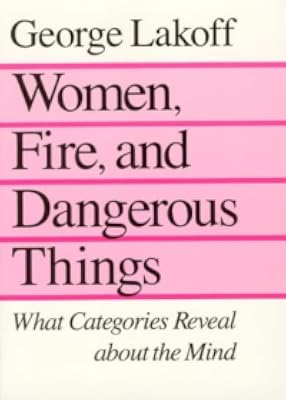
Women, Fire, and Dangerous Things: What Categories Reveal About the Mind
by George Lakoff
On This Page
Description
"Its publication should be a major event for cognitive linguistics and should pose a major challenge for cognitive science. In addition, it should have repercussions in a variety of disciplines, ranging from anthropology and psychology to epistemology and the philosophy of science. . . . Lakoff asks: What do categories of language and thought reveal about the human mind? Offering both general theory and minute details, Lakoff shows that categories reveal a great deal."-David E. Leary, show more American Scientist. show lessTags
Recommendations



























Member Reviews
Lakoff comes out swinging hard in this book, challenging the classical theory of classification. Using many examples he shows, for instance, that categories aren’t always mutually exclusive with clear boundaries. This is a dense text that isn’t that easy to get through. Though fairly old, its arguments are still salient and timely.
Lakoff shows a knack in this book for combining dry, unimaginative, academic writing with an almost obscene lack of clarity.
Here's an excerpt of the sort of prose to which you'll be subjected while braving this tome: "But, most important, the EFFECTS = STRUCTURE and PROTOTYPE = REPRESENTATION INTERPRETATIONS are wildly inaccurate ways of understanding prototype and basic-level effects." (p. 142). You might think that in context this sentence would be decipherable. It isn't. Part of what Lakoff is getting at here is that semantic vagueness is not co-terminous with prototype effects. It would be nice if he would just say that.
And for having written a book so enthusiastic about the cognitive status of metaphor, its author sure has a hard show more time deploying the technique to any great literary or intellectual effect. To choose a particularly egregious example, in discussing dualism in Chapter 19, Lakoff refers to the dualist position as the "mind-as-machine paradigm." You read that right, and it is exactly as ass-backward as it sounds. People who are attracted to dualism are attracted to it precisely because it promises a means of escape from conceptualizing the mind as a machine! And in what sense can a machine be "disembodied," as Lakoff so fervently insists that the "mind-as-machine"-people believe the mind is? If you think the mind is disembodied, then the mind can't be a machine, because machines are embodied! Is this difficult?
Women, Fire, and Dangerous Things is emphatically not a rewarding read, but some of the ideas contained in it are worth being made aware of. The idea of "motivated" connections as distinguished from generative/predictable connections on the one hand, and arbitrary connections on the other seems to offer a valuable perspective on the categories demarcated by human language. Likewise, the idea that "basic-level" concepts arise out of human kinesthetics and neurophysiology, as opposed to divisions in nature itself, seems spot-on. The goodness of the ideas just makes you wish that they had been more artfully and clearly expressed.
As a sort of bonus, the book contains an excellent chapter covering the origins and history of mathematical formalism, and a relatively cogent explanation of Hilary Putnam's proof that "meaning" can't arise out of a mere isomorphism between inherently meaningless symbols and things in the world. I was unfamiliar with Putnam's result, and actually found it rather bracing.
On the other hand, the book is littered with typographical errors, and contains the ugliest typesetting ever to have escaped from a university press. show less
Here's an excerpt of the sort of prose to which you'll be subjected while braving this tome: "But, most important, the EFFECTS = STRUCTURE and PROTOTYPE = REPRESENTATION INTERPRETATIONS are wildly inaccurate ways of understanding prototype and basic-level effects." (p. 142). You might think that in context this sentence would be decipherable. It isn't. Part of what Lakoff is getting at here is that semantic vagueness is not co-terminous with prototype effects. It would be nice if he would just say that.
And for having written a book so enthusiastic about the cognitive status of metaphor, its author sure has a hard show more time deploying the technique to any great literary or intellectual effect. To choose a particularly egregious example, in discussing dualism in Chapter 19, Lakoff refers to the dualist position as the "mind-as-machine paradigm." You read that right, and it is exactly as ass-backward as it sounds. People who are attracted to dualism are attracted to it precisely because it promises a means of escape from conceptualizing the mind as a machine! And in what sense can a machine be "disembodied," as Lakoff so fervently insists that the "mind-as-machine"-people believe the mind is? If you think the mind is disembodied, then the mind can't be a machine, because machines are embodied! Is this difficult?
Women, Fire, and Dangerous Things is emphatically not a rewarding read, but some of the ideas contained in it are worth being made aware of. The idea of "motivated" connections as distinguished from generative/predictable connections on the one hand, and arbitrary connections on the other seems to offer a valuable perspective on the categories demarcated by human language. Likewise, the idea that "basic-level" concepts arise out of human kinesthetics and neurophysiology, as opposed to divisions in nature itself, seems spot-on. The goodness of the ideas just makes you wish that they had been more artfully and clearly expressed.
As a sort of bonus, the book contains an excellent chapter covering the origins and history of mathematical formalism, and a relatively cogent explanation of Hilary Putnam's proof that "meaning" can't arise out of a mere isomorphism between inherently meaningless symbols and things in the world. I was unfamiliar with Putnam's result, and actually found it rather bracing.
On the other hand, the book is littered with typographical errors, and contains the ugliest typesetting ever to have escaped from a university press. show less
As an academic study Lakoff's book is highly regarded as groundbreaking. Unfortunately, not having expertise in linguistics, it is also difficult to read as the author has an overly reliant focus on long lists, and on the use of terminology that is specific to this domain. The book presents reasoned arguments (particularly on the long discussion against objectivism in scientific theory) and carefully blends linguistics with philosophy and psychology with social linguistics, which at times is fascinating. Not an easy read, but worthwhile and thought-provoking, and better for the case studies included at the end of the book.
I have to hand it to George Lakoff. Despite his Chomsky training at MIT, he was able to break out and consider how people really construct metaphors and how much of language is really metaphor. All his works and those of his cohorts are insightful and evdn exciting, although this particular work has a sexist bias as the title reveals. I guess that was George's little joke
In this book Lakoff attempts to debunk the classical cognitive science theory of how humans categorize. According to Lakoff the old theory of categories limits our understanding of how humans think. His thesis for this book is that “reason is embodied and imaginative” and “not merely the manipulation of abstract symbols that are meaningless in themselves and get their meaning only by virtue of correspondences to things in the world.” To prove the validity of his thesis, he uses cognitive models (in book one) and case studies (in book two) as evidence.
Although some ideas are useful for those studying categorization, this work is more meaningful for the world of cognitive science than to that of library science. The beginning show more chapters are full of the history and summaries of pertinent categorical themes (such as “family resemblances” and “functional embodiment” ), a summary of pertinent scholars (Eleanor Rosch, Roger Brown ), and followed by a dense exploration of the cognitive process of categorization in many areas (such as mathematics and zoology) as well as linguistic categorization (metaphor and metonymy).
Lakoff’s tone is often unnecessarily dire: “To change the concept of category itself is to change our understanding of the world. At stake is our understanding of everything from what a biological species is…to what a word is.” Lakoff supports his argument with good examples and explanations of his theories, but he assumes the reader has a certain amount of existing knowledge of cognitive science, which can often leave the reader confused (usually by undefined terms specific to the field). Although this work on categorization can help those in the library field identify the underlying reasons why some categorization techniques work and others do not, ultimately this work may be too dense for those outside the world of cognitive science and is certainly not recommended for those searching for a basic introduction to categorization. show less
Although some ideas are useful for those studying categorization, this work is more meaningful for the world of cognitive science than to that of library science. The beginning show more chapters are full of the history and summaries of pertinent categorical themes (such as “family resemblances” and “functional embodiment” ), a summary of pertinent scholars (Eleanor Rosch, Roger Brown ), and followed by a dense exploration of the cognitive process of categorization in many areas (such as mathematics and zoology) as well as linguistic categorization (metaphor and metonymy).
Lakoff’s tone is often unnecessarily dire: “To change the concept of category itself is to change our understanding of the world. At stake is our understanding of everything from what a biological species is…to what a word is.” Lakoff supports his argument with good examples and explanations of his theories, but he assumes the reader has a certain amount of existing knowledge of cognitive science, which can often leave the reader confused (usually by undefined terms specific to the field). Although this work on categorization can help those in the library field identify the underlying reasons why some categorization techniques work and others do not, ultimately this work may be too dense for those outside the world of cognitive science and is certainly not recommended for those searching for a basic introduction to categorization. show less
The cognitive view of the mind, and language, but no mention of anthropologists like Whorf.
The cognitive view of the mind, and language, but no mention of anthropologists like Whorf.
Members
- Recently Added By
Lists

Metaphors, etc.
16 works; 3 members

Books With the Most Memorable Titles
478 works; 158 members

Author Information

37+ Works 9,735 Members
George Lakoff is distinguished professor of cognitive science and linguistics at the University of California, Berkeley. He is the author or coauthor of numerous books, including Metaphors We Live By and Women, Fire, and Dangerous Things, both also published by the University of Chicago Press.
Some Editions
Common Knowledge
- Canonical title
- Women, Fire, and Dangerous Things: What Categories Reveal About the Mind
- Original publication date
- 1986
- First words
- Cognitive science is a new field that brings together what is known about the mind from many academic disciplines: psychology, linguistics, anthropology, philosophy, and computer science. -Preface
Many readers, I suspect, will take the title of this book as suggesting that women, fire, and dangerous things have something in common - say, that women are fiery and dangerous. -Chapter 1, The Importance of Categorization - Canonical DDC/MDS
- 401.9
- Canonical LCC
- P37
Classifications
Statistics
- Members
- 1,185
- Popularity
- 21,098
- Reviews
- 9
- Rating
- (3.97)
- Languages
- 5 — Chinese, Czech, English, Polish, Russian
- Media
- Paper, Ebook
- ISBNs
- 7
- UPCs
- 1
- ASINs
- 3