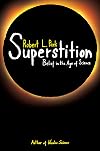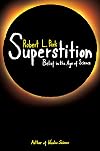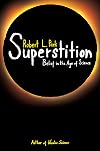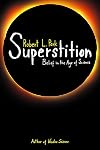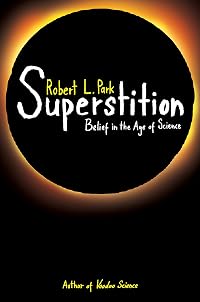
Superstition: Belief in the Age of Science
by Robert L. Park
On This Page
Description
From uttering a prayer before boarding a plane, to exploring past lives through hypnosis, has superstition become pervasive in contemporary culture? Robert Park, the best-selling author of Voodoo Science, argues that it has. In Superstition, Park asks why people persist in superstitious convictions long after science has shown them to be ill-founded. He takes on supernatural beliefs from religion and the afterlife to New Age spiritualism and faith-based medical claims. He examines recent show more controversies and concludes that science is the only way we have of understanding the world. Park sides with the forces of reason in a world of continuing and, he fears, increasing superstition. Chapter by chapter, he explains how people too easily mistake pseudoscience for science. He discusses parapsychology, homeopathy, and acupuncture; he questions the existence of souls, the foundations of intelligent design, and the power of prayer; he asks for evidence of reincarnation and astral projections; and he challenges the idea of heaven. Throughout, he demonstrates how people's blind faith, and their confidence in suspect phenomena and remedies, are manipulated for political ends. Park shows that science prevails when people stop fooling themselves. Compelling and precise, Superstition takes no hostages in its quest to provoke. In shedding light on some very sensitive--and Park would say scientifically dubious--issues, the book is sure to spark discussion and controversy. show lessTags
Recommendations



Member Reviews
Very disappointing. Superstition is a meandering exposition of the personal philosophy of Robert Park, not a serious attempt at debunking or criticism of belief. To be fair, Park is just as critical of New Age as he is of Creationism, and has some unpleasant things to say about the advocacy of “Alternative Medicine” by officials of the Clinton administration as well as prohibition of stem cell research (Park does point out that only Federal support of stem cell research was prohibited) by the Bush administration.
Park never gets deep enough into any of his subjects to be convincing. His chapter on homeopathy, for example, runs through the tired argument that a homeopathic preparation doesn’t contain any of the original substance show more – that’s true, but irrelevant, because homeopaths don’t claim that it does. The real hammer against homeopathy is its failure to perform in double blind tests. A good, solid, explanation of what a double blind test is (I ran across a dowser website in which one of the posters was convinced that it meant he had to wear two blindfolds while dowsing) and what it’s supposed to measure is worth 1000 calculations on the number of duck liver molecules in a 30X homeopathic preparation. (Park does narrate his failure to get Jaques Benveniste to submit his Web-based homeopathy to a double-blind test).
The concept of “metric” also works against Park. His case against various medical studies supposedly showing the efficacy of prayer centers on the fact that there is no metric for prayer – Christian prayer versus Jewish? Presbyterians versus Congregationalists? Tests of “prayer sincerity”? (I once answered the question “How much do you love me?” by saying “138.2 International Standard Love Units”. The relationship did not thrive). Park is, of course, correct. However, he apparently doesn’t realize that the same lack of metrics makes some of his own criticisms of religious belief cases of being hoist with his own petard. For example, consider this casual comment about the Ten Commandments (p 197 in my edition): “Indeed, fundamentalists who trumpet the Ten Commandments most loudly are often the first to call for war”. Oh, that’s interesting. What’s the “metric” for fundamentalists? How do you measure how much a fundamentalist a particular believer is? And how do you measure how much trumpeting of the Ten Commandments he/she does (perhaps in decibels?). And how often do the measured trumpeting fundamentalists call for war? And what percentage of the time are they “the first”?
I never read a book that had nothing useful in it, and this book does, of course, even if it’s often only to remind me of stuff I already knew. Park’s prose reads very smoothly and it’s a really quick read. But I got it out of the remainder bin, which isn’t surprising. show less
Park never gets deep enough into any of his subjects to be convincing. His chapter on homeopathy, for example, runs through the tired argument that a homeopathic preparation doesn’t contain any of the original substance show more – that’s true, but irrelevant, because homeopaths don’t claim that it does. The real hammer against homeopathy is its failure to perform in double blind tests. A good, solid, explanation of what a double blind test is (I ran across a dowser website in which one of the posters was convinced that it meant he had to wear two blindfolds while dowsing) and what it’s supposed to measure is worth 1000 calculations on the number of duck liver molecules in a 30X homeopathic preparation. (Park does narrate his failure to get Jaques Benveniste to submit his Web-based homeopathy to a double-blind test).
The concept of “metric” also works against Park. His case against various medical studies supposedly showing the efficacy of prayer centers on the fact that there is no metric for prayer – Christian prayer versus Jewish? Presbyterians versus Congregationalists? Tests of “prayer sincerity”? (I once answered the question “How much do you love me?” by saying “138.2 International Standard Love Units”. The relationship did not thrive). Park is, of course, correct. However, he apparently doesn’t realize that the same lack of metrics makes some of his own criticisms of religious belief cases of being hoist with his own petard. For example, consider this casual comment about the Ten Commandments (p 197 in my edition): “Indeed, fundamentalists who trumpet the Ten Commandments most loudly are often the first to call for war”. Oh, that’s interesting. What’s the “metric” for fundamentalists? How do you measure how much a fundamentalist a particular believer is? And how do you measure how much trumpeting of the Ten Commandments he/she does (perhaps in decibels?). And how often do the measured trumpeting fundamentalists call for war? And what percentage of the time are they “the first”?
I never read a book that had nothing useful in it, and this book does, of course, even if it’s often only to remind me of stuff I already knew. Park’s prose reads very smoothly and it’s a really quick read. But I got it out of the remainder bin, which isn’t surprising. show less
Not so much about superstition in general as about religious superstition. The author explores the ways in which religion and science are quite simply incompatible. Sort of a lightweight book, reasonably well written, but with frequent errors that could have been easily caught by a beginning proofreader. These annoyed and detracted, though they were not so damaging that they made the book impossible to read, just occasionally accidentally incoherent. (This is NOT a compliment). An example of a more major error is mistakenly attributing to Gary Trudeau the disgraceful career of Kevin Trudeau; honestly, why did an editor not catch that? In addition, the author presents a lot of biological hypotheses as though they are so solidly acccepted show more by all scientists that no one questions them anymore, though many of them are still somewhat uncertain. Included in this is the idea that our brain has not evolved since the Pleistocene and the tendency to equate everything to "a gene for" that. Not really anything new to add to the conversation, and not likely to convince anyone who is not already convinced that science and religion are incompatible. He makes all the right arguments, but he fails to follow them up well. At best a humble beginning. show less
Ratings
Members
- Recently Added By
Author Information

6+ Works 656 Members
Robert L. Park is professor of physics at the University of Maryland. He is the author of Voodoo Science: The Road from Foolishness to Fraud.
Common Knowledge
- Original publication date
- 2008
- Last words
- (Click to show. Warning: May contain spoilers.)Science is the only way of knowing -- everything else is just superstition.
- Blurbers
- Shermer, Michael; Randi, James; Scott, Eugenie C.; Fitch, Val; Gingras, Yves
Classifications
- Genres
- Nonfiction, Religion & Spirituality, Sociology, General Nonfiction, Philosophy
- DDC/MDS
- 215 — Religion Philosophy & theory of religion Science and religion
- LCC
- BL240.3 .P37 — Philosophy, Psychology and Religion Religions. Mythology. Rationalism Religions. Mythology. Rationalism Natural theology Religion and science
- BISAC
Statistics
- Members
- 108
- Popularity
- 301,163
- Reviews
- 2
- Rating
- (4.25)
- Languages
- English
- Media
- Paper, Ebook
- ISBNs
- 4
- ASINs
- 1