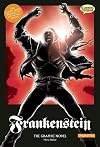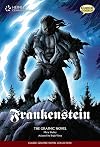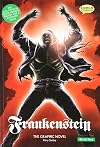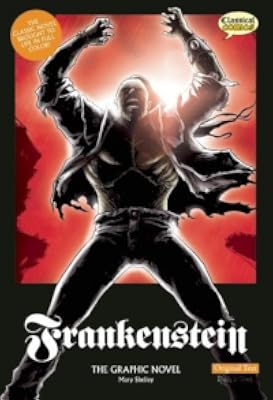
Frankenstein: The Graphic Novel
by Jason Cobley (Author), Declan Shalvey (Illustrator)
On This Page
Description
A monster assembled by a scientist from parts of dead bodies develops a mind of his own as he learns to loathe himself and hate his creator.Tags
Recommendations

Member Reviews
"His countenance expressed the utmost extent of malice and treachery."
Of all the classic works of fiction, Mary Shelley’s Frankenstein is probably the most suited for this sort of adaptation.*
It’s a brooding tale of mortality and the quest for the ultimate knowledge over life and death; it’s a gothic horror masterpiece about longing and revenge and the need for companionship. It has weird pseudo-science and daring voyages and an enormous, unstoppable monster, which might well be a metaphor for something but which is, in the meantime, actually an enormous, unstoppable monster.
And all that before you add the illustrations of men hollering ‘AAARGH’ and women exclaiming ‘SHRIEK’ (no, really). Aside from a little dumbing-down show more here and there, the artwork and glossy sleekness of this graphic novel are compelling. Even the purest of literary scholars would bend a little, on getting a whiff of the new paper and ink, and viewing the exquisite colours. Said purist could not even fault the text, which is largely (completely?) from the original story and made to work very well with the illustrated panels, although there is something a touch surreal about the modern / classic juxtaposition; maybe it’s just that the artist has read one too many hulk comics.
I’m a fan. I’m impressed at how this series brings a new format to classic literature; if it's purpose is to reach new readers, then it's seductive lines and accessible story-telling are marketing at its cleverest. The inclusion of additional information on the author, the Frankenstein’s Monster’s place in film and history, and even a breakdown of the graphic novel’s page creation is a nice touch and lends the book a certain authenticity as a study-aid, and the solid weight and style speak to the quality of production.
The graphic novel manages to largely capture the sadness, richness and fear of the original tale; I’d still rather read the original, but I’d want this on my shelf as well.
*That said, I’m dying to get my hands on the graphic novel version of Great Expectations… what larks, Pip! show less
Of all the classic works of fiction, Mary Shelley’s Frankenstein is probably the most suited for this sort of adaptation.*
It’s a brooding tale of mortality and the quest for the ultimate knowledge over life and death; it’s a gothic horror masterpiece about longing and revenge and the need for companionship. It has weird pseudo-science and daring voyages and an enormous, unstoppable monster, which might well be a metaphor for something but which is, in the meantime, actually an enormous, unstoppable monster.
And all that before you add the illustrations of men hollering ‘AAARGH’ and women exclaiming ‘SHRIEK’ (no, really). Aside from a little dumbing-down show more here and there, the artwork and glossy sleekness of this graphic novel are compelling. Even the purest of literary scholars would bend a little, on getting a whiff of the new paper and ink, and viewing the exquisite colours. Said purist could not even fault the text, which is largely (completely?) from the original story and made to work very well with the illustrated panels, although there is something a touch surreal about the modern / classic juxtaposition; maybe it’s just that the artist has read one too many hulk comics.
I’m a fan. I’m impressed at how this series brings a new format to classic literature; if it's purpose is to reach new readers, then it's seductive lines and accessible story-telling are marketing at its cleverest. The inclusion of additional information on the author, the Frankenstein’s Monster’s place in film and history, and even a breakdown of the graphic novel’s page creation is a nice touch and lends the book a certain authenticity as a study-aid, and the solid weight and style speak to the quality of production.
The graphic novel manages to largely capture the sadness, richness and fear of the original tale; I’d still rather read the original, but I’d want this on my shelf as well.
*That said, I’m dying to get my hands on the graphic novel version of Great Expectations… what larks, Pip! show less
 This review was written for LibraryThing Early Reviewers.
There is so much about Frankenstein and its place in literature that I would need to know to fully appreciate the novel, but my God, reading it is a dreary business.
Dreariness and comics, though, are no strangers, and this graphic version of Frankenstein works well. The selected fragments of the original prose flow nicely, with the suitably gloomy illustrations amply filling in for the missing text. It does suffer from one comic book trait: every fourth word or so is inexplicably bolded, making Shelley's already overwrought prose seem even more so.
Dreariness and comics, though, are no strangers, and this graphic version of Frankenstein works well. The selected fragments of the original prose flow nicely, with the suitably gloomy illustrations amply filling in for the missing text. It does suffer from one comic book trait: every fourth word or so is inexplicably bolded, making Shelley's already overwrought prose seem even more so.
In a surprising fit of diligence, I decided to read the novel Frankenstein before reading and reviewing the graphic novel for the LT Early Reviewers.
And “frankly,” what struck me the most was the language Shelley used. I’ve read a fair number of authors who were working in the mid to late 1800s, and rarely did I find the style and state of the English language to be as obtrusive as they were in Frankenstein, which was published in 1818.
This isn’t necessarily a bad thing, but, for me, it did put an extra barrier between myself and the text, making the reading experience a little less natural feeling. An example of what I mean is the following passage, describing Frankenstein’s feelings of disappointment after bringing the show more monster to life.
“Thus not the tenderness of friendship, nor the beauty of earth, nor of heaven, could redeem my soul from woe: the very accents of love were ineffectual. I was encompassed by a cloud which no beneficial influence could penetrate. The wounded deer dragging its fainting limbs to some untrodden brake, there to gaze upon the arrow which had pierced it, and to die--was but a type of me.”
I also have to wonder if the nearly 200 years between Shelley’s writing and my reading affect what I thought of some of the wilder aspects of the plot. And I don’t only mean those having to do with the monster. But I’ll get back to that.
Anyway, the basic outline of the book is that Victor Frankenstein, from a noble Genevan family, discovers how to bring the spark of life to the dead and goes about putting together and animating the “monster” from body parts harvested from corpses.
But when the monster lives and Frankenstein sees its physical ugliness, he can’t bear it. He essentially turns the monster out. Years pass and the monster becomes acquainted with the ways of mankind: That is, that people will not look beyond his physical appearance to find the humanity that lies inside.
So he then tracks down Frankenstein to have his revenge, which involves killing off Frankenstein’s friends and family in a way that is supposed to ultimately force the good doctor to create a female monster, with whom the original will retire the some uncivilized part of the world and leave the rest of mankind alone.
Frankenstein eventually gives it a try, but when the time comes to reanimate the female monster, he can’t do it, concerned about playing god and letting loose another daemon the world.
The monsters gets his revenge by killing Frankenstein’s wife on his/her wedding day. Frankenstein vows to hunt him down. The books ends w/Frankenstein dying essentially of exhaustion and the creature, upon discovering this, vows to kill himself as well, now that his tormentor/creator, Frankenstein, is also dead.
There’s some good philosophical stuff here about technology, its limits and how people treat one another, and that’s what gives the novel its timeless appeal.
But, as I mentioned, some of the other plot points deserve a second look. The key example is that Frankenstein’s significant other, Elizabeth, was actually the child of a nobleman and his mistress a German woman, who died when Elizabeth was born. She was then taken in by a peasant family, which was discovered by Frankenstein’s mother and “adopted” as Frankenstein’s cousin/sister. This was when Victor was about five and Elizabeth was younger.
The elder Frankensteins’ plan, it becomes clear, was for Victor and Elizabeth to marry. After being raised together as siblings for 15 or so years.
This way of treating people as products to be traded and moved about likely informs the way Frankenstein treats the creature as well.
And one final thing did strike me as a misstep, plot-wise. The monster tells Frankenstein that he (the monster) plans on getting his revenge by striking at those he (Frankenstein) loves best. But despite this, when the monster says he will get his ultimate revenge on Frankenstein’s wedding night, the doctor thinks the monster means to kill him, not his wife.
That just didn’t seem likely to me, even in the context of all the other unlikelinesses.
Finally getting to the graphic novel, I have to say this was relatively well done. The illustrator’s take on the monster was new to me, but believable, and the overall level of the graphics throughout was good.
Further, it used Shelley’s original text, although I found a passage that, in the novel, involved Frankenstein narrating to himself a bit of action that became, in the graphic novel, a quote in the mouth of someone else.
But all in all, the graphic novel stripped out some of the more purple prose, allowing a modern reader to focus on the essential points of the original.
And that does bring up a point in which some readers will be interested: The company behind the graphic novel explicitly positions the book as a way to get today’s younger (high school-ish) readers interested in some of the classics. The company even advertises versions of the graphic novel that have been translated into modern English and, beyond this, further specially edited into some sort of even easier to read “QuickText.”
In the end, I recommend both the original novel and the original text graphic novel, but with the caveat that the former requires a bit more effort and the latter loses just a bit of the nuances of the story. show less
And “frankly,” what struck me the most was the language Shelley used. I’ve read a fair number of authors who were working in the mid to late 1800s, and rarely did I find the style and state of the English language to be as obtrusive as they were in Frankenstein, which was published in 1818.
This isn’t necessarily a bad thing, but, for me, it did put an extra barrier between myself and the text, making the reading experience a little less natural feeling. An example of what I mean is the following passage, describing Frankenstein’s feelings of disappointment after bringing the show more monster to life.
“Thus not the tenderness of friendship, nor the beauty of earth, nor of heaven, could redeem my soul from woe: the very accents of love were ineffectual. I was encompassed by a cloud which no beneficial influence could penetrate. The wounded deer dragging its fainting limbs to some untrodden brake, there to gaze upon the arrow which had pierced it, and to die--was but a type of me.”
I also have to wonder if the nearly 200 years between Shelley’s writing and my reading affect what I thought of some of the wilder aspects of the plot. And I don’t only mean those having to do with the monster. But I’ll get back to that.
Anyway, the basic outline of the book is that Victor Frankenstein, from a noble Genevan family, discovers how to bring the spark of life to the dead and goes about putting together and animating the “monster” from body parts harvested from corpses.
But when the monster lives and Frankenstein sees its physical ugliness, he can’t bear it. He essentially turns the monster out. Years pass and the monster becomes acquainted with the ways of mankind: That is, that people will not look beyond his physical appearance to find the humanity that lies inside.
So he then tracks down Frankenstein to have his revenge, which involves killing off Frankenstein’s friends and family in a way that is supposed to ultimately force the good doctor to create a female monster, with whom the original will retire the some uncivilized part of the world and leave the rest of mankind alone.
Frankenstein eventually gives it a try, but when the time comes to reanimate the female monster, he can’t do it, concerned about playing god and letting loose another daemon the world.
The monsters gets his revenge by killing Frankenstein’s wife on his/her wedding day. Frankenstein vows to hunt him down. The books ends w/Frankenstein dying essentially of exhaustion and the creature, upon discovering this, vows to kill himself as well, now that his tormentor/creator, Frankenstein, is also dead.
There’s some good philosophical stuff here about technology, its limits and how people treat one another, and that’s what gives the novel its timeless appeal.
But, as I mentioned, some of the other plot points deserve a second look. The key example is that Frankenstein’s significant other, Elizabeth, was actually the child of a nobleman and his mistress a German woman, who died when Elizabeth was born. She was then taken in by a peasant family, which was discovered by Frankenstein’s mother and “adopted” as Frankenstein’s cousin/sister. This was when Victor was about five and Elizabeth was younger.
The elder Frankensteins’ plan, it becomes clear, was for Victor and Elizabeth to marry. After being raised together as siblings for 15 or so years.
This way of treating people as products to be traded and moved about likely informs the way Frankenstein treats the creature as well.
And one final thing did strike me as a misstep, plot-wise. The monster tells Frankenstein that he (the monster) plans on getting his revenge by striking at those he (Frankenstein) loves best. But despite this, when the monster says he will get his ultimate revenge on Frankenstein’s wedding night, the doctor thinks the monster means to kill him, not his wife.
That just didn’t seem likely to me, even in the context of all the other unlikelinesses.
Finally getting to the graphic novel, I have to say this was relatively well done. The illustrator’s take on the monster was new to me, but believable, and the overall level of the graphics throughout was good.
Further, it used Shelley’s original text, although I found a passage that, in the novel, involved Frankenstein narrating to himself a bit of action that became, in the graphic novel, a quote in the mouth of someone else.
But all in all, the graphic novel stripped out some of the more purple prose, allowing a modern reader to focus on the essential points of the original.
And that does bring up a point in which some readers will be interested: The company behind the graphic novel explicitly positions the book as a way to get today’s younger (high school-ish) readers interested in some of the classics. The company even advertises versions of the graphic novel that have been translated into modern English and, beyond this, further specially edited into some sort of even easier to read “QuickText.”
In the end, I recommend both the original novel and the original text graphic novel, but with the caveat that the former requires a bit more effort and the latter loses just a bit of the nuances of the story. show less
This review was written for LibraryThing Early Reviewers.Lazy adaptation, simply keeping a simplified version of Shelley's text and letting Frankenstein monologue on top of images.
The one thing I do like is that it downplays the monster's ugliness, making him (at least in the text) more horrifying and wrong than simply ugly. Much better recipe for horror.
The one thing I do like is that it downplays the monster's ugliness, making him (at least in the text) more horrifying and wrong than simply ugly. Much better recipe for horror.
SYNOPSIS
Victor Frankenstein creates a new man out of body parts scavenged from corpses and brings it back to life. The creature longs to be connected with others, but commits murder when he is rejected by society. The creature demands that Victor make a companion for him, but Victor refuses. The creature retaliates by murdering Victor's bride during their honeymoon.
Frankenstein's monster is not the lumbering, monosyllabic brute as portrayed in the classic Boris Karloff film. Rather, he is incredibly articulate and aware of what he is, tormented by existential angst and his longing for companionship. The monster and his creator are locked in a bitter cycle of retribution that will lead both of them to ruin.
REVIEW
It's been quite a while show more since I've read the original novel, but it seems to me that this does a fine job of capturing the essence of the story. The artwork is very strong and appealing; a bit too modern perhaps for some, but it should grab the attention of younger readers.
This graphic novel uses the original text from the classic novel, and is intended to be used as a study aid in school. It is also available in a "quick text" version. A short biography of the author appears at the end, as well as an essay about the lasting cultural significance of Frankenstein.
While certainly not a substitute for reading the novel itself, this book serves as a fine companion that can help students understand what the story is really about.
From the back of the book I see that even more adaptations are planned, including Dickens and Shakespeare. I am curious to see what these will look like. show less
Victor Frankenstein creates a new man out of body parts scavenged from corpses and brings it back to life. The creature longs to be connected with others, but commits murder when he is rejected by society. The creature demands that Victor make a companion for him, but Victor refuses. The creature retaliates by murdering Victor's bride during their honeymoon.
Frankenstein's monster is not the lumbering, monosyllabic brute as portrayed in the classic Boris Karloff film. Rather, he is incredibly articulate and aware of what he is, tormented by existential angst and his longing for companionship. The monster and his creator are locked in a bitter cycle of retribution that will lead both of them to ruin.
REVIEW
It's been quite a while show more since I've read the original novel, but it seems to me that this does a fine job of capturing the essence of the story. The artwork is very strong and appealing; a bit too modern perhaps for some, but it should grab the attention of younger readers.
This graphic novel uses the original text from the classic novel, and is intended to be used as a study aid in school. It is also available in a "quick text" version. A short biography of the author appears at the end, as well as an essay about the lasting cultural significance of Frankenstein.
While certainly not a substitute for reading the novel itself, this book serves as a fine companion that can help students understand what the story is really about.
From the back of the book I see that even more adaptations are planned, including Dickens and Shakespeare. I am curious to see what these will look like. show less
This review was written for LibraryThing Early Reviewers.It has been years since I read the original, that was in college. I remember enjoying it; I enjoyed it all the more for it's nearly total lack of relationship to the (mostly) awful and still delightful movies I grew up watching on Saturday afternoon on "Shock Theater." This version of the graphic novel interpretation (Classical Comics has two, this and a "Quick Text" version that abandons the original language but sticks to the story) uses a lot of the original text in the narration and the "talk bubbles." That said it is still an adaptation and an abridgment. It preserves a lot of the original language and most of the original storyline.
The art work is dark and dynamic. The color and some of the linework has a show more computer-generated/enhanced look to it, but on the whole it is well done from beginning to end.
And speaking of "end": the extras Classical Comics have added after the graphic story is done are GREAT. There is a biography of Mary Shelley focusing on the novel, her family tree, a short piece about how the novel came about including images of the actual manuscript, a short history of the ways the story has been brought to life, and finally an explanation of how this work was created.
I hesitate to say this because I have always been against abridgments of any kind (wait until you are old enough to read the original, there are plenty of works on your level whatever it might be to read in the interim) but I do think this would work as an exccellent introduction to Shelley's novel...and it could be used in schools...several of my co-workers have just fainted (because I wrote those words). show less
The art work is dark and dynamic. The color and some of the linework has a show more computer-generated/enhanced look to it, but on the whole it is well done from beginning to end.
And speaking of "end": the extras Classical Comics have added after the graphic story is done are GREAT. There is a biography of Mary Shelley focusing on the novel, her family tree, a short piece about how the novel came about including images of the actual manuscript, a short history of the ways the story has been brought to life, and finally an explanation of how this work was created.
I hesitate to say this because I have always been against abridgments of any kind (wait until you are old enough to read the original, there are plenty of works on your level whatever it might be to read in the interim) but I do think this would work as an exccellent introduction to Shelley's novel...and it could be used in schools...several of my co-workers have just fainted (because I wrote those words). show less
This review was written for LibraryThing Early Reviewers.Frankenstein tells the story of a scientist named Victor who creates a creature from dead body parts. He is horrified by his creation and abandons it. The creature is not well received by those he meets and is often greeted with violence. The creature starts to kill those close to Victor for revenge.
This graphic novel is a fairly well done adaptation of the novel of the same name, so a lot of the themes are still there. It leaves out a minimal amount of story. The only thing that stands out to me is the omission of the books the creature uses to learn about humans and society. This does eliminate the themes that deal with the revolution happening in France during the time this novel was penned, but that shouldn’t matter for secondary show more ed. purposes.
Personally, I thought that this graphic novel was a very well done adaptation of the novel. The illustrations were very well done, and the color scheme was excellent. It is rather on the short side. For a good reader, 15 minutes is plenty enough time to finish the graphic novel. It could stand to be a little longer and include a little more meat, but it works as is. show less
This graphic novel is a fairly well done adaptation of the novel of the same name, so a lot of the themes are still there. It leaves out a minimal amount of story. The only thing that stands out to me is the omission of the books the creature uses to learn about humans and society. This does eliminate the themes that deal with the revolution happening in France during the time this novel was penned, but that shouldn’t matter for secondary show more ed. purposes.
Personally, I thought that this graphic novel was a very well done adaptation of the novel. The illustrations were very well done, and the color scheme was excellent. It is rather on the short side. For a good reader, 15 minutes is plenty enough time to finish the graphic novel. It could stand to be a little longer and include a little more meat, but it works as is. show less
Members
- Recently Added By
Lists

Graphic Novels Adapted from Other Books
206 works; 1 member
Author Information
All Editions
Awards and Honors
Notable Lists
Series
Belongs to Publisher Series
Work Relationships
Is an adaptation of
Common Knowledge
- Canonical title
- Frankenstein: The Graphic Novel
- People/Characters
- Mary Wollstonecraft Shelley
- Disambiguation notice
- This is the Classical Comics graphic novel adaptation of Frankenstein, not the original book. It should not be combined with the major work or with different graphic novel adaptations. Thank you.
Classifications
- Genre
- Graphic Novels & Comics
- DDC/MDS
- 741.5 — Arts & recreation Drawing & decorative arts Drawing Comic books, graphic novels, fotonovelas, cartoons, caricatures, comic strips
- LCC
- PN6737 .S44 .F73 — Language and Literature Literature (General) Literature (General) Collections of general literature Comic books, strips, etc.
- BISAC
Statistics
- Members
- 230
- Popularity
- 141,677
- Reviews
- 17
- Rating
- (3.79)
- Languages
- English
- Media
- Paper
- ISBNs
- 10
- ASINs
- 2