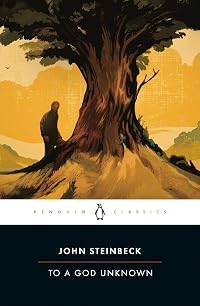
To a God Unknown
by John Steinbeck
On This Page
Description
On his new ranch in California, Joseph Wayne sees a huge tree as the symbol of his father's spirit. But then one of his brothers, terrified by Joseph's pagan beliefs, kills the tree.Tags
Recommendations










Member Reviews
Rating: how it hurts me to do this, but a squeaking-by three stars of five
Steinbeck's second novel, which he labored over for five years, was damned near never published. The title is from a Vedic hym to Prajapati, who is occasionally the Supreme God and, at other times, an avatar of "...Brahma, Vishnu, Shiva, Agni, Indra, Vishvakarma, Bharata, Kapila and many others." (Dalal, [Hinduism: An Alphabetical Guide]). The inspiratin for the novel's ancient tree spirit, then, explains the novel's complete and utter incoherence of purpose. Are we pro-tree-worship or anti-? We're both? But surely on opposite sides the characters discussing the subject are...wait, they *aren't* different characters? But, but that's waffling! It's not? Why isn't show more that waffling? Pshaw, the characters aren't Jungian archetypes and larger-than-life...what? There's a thirty-seven page essay introducing the book, written by Steinbeck scholar [[Robert DeMott]] saying it isn't?
The prostitution rests.
If you need thirty-seven pages of waffle to explain why something's good enough to read, nobody wants to read it and for a reason. Steinbeck got a few hundred for the book as an advance and, as the opus sold a whopping 598 copies, it lost money. The publisher also rejected, in breaking this bad news, [Tortilla Flat]; a sad mistake on his part as that was an altogether superior book and went on to make pots of moolah. Read it instead of this one. To a God Unknown deserves its commercial and scholarly oblivion. show less
Steinbeck's second novel, which he labored over for five years, was damned near never published. The title is from a Vedic hym to Prajapati, who is occasionally the Supreme God and, at other times, an avatar of "...Brahma, Vishnu, Shiva, Agni, Indra, Vishvakarma, Bharata, Kapila and many others." (Dalal, [Hinduism: An Alphabetical Guide]). The inspiratin for the novel's ancient tree spirit, then, explains the novel's complete and utter incoherence of purpose. Are we pro-tree-worship or anti-? We're both? But surely on opposite sides the characters discussing the subject are...wait, they *aren't* different characters? But, but that's waffling! It's not? Why isn't show more that waffling? Pshaw, the characters aren't Jungian archetypes and larger-than-life...what? There's a thirty-seven page essay introducing the book, written by Steinbeck scholar [[Robert DeMott]] saying it isn't?
The prostitution rests.
If you need thirty-seven pages of waffle to explain why something's good enough to read, nobody wants to read it and for a reason. Steinbeck got a few hundred for the book as an advance and, as the opus sold a whopping 598 copies, it lost money. The publisher also rejected, in breaking this bad news, [Tortilla Flat]; a sad mistake on his part as that was an altogether superior book and went on to make pots of moolah. Read it instead of this one. To a God Unknown deserves its commercial and scholarly oblivion. show less
Ostensibly a book about the overlap of the Christian settlers in the West and the more antediluvian paganism – really more like pantheism – that was already awaiting them in the land, John Steinbeck's early To a God Unknown works better as a sensory experience. A mix of brutal and pastoral, as a reader you feel the arid heat when the droughts come and the moist soil when it rains. The prose is clean and loamy, and whilst it is not 'mystical' (Steinbeck apparently disliked it being described as that), it is a very earthy book.
However, in its literary aims it is rather laboured. The book took longer to write than any of his other novels, including his dense masterpieces The Grapes of Wrath and East of Eden, and this difficult birth is show more very much evident as you read it. The Christian/pagan-pantheist duality never really breathes or provides direction for the reader, and Steinbeck's later powers of observation are still developing. The characters are rather stunted and they talk like parables (when the protagonist's wife tells him she is pregnant, his reply is "the child is precious, but not so precious as the bearing of it… That is a tie to the earth" (pg. 95)). The problem is that it is a parable without a clear message. That said, I liked the ending and the prose is not as dull as it first appears. I don't think Steinbeck got closer to the unknown God in this book, but I did get a sense of his atavistic joys. I can smell the soil and the liberating rain. show less
However, in its literary aims it is rather laboured. The book took longer to write than any of his other novels, including his dense masterpieces The Grapes of Wrath and East of Eden, and this difficult birth is show more very much evident as you read it. The Christian/pagan-pantheist duality never really breathes or provides direction for the reader, and Steinbeck's later powers of observation are still developing. The characters are rather stunted and they talk like parables (when the protagonist's wife tells him she is pregnant, his reply is "the child is precious, but not so precious as the bearing of it… That is a tie to the earth" (pg. 95)). The problem is that it is a parable without a clear message. That said, I liked the ending and the prose is not as dull as it first appears. I don't think Steinbeck got closer to the unknown God in this book, but I did get a sense of his atavistic joys. I can smell the soil and the liberating rain. show less
Another hit by Steinbeck!
I really enjoyed this book overall, particularly the elements of a more wild "magic" for lack of a better word. I was very much having fun seeing this family move to the land and be very successful with their ventures there (all seemingly thanks to Joseph and the big oak tree), though I was very much waiting for the classic Steinbeck twist/deaths, and boy did that happen.
I really enjoyed this book overall, particularly the elements of a more wild "magic" for lack of a better word. I was very much having fun seeing this family move to the land and be very successful with their ventures there (all seemingly thanks to Joseph and the big oak tree), though I was very much waiting for the classic Steinbeck twist/deaths, and boy did that happen.
Never even knew this book existed until I came across this 1955 paperback edition at a used book store, priced at $1, up just bit from its original thirty-five cent cover price. It's hawked as the progenitor of East of Eden, the story of a family and the land to which they have tied themselves, but is mostly an overwritten turd. The theatrical dialogue made me cringe from start to finish.
It did amuse me to start thinking of it as dark magical realism and even a full-on horror novel, rife with Lovecraftian dread, a haunted tree, Native American sacred ground, pagan offerings, two (!) dance orgies, and blood and human sacrifice. The WTF elements couldn't pull it out of its long, slow and inevitable crash and burn though.
My least favorite show more outing with one of my favorite authors. show less
It did amuse me to start thinking of it as dark magical realism and even a full-on horror novel, rife with Lovecraftian dread, a haunted tree, Native American sacred ground, pagan offerings, two (!) dance orgies, and blood and human sacrifice. The WTF elements couldn't pull it out of its long, slow and inevitable crash and burn though.
My least favorite show more outing with one of my favorite authors. show less
The junior version of East of Eden that Steinbeck would write when he had mastered a more subtle way of expressing himself. To a God is full of hyperbole and awkward religious symbolism, both pagan and Christian. To a God Unknown tries too hard and isn't as profound as Steinbeck seems to want it to be. It smashes you in the face with the overwrought emotions of superstitious people struggling to find a purpose in life.
Despite loving the potential of the book and hoping it would get better, it just made me sad and frustrated.
Update 06/03/2024: I'm updating this. I don't think I was fair to this book. When I can remember scenes and characters from it vividly more than a year later, it deserves more credit. Maybe I found it wanting because show more I couched my reading between other books from Steinbeck, I don't know. But, I'm upgrading from two to three-point-five, rounded up to four. Two-star books don't stay in my brain over a year. show less
Despite loving the potential of the book and hoping it would get better, it just made me sad and frustrated.
Update 06/03/2024: I'm updating this. I don't think I was fair to this book. When I can remember scenes and characters from it vividly more than a year later, it deserves more credit. Maybe I found it wanting because show more I couched my reading between other books from Steinbeck, I don't know. But, I'm upgrading from two to three-point-five, rounded up to four. Two-star books don't stay in my brain over a year. show less
Ancient pagan beliefs, the great Greek epics, and the Bible all inform this extraordinary novel by Nobel Prize winner John Steinbeck, which occupied him for more than five difficult years. While fulfilling his dead father’s dream of creating a prosperous farm in California, Joseph Wayne comes to believe that a magnificent tree on the farm embodies his father’s spirit. His brothers and their families share in Joseph’s prosperity, and the farm flourishes—until one brother, frightened by Joseph’s pagan belief, kills the tree, allowing disease and famine to descend on the farm.
This was the first Steinbeck novel that I have read and it is fantastic. I read that he struggled to finish this book, and that it took much more time than his later, and larger novels, Of Mice and Men and Grapes of Wrath. I think that Steinbeck's struggle to produce a novel is paralleled in the struggles that the protagonist in trying to make the land produce. I've not read any other Steinbeck novels, but the engaging themes of the cycles of the land, the interplay between Christianity and pagan animism, and the conflict between carving out one's own destiny and succumbing to forces greater than oneself made it difficult to put the book down. It was earthy, and gritty, but also spiritual and ethereal.
Members
- Recently Added By
Lists

1930s
262 works; 5 members

SHOULD Read Books!
354 works; 9 members

Llibres que he llegit el 2010
35 works; 1 member

Llibres que he llegit el 2016
36 works; 1 member

Reading LIst
648 works; 1 member
Author Information

483+ Works 207,527 Members
In recent years Steinbeck has been elevated to a more prominent status among American writers of his generation. If not quite at the world-class artistic level of a Hemingway or a Faulkner, he is nonetheless read very widely throughout the world by readers of all ages who consider him one of the most "American" of writers. Born in Salinas County, show more California on February 27, 1902, Steinbeck was of German-Irish parentage. After four years as a special student at Stanford University, he went to New York, where he worked as a reporter and as a hod carrier. Returning to California, he devoted himself to writing, with little success; his first three books sold fewer than 3,000 copies. Tortilla Flat (1935), dealing with the paisanos, California Mexicans whose ancestors settled in the country 200 years ago, established his reputation. In Dubious Battle (1936), a labor novel of a strike and strike-breaking, won the gold medal of the Commonwealth Club of California. Of Mice and Men (1937), a long short story that turns upon a melodramatic incident in the tragic friendship of two farm hands, written almost entirely in dialogue, was an experiment and was dramatized in the year of its publication, winning the New York Drama Critics Circle Award. It brought him fame. Out of a series of articles that he wrote about the transient labor camps in California came the inspiration for his greatest book, The Grapes of Wrath (1939), the odyssey of the Joad family, dispossessed of their farm in the Dust Bowl and seeking a new home, only to be driven on from camp to camp. The fiction is punctuated at intervals by the author's voice explaining this new sociological problem of homelessness, unemployment, and displacement. As the American novel "of the season, probably the year, possibly the decade," it won the Pulitzer Prize in 1940. It roused America and won a broad readership by the unusual simplicity and tenderness with which Steinbeck treated social questions. Even today, The Grapes of Wrath remains alive as a vivid account of believable human characters seen in symbolic and universal terms as well as in geographically and historically specific ones. Ma Joad is one of the most memorable characters in twentieth-century American fiction. It is her courage that sustains the family. Steinbeck's best and most ambitious novel after The Grapes of Wrath is East of Eden (1952), a saga of two American families in California from before the Civil War through World War I. Cannery Row (1945), The Wayward Bus (1947), and Sweet Thursday (1955) are lighter works that find Steinbeck returning to the lighthearted tone of Tortilla Flat as he recounts picaresque adventures of modern-day picaros. The Winter of Our Discontent (1961) struck some reviewers as being appropriately titled because of its despairing treatment of humanity's fall from grace in a wasteland world where money is king. Steinbeck also wrote important nonfiction, including Russian Journal (1948) in collaboration with the photographer Robert Capa; Once There Was a War (1958) and America and Americans (1966), which features pictures by 55 leading photographers and a 70-page essay by Steinbeck. His interest in marine biology led to two books primarily about sea life, Sea of Cortez (1941) (with Edward F. Ricketts) and The Log from the Sea of Cortez (1951). Travels with Charley (1962) is an engaging account of his journey of rediscovery of America, which took him through approximately 40 states. Steinbeck was married three times and died in New York City on December 20, 1968 of heart disease and congestive heart failure. He was 66, and had been a life-long smoker. (Bowker Author Biography) show less
Some Editions
Series
Belongs to Publisher Series
Work Relationships
Common Knowledge
- Canonical title
- To a God Unknown
- Original title
- To a God Unknown; To a god unknown
- Original publication date
- 1933
- People/Characters
- Joseph Wayne; Thomas Wayne; Burton Wayne; Juanito; Benjamin Wayne; Rama Wayne (show all 16); Harriet Wayne; Jennie Ramsey Wayne; Elizabeth McGreggor Wayne; John Wayne; Romas; Willie Romas; McGreggor; Alice Garcia; Old Juan; Father Angelo
- Important places
- Vermont, USA; California, USA; Pittsford, Vermont, USA; Nuestra Señora, California, USA; Salinas Valley, California, USA; Our Lady, California, USA (show all 7); Monterey, California, USA
- Epigraph
- TO A GOD UNKNOWN
He is the giver of breath, and strength is his gift.
The high Gods revere his commandments.
His shadow is life, his shadow is death;
Who is He to whom we shall offer our sacrifice?
Th... (show all)rough His might He became lord of the living and glittering world
And he rules th world and the men and the beasts
Who is He to whome we shall offer our sacrifice?
From His strength the mountains take being, and the sea, and they say,
And the distant river;
And these are his body and his two arms.
Who is He to whom we shall offer our sacrifice?
He made the sky and the earth, and His will fixed their places,
Yet they look to Him and tremble.
The risen sun shines forth over Him.
Who is He to whom we shall offer our sacrifices?
He looked over the waters which stored His power and gendered the sacrifice.
He is God over Gods.
Who is He to whom we shall offer our sacrifice?
May He not hurt us, He who made the earth,
Who made the sky and the shining sea?
Who is the God to whom we shall offer our sacrifice?
VEDA - Dedication
- [None]
- First words
- When the crops were under cover on the Wayne farm near Pittsford in Vermont, when the winter wood was cut and the first light snow lay on the ground, Joseph Wayne went to the wing-back chair by the fireplace late one afternoo... (show all)n and stood before his father.
- Last words
- (Click to show. Warning: May contain spoilers.)He thought of Joseph Wayne, and he saw the pale eyes suffering because of the land's want. "That man must be very happy now," Father Angelo said to himself.
- Original language
- English
Classifications
Statistics
- Members
- 1,923
- Popularity
- 11,107
- Reviews
- 37
- Rating
- (3.88)
- Languages
- 16 — Czech, Danish, Dutch, English, Finnish, French, German, Italian, Norwegian (Bokmål), Polish, Portuguese, Romanian, Slovenian, Spanish, Swedish, Turkish
- Media
- Paper, Audiobook, Ebook
- ISBNs
- 52
- ASINs
- 46