
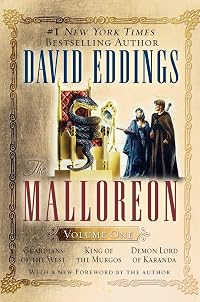
The Malloreon, Volume One
by David Eddings
The Malloreon (Collections and Selections — Omnibus 01-03), Belgariad Universe (Collections and Selections — Omnibus 08-10)
On This Page
Description
Garion has slain the evil God Torak and is now the King of Riva. The prophecy has been fulfilled--or so it seems. For there is a dire warning, as a great evil brews in the East. Now Garion once again finds himself with the fate of the world resting on his shoulders. When Garion's infant son is kidnapped by Zandramas, the Child of Dark, a great quest begins to rescue the boy. Among those on the dangerous mission are Garion and his wife, Queen Ce'Nedra, and the immortal Belgarath the Sorcerer show more and his daughter, Polgara. They must make their way through the foul swamps of Nyissa, then into the lands of the Murgos. Along the way, they will face grave dangers--captivity, a horde of demons, a fatal plague--while Zandramas plots to use Garion's son in a chilling ritual that will make the Dark Destiny supreme. show lessTags
Recommendations

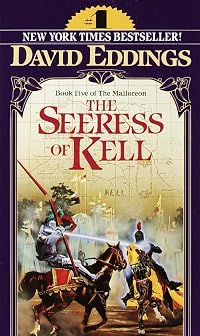
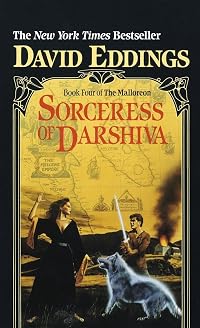
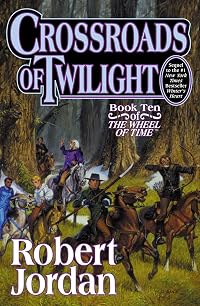
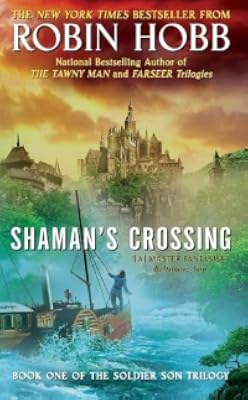
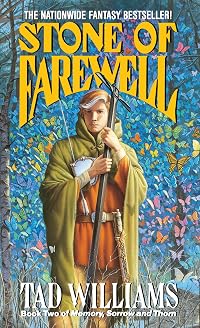
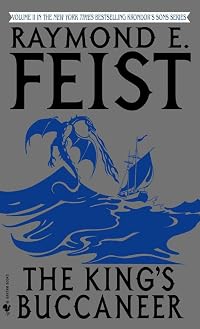
Member Reviews
They say that familiarity breeds contempt. I must say that this is true with my relationship with the late David Eddings. The more I read him, the less I like him.
I received The Belagariad and The Malloreon (each in two-volume sets) for Christmas, unprompted, and managed to get through the Belgariad with no problems, other than my distaste for the very strong racist themes in the book.
In the Malloreon, at least, the first three books, the racist themes are still present, but so are even more sexist themes. It doesn't matter that the party, the same cast as the Belgariad, consists of the worlds greatest sorceress, the most powerful Queen in the West, and one of the greatest female spies known, when it comes to making dinner or doing show more laundry or other stereotypical activities, guess who does it.
The plot is effectively a rehash of the plot of the Belgariad. Garion must travel some place, and defeat the Child of Dark. Been there, done that.
Likewise, much like its predecessor, it relies HEAVILY on this mysterious author's outline called "the Prophecy." "Why are we waiting around in this place when we're in a hurry to kill the evil dudes? Oh, prophecy." "Why did you act atypically and out of character just now? Oh, prophecy."
It's a very, very weak way to "plot" a story, I think. If prophecies exist, well, that's fine. But don't make the characters total slaves to it, and acknowledge it every other page. It makes me feel like I'm reading a fantasy novel written by John Calvin.
Additionally, the writing in the Malloreon is much weaker than that of the Belgarion. In one scene, after the Murgo King leaves his kingdom on a boat to roll with the adventures (for various reasons), once the ship comes aground, the helpful Murgo sailors decide to cease being helpful, and try to KILL the party, including their King, to whom they're LOYAL. So, I guess the king helped kill his own people, or something. Eddings wasn't clear.
On that topic, the characters were more like characters in one of those RPGs where you have roughly seven billion different playable characters, but when they're not actually DOING anything, they disappear into the main character. It felt like that. While the party went on, one character or another would emerge from the character mass, say something in character, and then disappear until they were needed again to fulfill some aspect of the prophecy.
And another thing! Eddings tries to cleverly disguise some character as another, in which a major fail-whale beaches itself from the first introduction. I imagine that nobody else was surprised to find out who the mysterious juggler was. Or maybe I'm just sharper than most Eddings' readers.
To top it off, it's more of the same Tolkienoid fantasy, with pretty much the same cast, doing pretty much the same thing.
If you've read the Belgariad, you don't REALLY need to read the Malloreon. And if you've read Tolkien's The Lord of the Rings, you don't really need to read anything written by Eddings. show less
I received The Belagariad and The Malloreon (each in two-volume sets) for Christmas, unprompted, and managed to get through the Belgariad with no problems, other than my distaste for the very strong racist themes in the book.
In the Malloreon, at least, the first three books, the racist themes are still present, but so are even more sexist themes. It doesn't matter that the party, the same cast as the Belgariad, consists of the worlds greatest sorceress, the most powerful Queen in the West, and one of the greatest female spies known, when it comes to making dinner or doing show more laundry or other stereotypical activities, guess who does it.
The plot is effectively a rehash of the plot of the Belgariad. Garion must travel some place, and defeat the Child of Dark. Been there, done that.
Likewise, much like its predecessor, it relies HEAVILY on this mysterious author's outline called "the Prophecy." "Why are we waiting around in this place when we're in a hurry to kill the evil dudes? Oh, prophecy." "Why did you act atypically and out of character just now? Oh, prophecy."
It's a very, very weak way to "plot" a story, I think. If prophecies exist, well, that's fine. But don't make the characters total slaves to it, and acknowledge it every other page. It makes me feel like I'm reading a fantasy novel written by John Calvin.
Additionally, the writing in the Malloreon is much weaker than that of the Belgarion. In one scene, after the Murgo King leaves his kingdom on a boat to roll with the adventures (for various reasons), once the ship comes aground, the helpful Murgo sailors decide to cease being helpful, and try to KILL the party, including their King, to whom they're LOYAL. So, I guess the king helped kill his own people, or something. Eddings wasn't clear.
On that topic, the characters were more like characters in one of those RPGs where you have roughly seven billion different playable characters, but when they're not actually DOING anything, they disappear into the main character. It felt like that. While the party went on, one character or another would emerge from the character mass, say something in character, and then disappear until they were needed again to fulfill some aspect of the prophecy.
And another thing! Eddings tries to cleverly disguise some character as another, in which a major fail-whale beaches itself from the first introduction. I imagine that nobody else was surprised to find out who the mysterious juggler was. Or maybe I'm just sharper than most Eddings' readers.
To top it off, it's more of the same Tolkienoid fantasy, with pretty much the same cast, doing pretty much the same thing.
If you've read the Belgariad, you don't REALLY need to read the Malloreon. And if you've read Tolkien's The Lord of the Rings, you don't really need to read anything written by Eddings. show less
Omnibus edition, books reviewed separately below:
Guardians of the West:
This is such an oddly structured book, and yet it's easily my favorite of the entire ten-book series. The whole first section is just a gentle, peaceful refresher of what all of Our Heroes have been up to since the events of the Belgariad that I find it immensely relaxing, and the middle section, covering Garion's exploits as King, is equally soothing in a episodic sort of way. And then bam! the last third of the book is All Action All the Time, and serves as the lead-in to the whole narrative arc. I can understand if people found this volume boring unto death, but I like it rather a lot.
King of the Murgos:
The first half or so of the book tends towards the tedious - show more it's a rehash of Queen of Sorcery to the point where the characters are remarking on it. (The fact that Eddings made this into an actual plot/worldbuilding point is sort of clever, I guess, but given the fact that his entire oeuvre consists of the exact same plots/themes/characters, it comes across as retconning rather than planning.) It is a trifle more grown-up, though - the violence isn't nearly as underplayed, and the villain does some pretty horrific things, if always offscreen.
The second half, involving the titular King, works much better. If you can ignore the problematic implications of the pervasive race-as-destiny assumption, Urgit's story is unexpected and rather delightful, and while it doesn't really undercut the core "the slanty-eyed people are bad" premise, at least they become rather more human than they were. The various adventures are entertaining enough that I was mostly able to block out some of the gender-related twitching, and while the ghouls rang particularly false - just needed to move that section along, huh? - it remains a solid entry in the series.
Demon Lord of Karanda:
Demon Lord is a rather disjointed book - there are several episodes that don't really hang together in theme or narrative drive. None of them are bad in themselves, really, they just don't come together to make anything that feels like a stand-alone volume. Definitely a middle book. show less
Guardians of the West:
This is such an oddly structured book, and yet it's easily my favorite of the entire ten-book series. The whole first section is just a gentle, peaceful refresher of what all of Our Heroes have been up to since the events of the Belgariad that I find it immensely relaxing, and the middle section, covering Garion's exploits as King, is equally soothing in a episodic sort of way. And then bam! the last third of the book is All Action All the Time, and serves as the lead-in to the whole narrative arc. I can understand if people found this volume boring unto death, but I like it rather a lot.
King of the Murgos:
The first half or so of the book tends towards the tedious - show more it's a rehash of Queen of Sorcery to the point where the characters are remarking on it. (The fact that Eddings made this into an actual plot/worldbuilding point is sort of clever, I guess, but given the fact that his entire oeuvre consists of the exact same plots/themes/characters, it comes across as retconning rather than planning.) It is a trifle more grown-up, though - the violence isn't nearly as underplayed, and the villain does some pretty horrific things, if always offscreen.
The second half, involving the titular King, works much better. If you can ignore the problematic implications of the pervasive race-as-destiny assumption, Urgit's story is unexpected and rather delightful, and while it doesn't really undercut the core "the slanty-eyed people are bad" premise, at least they become rather more human than they were. The various adventures are entertaining enough that I was mostly able to block out some of the gender-related twitching, and while the ghouls rang particularly false - just needed to move that section along, huh? - it remains a solid entry in the series.
Demon Lord of Karanda:
Demon Lord is a rather disjointed book - there are several episodes that don't really hang together in theme or narrative drive. None of them are bad in themselves, really, they just don't come together to make anything that feels like a stand-alone volume. Definitely a middle book. show less
Review by: Bookman
I have always loved this book. It has a great depth of story, and you must re-read it several times to see everything of this story. It has a very detailed set of cultures, almost all of them loosely based on societies from our world. I believe this to be one of the greatest books of its genre. And it's funny too!
I have always loved this book. It has a great depth of story, and you must re-read it several times to see everything of this story. It has a very detailed set of cultures, almost all of them loosely based on societies from our world. I believe this to be one of the greatest books of its genre. And it's funny too!
Wonderful conclusion to the story. By the time I was reading this though some of the dialogue had gotten a bit repetitious. But that's okay, I still love the story and characters.
Like all Eddings' books, it's not perfect but it's a favorite of mine - rereading these is like meeting an old friend!
My first fantasy series. Will always have a special place in my heart.
Members
- Recently Added By
Lists

Books Read in 2009
464 works; 11 members
Author Information

117 Works 123,208 Members
David Eddings was born on July 7, 1931 in Spokane, Washington. He received a B.A. in English from Reed College in Portland in 1954 and a M.A. in Middle English from the University of Washington in 1961. After serving in the U.S. Army for two years, he worked as a grocery clerk, as a sales clerk for the Boeing Company, and as an English teacher in show more a business college and a teachers' college. During his lifetime, he wrote more than 25 books, many of them with his wife Leigh Eddings. His first novel, High Hunt, was published in 1973. His other works include the Belgariad series, the Mallorean series, the Elenium series, and the Dreamers series. He died on June 2, 2009 at the age of 77. (Bowker Author Biography) show less
Some Editions
Series


Work Relationships
Contains
Common Knowledge
- Canonical title
- The Malloreon, Volume One
- Original title
- The Malloreon, Volume One
- Original publication date
- 2005
- People/Characters
- Atesca (General); Beldin; Belgarath (the Eternal Man, Mister Wolf, Old Wolf); Brador; Ce'Nedra (Imperial Princess of Tolnedra, jewel of the House of Borune, the Queen of the World); Cyradis (Seeress of Kell) (show all 40); Durnik (the Man with Two Lives, the One with Two Lives); Eriond (Errand); Garion (Belgarion, the Child of Light); Geran; Harakan (Ulfgar); Hettar (the Horse Lord); Javelin (Margrave Khendon); Kheva (Crown Prince of Drasnia); Lelldorin of Wildantor (the Archer, the Bowman); Mandorallen (Baron of Vo Mandor, the Knight Protector); Nahaz; Naradas; Oldorin of Perivor (King of Perivor); Oskatat the Seneschal; Poledra (the Woman Who Watches); Polgara (Aunt Pol, the Duchess of Erat); Porenn (Queen of Drasnia); Prala (Princess of the House of Cthan); Sadi (the Man Who Is No Man); Eternal Salmissra; Silk (Ambar of Kotu, the Guide, the Nimble Thief, Prince Kheldar, Radek of Boktor); Tamazin (Queen Mother of Cthol Murgos); Toth (the Silent Man); Urgit (King of the Murgos); Urvon; Varana (the Duke of Anadile, Ran Borune XXIV, Emperor of Tolnedra); Vella; Velvet (the Huntress, Margravine Liselle); Yarblek; Zakath (Emperor of Mallorea, the Empty Man); Zandramas (the Child of Dark); Aldur; Algar Fleet-foot; Agachak
- Important places
- Arendia; Asturia, Arendia
- First words
- After the seven Gods created the world, it is said that they and those races of men they had chosen dwelt together in peace and harmony.
- Last words
- (Click to show. Warning: May contain spoilers.)Then she laughed, shimmered back into the form of the blue wolf, and loped away, her paws seeming scarcely to touch the ground.
- Disambiguation notice
- This is the omnibus edition that contains Guardians of the West, King of the Murgos, and Demon Lord of Karanda. It is not to be combined with the first book of the Malloreon, Guardians of the We... (show all)st.
Classifications
- Genres
- Fiction and Literature, Fantasy
- DDC/MDS
- 808.838766 — Literature & rhetoric Literature, rhetoric & criticism Composition Literature Collections Collections of fiction Genre fiction Adventure fiction Science and Fantasy Fiction Fantasy Fiction
- LCC
- PS3555 .D38 .M35 — Language and Literature American literature American literature Individual authors 1961-
- BISAC
Statistics
- Members
- 1,068
- Popularity
- 23,924
- Reviews
- 7
- Rating
- (4.03)
- Languages
- English, Italian
- Media
- Paper
- ISBNs
- 2
- ASINs
- 3