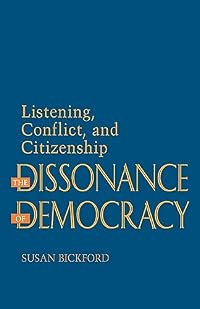
The Dissonance of Democracy: Listening, Conflict, and Citizenship
by Susan Bickford
On This Page
Description
Although the role of shared speech in political action has received much theoretical attention, too little thought has focused on the practice of listening in political interaction, according to Susan Bickford. Even in a formally democratic polity, political action occurs in a context of conflict and inequality; thus, the shared speech of citizenship differs significantly from the conversations of friendly associates. Bickford suggests that democratic politics requires a particular quality show more of attention, one not based on care or friendship. Analyzing specifically political listening is central to the development of democratic theory, she contends, and to envisioning democratic practices for contemporary society.Bickford's analysis draws on the work of Aristotle and of Hannah Arendt to establish the conflictual and contentious character of politics. To analyze the social forces that deflect attention from particular voices, Bickford mobilizes contemporary feminist theory, including Gloria Anzaldua's work on the connection between identity and politics. She develops a conception of citizen interaction characterized by adversarial communication in a context of inequality. Such a conception posits public identity-and hence public listening-as active and creative, and grounded in particular social and political contexts. show lessTags
Members
- Recently Added By
Author Information
3+ Works 78 Members
Classifications
- Genres
- Politics and Government, Nonfiction, Philosophy, Sexuality and Gender Studies
- DDC/MDS
- 302.2 — Society, government, & culture Social sciences, sociology & anthropology Mass Communication & Media Communication
- LCC
- JA85 .B53 — Political Science Political science (General) Political science (General)
- BISAC
Statistics
- Members
- 16
- Popularity
- 1,513,828
- Languages
- English
- Media
- Paper, Ebook
- ISBNs
- 3