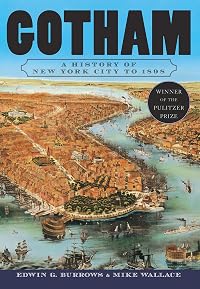
Gotham: A History of New York City to 1898
by Edwin G. Burrows, Mike Wallace
Gotham series (1), Gotham (3)
On This Page
Description
In Gotham, Edwin G. Burrows and Mike Wallace have written an epic as vast and varied as the city it chronicles. Drawing on the work of hundreds of scholars who have reexamined New York's past, the authors weave together diverse histories - of sex and sewer systems, finance and architecture, immigration and politics, poetry and crime - into a single narrative tapestry that reads like a fast-paced novel. Readers will relive the tumultuous early years of New Amsterdam under the Dutch, the show more Indian wars and Peter Stuyvesant's autocratic regime, the English conquest, the rise of slave trading and slave revolts, the invasion and garrisoning of the city during the Revolution. They will watch New York blossom over the nineteenth century into the country's greatest port, leading manufacturing center, preeminent financial hub, corporate headquarters, and incubator of mass cultural innovations from vaudeville and baseball to Coney Island and the department store. But the real heroes and heroines of Gotham are New Yorkers themselves, and the authors provide mini-biographies of hundreds of individuals, ranging from the world famous to the virtually unknown. The interplay among New York's fiercely heterogeneous citizens was often abrasive, and Gotham recounts the way clashes between immigrants and old-timers, rich and poor, blacks and whites flamed into fierce street battles like the Civil War draft riots. But New Yorkers also forged connections and coalitionscreating multi-national picket lines, interracial reform movements, and multi-ethnic political tickets. Their fusions and collisions generated tremendous kinetic energy, cultural inventiveness, and a vision of unity-in-diversity that would become a distinctive contribution to world civilization. show lessTags
Recommendations






Member Recommendations
Member Reviews
Written as a novel, this book covers most of American history: focusing on New York meant concentrating on the world. Very well documented and superbly written, it's a gem of sociopolitical history with emphasis on the poor and inequality's distant roots.
I decided to read Gotham because it had been quite some time since I had a "project." By this term, I mean an oversized book history or philosophy that triggers collateral inquiries and stimulates further reading. I have read, so far, 957 pages of this splendid book, richly illustrated and superbly written by a duo of true historians. Every aspect of New York's development is analyzed and dissected (hence the size of the tome!) with particular emphasis on people, the masses that are show more usually barely mentioned in history books. It talks about the Native life before the arrival of the colonizers and the early development of what will become a beacon on world history and economic discourse.
I mentioned attention to detail: don't let this discourage you, for the book reads as a very interesting novel with a solid plot and many characters, from Cornelius Vanderbilt to the street prostitutes, from Morse to indigent people and drunks, those of religious believes to secular groups.
A few of the achievements of olden times are, even with today's technology, impressive: connecting by underwater cables to Europe and the Erie canal come to mind.
Give yourself time and sample this phenomenal work of art, literature and history. show less
I decided to read Gotham because it had been quite some time since I had a "project." By this term, I mean an oversized book history or philosophy that triggers collateral inquiries and stimulates further reading. I have read, so far, 957 pages of this splendid book, richly illustrated and superbly written by a duo of true historians. Every aspect of New York's development is analyzed and dissected (hence the size of the tome!) with particular emphasis on people, the masses that are show more usually barely mentioned in history books. It talks about the Native life before the arrival of the colonizers and the early development of what will become a beacon on world history and economic discourse.
I mentioned attention to detail: don't let this discourage you, for the book reads as a very interesting novel with a solid plot and many characters, from Cornelius Vanderbilt to the street prostitutes, from Morse to indigent people and drunks, those of religious believes to secular groups.
A few of the achievements of olden times are, even with today's technology, impressive: connecting by underwater cables to Europe and the Erie canal come to mind.
Give yourself time and sample this phenomenal work of art, literature and history. show less
To the people who only gave this book two stars: I wish you would write a review and let us know why!
I read this book over a lazy summer, and have never been more fascinated by a work of non-fiction. Burrows and Wallace profile the city from its "discovery" by white men to the bustle of the 1890s. They discuss almost every conceivable aspect of the city with humour and insightful research, providing us with astonishing statistics, fascinating quotes from the time, and a comprehensive scope that reaches from the aristocracy to the slums. Individual readers will have their own areas that could have been further researched, but truthfully this is a truly absorbing read. (And, since the book at least touches on every aspect of the city's show more history, it's a good starting point to find areas for more specialised reading.)
More so than just the history of one city, this book is a history of trade, urban life, culture and really America as a whole. It is filled with colourful personalities, uplifting stories and tragedies. In some areas, it can be quite academic with its catalogues and investigations of history, but I'm the kind of person who loves that. Better to be ambitious than lazy, I say!
I can't wait for the promised sequel to this book (chronicling the 20th century). show less
I read this book over a lazy summer, and have never been more fascinated by a work of non-fiction. Burrows and Wallace profile the city from its "discovery" by white men to the bustle of the 1890s. They discuss almost every conceivable aspect of the city with humour and insightful research, providing us with astonishing statistics, fascinating quotes from the time, and a comprehensive scope that reaches from the aristocracy to the slums. Individual readers will have their own areas that could have been further researched, but truthfully this is a truly absorbing read. (And, since the book at least touches on every aspect of the city's show more history, it's a good starting point to find areas for more specialised reading.)
More so than just the history of one city, this book is a history of trade, urban life, culture and really America as a whole. It is filled with colourful personalities, uplifting stories and tragedies. In some areas, it can be quite academic with its catalogues and investigations of history, but I'm the kind of person who loves that. Better to be ambitious than lazy, I say!
I can't wait for the promised sequel to this book (chronicling the 20th century). show less
This is an immensly detailed history of New York City from it's beginning to 1898. It is well written but long, very long. There were times when I was totally fascinated and other times when I was totally bored. At one point I even stopped reading for a while. One thing really surprised me. In the 1800s and before the Civil War, there was a chapter on women's issues. The hot topic? Abortion. Yup. Ending abortion and prosecuting those providing abortions. And those seeking it? Yup, same group as today, conservative Christians. I guess the sayings are true. There's nothing new under the sun and the more things change, the more they stay the same.
All in all it was good, and I was considering reading the sequel that takes us to the prsent. show more But not till next year. BUT I learned it is the same length and only goes through World War I, or about 2 decades. Oh, hell no. show less
All in all it was good, and I was considering reading the sequel that takes us to the prsent. show more But not till next year. BUT I learned it is the same length and only goes through World War I, or about 2 decades. Oh, hell no. show less
Obviously I won’t remember all of it, and some parts of the history are sketchier than others. But overall, well worth the read. I learned a lot, and not just about NYC itself—this is kind of a “life and times” approach to the city’s early history, and so has a lot to say about American history, especially urban American history, generally. Very glad I read it, and I will almost certainly be reading the sequel
3458. Gotham: A History of New York City to 1898, by Edwin G. Burrows and Mike Wallace (read July 9, 2001) This won the 1999 History Pulitzer Prize. If it had not I doubt I'd have read it, since I live over a thousand miles from New York. It is a sweeping and magisterial history, full of interesting and amazing things, many of which were new to me. It is a great book--1236 pages of text, 69 pages of a not user-friendly bibliography, and 69 pages of index. This is a really good book, except for its failure to have decent footnotes. I am looking forward to volume II
(which finally came out in 2017 and which I completed reading on 29 Nov 2017).
(which finally came out in 2017 and which I completed reading on 29 Nov 2017).
At 1,424 pages, this is a big book, more a handy reference than sit-down-and-read-it page turner. But if you are looking for specific facts about New York City’s early history, this is the tome for you. “The authors,” noted The New York Times Book Review, “glide easily around town, peeking inside brothels for working men in Five Points, then pressing noses to the gilt-edged windows of the uptown rich.... Burrows and Wallace offer a large-canvas portrait of a city they clearly love.”
This is simply the best history of NYC until 1898, when the city we know today comprised of five boroughs was formed. All aspects of NYC history are covered in great detail. I strongly recommend this book to anyone who has ever lived in NYC or just wants to learn more about it.
Members
- Recently Added By
Lists

Good Nonfiction about New York City
62 works; 10 members
Author Information

4+ Works 2,041 Members
Edwin Gwynne Burrows was born in Detroit, Michigan on May 15, 1943. He received a bachelor's degree in history from the University of Michigan in 1964 and a doctorate in history from Columbia University. He taught history at Brooklyn College from 1972 until his retirement in 2013. His first book, Albert Gallatin and the Political Economy of show more Republicanism, 1761-1800, was published in 1986. His other books included Forgotten Patriots: The Untold Story of American Prisoners During the Revolutionary War and The Finest Building in America: The New York Crystal Palace, 1853-1858. He and Mike Wallace won the Pulitzer Prize for history in 1999 for Gotham: A History of New York City to 1898. Burrows was elected a fellow of the Society of American Historians in 2000. He died from Parkinson's disease on May 4, 2018 at the age of 74. (Bowker Author Biography) show less

5+ Works 2,053 Members
Mike Wallace is Distinguished Professor of History at John Jay College of Criminal Justice (CUNY). He is also Director of the Gotham Center for New York City History and a recent Fellow at the Center of Scholars and Writers at the New York Public Library.
Awards and Honors
Awards
Series


Common Knowledge
- Canonical title
- Gotham: A History of New York City to 1898
- Original publication date
- 1999
- Important places
- New York, New York, USA
- First words
- Introduction: The origin of many a great city lies swaddles in myth and legend.
"O this is Eden!" exulted the Dutch poet Jacob Steendam. - Last words
- (Click to show. Warning: May contain spoilers.)New York's financiers and industrialists, finally, would steadily expand New York's imperial outreach, their efforts reaching an apotheosis during the First World War, when the United States was transformed from a debtor to a creditor nation and its leading metropolis began to replace London as the fulcrum of the global economy, emergin as heir presumptive to the title of Capital of the World.
- Blurbers
- Burns, Ric; Jackson, Kenneth; Ellis, Edward Robb; Astor, Mrs. Vincent; Alexander, Jane
- Disambiguation notice
- Full title (1999): Gotham : a history of New York City to 1898 / Edwin G. Burrows and Mike Wallace.
Classifications
- Genres
- History, Nonfiction, General Nonfiction
- DDC/MDS
- 974.71 — History & geography History of North America Northeastern United States (New England and Middle Atlantic states) New York New York (N.Y.)
- LCC
- F128.3 .B95 — Local History of the United States, Canada and Latin America United States local history New York
- BISAC
Statistics
- Members
- 1,616
- Popularity
- 13,972
- Reviews
- 7
- Rating
- (4.20)
- Languages
- English
- Media
- Paper, Audiobook, Ebook
- ISBNs
- 7
- ASINs
- 7