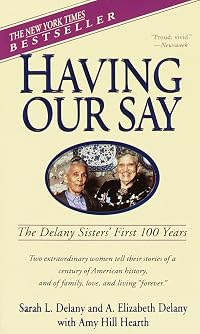
Having Our Say: The Delany Sisters' First 100 Years
by Sarah L. Delany, A. Elizabeth Delany, Amy Hill Hearth
On This Page
Description
Warm, feisty, and intelligent, the Delany sisters speak their mind in a book that is at once a vital historical record and a moving portrait of two remarkable women who continued to love, laugh and embrace life after over 100 years of living side by side. Their sharp memories show readers the post-reconstruction south and Booker T. Washington; Harlem's Golden age and Langston Hughes, W.E.B. Dubois and Paul Robeson. Bessie breaks barriers to become a dentist; Sadie quietly integrates the New show more York City system as a schoolteacher. show lessTags
Recommendations







Member Reviews
I never thought I'd see the day that the world would want to hear what two old Negro women have to say," says Bessie Delany. But Bessie and her sister, Sadie, born in 1893 and 1891, saw plenty, by eating a low-fat, high-vegetable diet and outliving the "old Rebby [rebel] boys" who once almost lynched Sadie. This remarkable memoir was a long-running bestseller, spawning a Broadway play and adding to their list of seasoned acquaintances (Marian Anderson, Langston Hughes, Paul Robeson, Cab Calloway) such spring chickens as Hillary Clinton. Born to a former slave whose owners broke the law by teaching him to read, the sisters got a solid education. North Carolina was paradise--despite the Rebbies--until Jim Crow reared its hideous head. The show more girls had loved to ride in the front of the trolley because the wind in their hair made them feel free, but one day the conductor sadly ordered them to the back. The family moved to New York, where Bessie became the town's second black woman dentist and Sadie the first black woman home-ec teacher. They befriended everyone who was anyone in the Harlem Renaissance (their brother won the 1925 Congressional primary there), pursued careers instead of husbands, and lived peacefully together, despite their differences. Sadie was more peaceable, like Booker T. Washington, while Bessie was a W.E.B. Du Bois-style militant.
They're funny: Bessie notes that blacks must be sharp to get ahead, "But if you're average and white, honey, you can go far. Just look at Dan Quayle. If that boy was colored he'd be washing dishes somewhere." And they are wise: Sadie says, "Life is short, and it's up to you to make it sweet."
-------------------------------------------------------------------------------- show less
They're funny: Bessie notes that blacks must be sharp to get ahead, "But if you're average and white, honey, you can go far. Just look at Dan Quayle. If that boy was colored he'd be washing dishes somewhere." And they are wise: Sadie says, "Life is short, and it's up to you to make it sweet."
-------------------------------------------------------------------------------- show less
This is a delightful small memoir of the lives of two 100-year-old African-American sisters who suffered under Jim Crow and other repressive situations, yet managed to be college educated (one a dentist, the other a teacher) and homeowners.
These ladies are absolutely irrepressible! They say whatever they think. Such as: “You see, when you are colored, everyone is always looking for your faults. If you are going to make it, you have to be entirely honest, clean, brilliant, and so on. Because if you slip up once, the white folks say to each other ‘See, what’d I tell you,’ So you don’t have to be as good as white people, you have to be better or the best. When Negroes are average, they fail, unless they are very, very lucky. Now show more if you‘re average and white, honey, you can go far. Just look at Dan Quayle. If that boy was colored he’d be washing dishes somewhere.” and “It’s interesting the way folks have become interested in Malcolm X again. A lot of the things he said were true, but he said them so bluntly that white folks were scared to death of him. It was easier for white folks to admire Martin Luther King, because he was less threatening to them.” and “For instance, everybody knew that Nestle’s would hire Negroes, but Hershey’s wouldn’t once I had encountered that, I used to walk through Harlem and scold any Negro eating a Hershey bar. Usually, they would stop eating it, but sometimes they thought I was crazy. Well honey, I do not allow Hershey candy in my home to this day.”
A quick read, and highly recommended. show less
These ladies are absolutely irrepressible! They say whatever they think. Such as: “You see, when you are colored, everyone is always looking for your faults. If you are going to make it, you have to be entirely honest, clean, brilliant, and so on. Because if you slip up once, the white folks say to each other ‘See, what’d I tell you,’ So you don’t have to be as good as white people, you have to be better or the best. When Negroes are average, they fail, unless they are very, very lucky. Now show more if you‘re average and white, honey, you can go far. Just look at Dan Quayle. If that boy was colored he’d be washing dishes somewhere.” and “It’s interesting the way folks have become interested in Malcolm X again. A lot of the things he said were true, but he said them so bluntly that white folks were scared to death of him. It was easier for white folks to admire Martin Luther King, because he was less threatening to them.” and “For instance, everybody knew that Nestle’s would hire Negroes, but Hershey’s wouldn’t once I had encountered that, I used to walk through Harlem and scold any Negro eating a Hershey bar. Usually, they would stop eating it, but sometimes they thought I was crazy. Well honey, I do not allow Hershey candy in my home to this day.”
A quick read, and highly recommended. show less
I don't know if this really a five star book, but I read it when it first came out, when I was in my early 30s, and I have often thought of it in the years since. I wanted to read it again, so about a decade ago I picked up a copy and saved it for a rainy-day comfort/ inspiration read. Well, now I'm using for a 'read a bestseller challenge' *and* for personal inspiration, and it's just as wonderful as I remember. I love these women's voices, and love learning about history from their experiences.
"Life is short and it's up to you to make it sweet." (Well, if Sadie says 103 is 'short' I better get going on making the most of my next 5 decades!)
The journalist who edited their stories deserves credit, too. And the pictures are interesting, show more in that they're family photos that also reveal history. show less
"Life is short and it's up to you to make it sweet." (Well, if Sadie says 103 is 'short' I better get going on making the most of my next 5 decades!)
The journalist who edited their stories deserves credit, too. And the pictures are interesting, show more in that they're family photos that also reveal history. show less
Two sisters of mixed parentage, both over 100 years of age, share their observations on life from a unique perspective. Their father was born into slavery, but became the first black bishop in the Episcopal church, as well as vice-principal of St. Augustine's School in Raleigh, NC. Bessie was the second black woman to be licensed to practice dentistry in New York State; Sadie was a teacher. Both women chose their professions over marriage, feeling they could not do justice to both, but both also spent endless time and effort supporting members of their large family when need arose. They were active in the civil rights movement, and witnessed an incredible march of history. They lived together in Harlem for many years, and eventually show more moved to a predominantly white neighborhood in Mount Vernon, NY, where Bessie died at the age of 104 (about 3 years after this book was written), and Sadie died at 107. This is just irresistible.
Review written March 2016 show less
Review written March 2016 show less
Charming, interesting, and easy to read! I really enjoyed the perspectives of the sisters, who are from a bygone era and had a lot of wisdom to pass on. I felt I was really hearing their voices. The interstitial material about history written by the editor/ghostwriter was pretty simpleminded, though.
Super interesting story of an educated black family as told by two elderly sisters and their memories of how things have changed over the years.
Read this sometime before starting LT, and enjoyed it tremendously. Very informative and entertaining.
Members
- Recently Added By
Lists

Female Author
1,234 works; 67 members

Non-Fiction Worth Reading
1,016 works; 255 members

Literature About Women and Girls
394 works; 39 members

Best Books With Sisters
130 works; 30 members

Blue Pyramid 1,276 Best Books of All Time
1,248 works; 32 members

Best Biographies of Notable Women
279 works; 101 members
Author Information

3+ Works 1,987 Members
Sarah Louise (Sadie) Delany was born in 1889. Her father was a former slave and her mother's parents were a free African American woman and a white Virginia farmer. Sarah Delany had nine siblings, including her sister, Elizabeth, born in 1891, with whom she co-authored Having Our Say: The Delany Sisters' First 100 Years. The book chronicles the show more story of their well-lived lives with wit and wisdom. It begins with an idyllic childhood in North Carolina where their father was the principal of St. Augustine's School. The legislation of Jim Crow laws prompted their move to Harlem. Sarah Delany attended Pratt College, becoming a high school teacher, and Elizabeth Delany attended Columbia University, becoming a dentist. The sisters experienced most of the 20th century and describe major events such as the struggle for Civil Rights and their feelings about it. Delany has also coauthored The Delany Sisters' Book of Everyday Wisdom and On My Own at 107: Reflections on Life Without Bessie, written following the death of her sister. (Bowker Author Biography) show less

2+ Works 1,819 Members

13+ Works 2,495 Members
The author of The New York Times bestseller "Having Our Story: The Delany Sisters' First 100 Years". (Bowker Author Biography)
Some Editions
Awards and Honors
Distinctions
Notable Lists
Work Relationships
Has the adaptation
Is abridged in
Common Knowledge
- Canonical title
- Having Our Say: The Delany Sisters' First 100 Years
- Original publication date
- 1993
- People/Characters
- Sarah L. Delany (Sadie); A. Elizabeth Delany (Bessie)
- Important places
- Raleigh, North Carolina, USA
- Dedication
- Dedicated to Henry Beard Delany (1858-1928)
and Nanny Logan Delany (1861-1956)
and to
Blair A. T. Hearth - First words
- Both more than one hundred years old, Sarah ("Sadie") Delany and her sister, Annie Elizabeth ("Bessie") Delany are among the oldest living witnesses to American history.
- Last words
- (Click to show. Warning: May contain spoilers.)I may have to hang on to Sadie's heels, but I'll get there.
- Canonical DDC/MDS
- 973.04960730092
- Canonical LCC
- E185.96
Classifications
- Genres
- Biography & Memoir, Nonfiction, General Nonfiction, History
- DDC/MDS
- 973.04960730092 — History & geography History of North America United States United States Ethnic And National Groups Other Groups African Americans African Americans
- LCC
- E185.96 — History of the United States United States Elements in the population Afro-Americans Biography. Genealogy
- BISAC
Statistics
- Members
- 1,482
- Popularity
- 15,743
- Reviews
- 23
- Rating
- (4.06)
- Languages
- 7 — Danish, English, German, Japanese, Norwegian (Bokmål), Russian, Spanish
- Media
- Paper, Audiobook, Ebook
- ISBNs
- 27
- ASINs
- 21