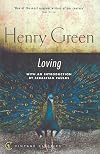
Loving
by Henry Green
On This Page
Description
"Loving is set in the vast hereditary house of the Tennants, an aristocratic Anglo-Irish family, but the story mainly involves their servants. The war has led to a scarcity of experienced staff, and when Eldon the butler dies, Raunce the head doorman is assigned his job. The other servants are taken aback by this irregular promotion, but lovely young Edith, a recent hire, is quite attracted to the older Raunce and a flirtation begins. And it is Edith who discovers Mrs. Tennant's daughter, show more whose husband is fighting at the front, in bed with a neighbor one morning, scandalizing the whole household. When the Tennants depart for England, Raunce is left in charge of the house and struggles to control its disputatious inhabitants as well as to secure the love of Edith, especially after a precious family jewel disappears. In Loving, Henry Green explores the deeply precarious nature of ordinary life against the background of the larger world at war"-- show lessTags
Recommendations









Member Recommendations
Member Reviews
"Loving" is the story of the upstairs-downstairs goings-on at a Protestant-owned and -run manse in the first decades after the founding of the Irish republic. It's also a books I'd never even heard of before it showed up on the Modern Library's list of the twentieth century's one hundred best novels. I think it's a quality book, but not necessarily an enjoyable read. "Loving" might the longest two-hundred pages you'll ever read, and if you're going to get anything at all out of them, you'll have to read them carefully.
Some reviewers here have mentioned that the dialect is challenging, and, for many American readers, it may be. Although it's set during the Second World War, the language it's written in struck me as much older as less show more accessible. It makes no concessions to an American -- or even non-Irish -- audience. But what really slowed things down for me was the extraordinary intimacy of every conversation and interaction in the book. The characters here live lives governed by custom, even as they are they are, understandably, beset by the usual run of human passions, and they do so in such close quarters that they might as well be at sea. Sometimes I thought that there wasn't a single exchange in "Loving," no matter how practical or inconsequential, that couldn't be seen as uncomfortably intimate. It feels that these people have been living all over each other for generations. It's hardly surprising, then, that can be exhausting to read about.
Luckily, there are some memorable characters here to hold your interest. Charley Raunce -- the new butler, formerly the footman -- is the book's center, and I spent a lot of time trying to figure out if he was clever, a fool, a scoundrel or a sincere suitor. My estimation of him kept shifting as I read on, and, honestly, he may be all of these things. At any rate, his charisma is undeniable. There's also the maids: lovely Edith, roommate and complement to the more ordinary but still attractive Kate, both of whom display an easy, irresistible sensuality. There's a set of characters -- Nanny Swift, Miss Burch, and Miss Welch -- who seem as old and dug-in as the castle itself, and, finally, there's Mrs. Tennant, the lady of the manor, who displays the kind of eccentricity that only money and inherited privilege can produce.
In the end, to borrow from Joyce, this isn't just a novel about loving but also one about leaving. The house is mostly shut up, the business model that built it expired generations ago, and the castle's residents can only pretend that time hasn't advanced a second since the summer of 1914 for so long. What Green is describing here -- along with a complex web of professional and personal relationships -- is the slow undoing of an institution and a way of life. I didn't find this one easy to read or quite to my taste, but only a writer of real talent could have written it. Recommended. show less
Some reviewers here have mentioned that the dialect is challenging, and, for many American readers, it may be. Although it's set during the Second World War, the language it's written in struck me as much older as less show more accessible. It makes no concessions to an American -- or even non-Irish -- audience. But what really slowed things down for me was the extraordinary intimacy of every conversation and interaction in the book. The characters here live lives governed by custom, even as they are they are, understandably, beset by the usual run of human passions, and they do so in such close quarters that they might as well be at sea. Sometimes I thought that there wasn't a single exchange in "Loving," no matter how practical or inconsequential, that couldn't be seen as uncomfortably intimate. It feels that these people have been living all over each other for generations. It's hardly surprising, then, that can be exhausting to read about.
Luckily, there are some memorable characters here to hold your interest. Charley Raunce -- the new butler, formerly the footman -- is the book's center, and I spent a lot of time trying to figure out if he was clever, a fool, a scoundrel or a sincere suitor. My estimation of him kept shifting as I read on, and, honestly, he may be all of these things. At any rate, his charisma is undeniable. There's also the maids: lovely Edith, roommate and complement to the more ordinary but still attractive Kate, both of whom display an easy, irresistible sensuality. There's a set of characters -- Nanny Swift, Miss Burch, and Miss Welch -- who seem as old and dug-in as the castle itself, and, finally, there's Mrs. Tennant, the lady of the manor, who displays the kind of eccentricity that only money and inherited privilege can produce.
In the end, to borrow from Joyce, this isn't just a novel about loving but also one about leaving. The house is mostly shut up, the business model that built it expired generations ago, and the castle's residents can only pretend that time hasn't advanced a second since the summer of 1914 for so long. What Green is describing here -- along with a complex web of professional and personal relationships -- is the slow undoing of an institution and a way of life. I didn't find this one easy to read or quite to my taste, but only a writer of real talent could have written it. Recommended. show less
[Loving] could be a traditional English (well, Irish) countryside estate family novel. But this 1945 book by Henry Green treats the familiar story in an unfamiliar way. The servants are the focus, the book is written in almost all dialogue, and there's quite a lot of sexual tension for this type of novel.
Most of the plot involves the death of the long-time butler and the assumption of the role by Charley Raunce. He struggles to navigate this new role. WWII is going on and the family goes to England to see the son who is on a brief leave. The servants take full advantage of this departure and things get a little crazy.
The magic of this brief novel is the writing style. Because it's virtually all dialogue, there is a lot taking place show more behind the words that the reader needs to extrapolate. The scattered thoughts of the characters lead to verbal misunderstandings and some of the exchanges are pretty confusing. Green also doesn't use punctuation in a traditional manner. At first all of this annoyed me, but in the end I am surprised at how close I got to the characters and how memorable they are.
Though this was published in 1945, it still feels like a modern take on the Victorian novel and I recommend it. show less
Most of the plot involves the death of the long-time butler and the assumption of the role by Charley Raunce. He struggles to navigate this new role. WWII is going on and the family goes to England to see the son who is on a brief leave. The servants take full advantage of this departure and things get a little crazy.
The magic of this brief novel is the writing style. Because it's virtually all dialogue, there is a lot taking place show more behind the words that the reader needs to extrapolate. The scattered thoughts of the characters lead to verbal misunderstandings and some of the exchanges are pretty confusing. Green also doesn't use punctuation in a traditional manner. At first all of this annoyed me, but in the end I am surprised at how close I got to the characters and how memorable they are.
Though this was published in 1945, it still feels like a modern take on the Victorian novel and I recommend it. show less
For non-Brits it may be difficult to get going with this book and its Cockney dialogue, but stick with it, stick with it, the reward is great. Perhaps hear in your head the voices 0f Bob Hoskins orMichael Caine. Hearing the rhythm and intonations of the characters' Cockney chatter is key to getting involved with them.
The culture of the grand English manor house with its servants and grounds and, yes, peacocks, will be largely gone by the end of WWII, and Green gives it a sympathetic but firm farewell. Kinalty castle, apparently one of the few that haven't burnt down (I.R.A.?), is already a fading relic of history. The sense of isolation drifts through whole book -- the physical isolation of Ireland and of the castle, of its culture, show more and of its residents. The novel begins with the death of the head butler - the ultimate isloation. The older servants sicken and die, and the younger ones must think of alternative lives, or face being stranded. The residents are essentially war refugees, sheltering in neutral Ireland from the cataclysm wracking Britain. The castle's vast, empty, echoing rooms rooms emphasize the isolation. Children play blind man's buff in a hall of silent, ancient statuary. The two young housemaids steal a few minutes to to waltz to a phonograph record in the closed up ballroom, where the chandeliers have been lowered almost to the floor and covered, and the shutters closed. Except for the living quarters, the castle is lifeless. With this atmosphere of emptiness and loss there is little reason to be believe Green's mock fairy-tale last sentence, that Raunce and Edith will live happily ever after in London. Raunce seems to be tubercular, and Edith is sweet but unworldly.
There is a lot of the silliness of broad comedy in the book. The entire staff, over their tea in the kitchen, break into uncontrollable hooting laughter at their own mimicry of the fat insurance investigator who had come about the missing ring and who had a lisp; the cook, Miss Welch, is a sot who has cases of gin surreptitiously delivered by the butcher; the nanny pretends to be deaf around the children but enjoys perfectly normal, though somewhat incoherent conversations with the cook in the kitchen. Green can surprise you peculiar juxtapositions: "Albert had been sent to bed. By this time he was probably running naked on the steeply sloping roofs high up. Mrs. Jack now looked after her children who ate with their mother and the grandparent while Miss Swift died inch by inch in the bedroom off the nursery."
Everything is described by the dialogue -- insecurities, hopes, anxieties, longings... in the rhythms and inflections, in the idiomatic speech. Green keeps out of the way and lets his characters talk.
There is a 1996 BBC adaptation with Mark Rylance as Raunce. The script condenses the book to 1 1/2 hour run time, which squeezes out most of the subtlety and all of the humor. show less
The culture of the grand English manor house with its servants and grounds and, yes, peacocks, will be largely gone by the end of WWII, and Green gives it a sympathetic but firm farewell. Kinalty castle, apparently one of the few that haven't burnt down (I.R.A.?), is already a fading relic of history. The sense of isolation drifts through whole book -- the physical isolation of Ireland and of the castle, of its culture, show more and of its residents. The novel begins with the death of the head butler - the ultimate isloation. The older servants sicken and die, and the younger ones must think of alternative lives, or face being stranded. The residents are essentially war refugees, sheltering in neutral Ireland from the cataclysm wracking Britain. The castle's vast, empty, echoing rooms rooms emphasize the isolation. Children play blind man's buff in a hall of silent, ancient statuary. The two young housemaids steal a few minutes to to waltz to a phonograph record in the closed up ballroom, where the chandeliers have been lowered almost to the floor and covered, and the shutters closed. Except for the living quarters, the castle is lifeless. With this atmosphere of emptiness and loss there is little reason to be believe Green's mock fairy-tale last sentence, that Raunce and Edith will live happily ever after in London. Raunce seems to be tubercular, and Edith is sweet but unworldly.
There is a lot of the silliness of broad comedy in the book. The entire staff, over their tea in the kitchen, break into uncontrollable hooting laughter at their own mimicry of the fat insurance investigator who had come about the missing ring and who had a lisp; the cook, Miss Welch, is a sot who has cases of gin surreptitiously delivered by the butcher; the nanny pretends to be deaf around the children but enjoys perfectly normal, though somewhat incoherent conversations with the cook in the kitchen. Green can surprise you peculiar juxtapositions: "Albert had been sent to bed. By this time he was probably running naked on the steeply sloping roofs high up. Mrs. Jack now looked after her children who ate with their mother and the grandparent while Miss Swift died inch by inch in the bedroom off the nursery."
Everything is described by the dialogue -- insecurities, hopes, anxieties, longings... in the rhythms and inflections, in the idiomatic speech. Green keeps out of the way and lets his characters talk.
There is a 1996 BBC adaptation with Mark Rylance as Raunce. The script condenses the book to 1 1/2 hour run time, which squeezes out most of the subtlety and all of the humor. show less
During WWII, the British Tennant family - the widowed Mrs Tennant, her son's wife Violet, and Violet's two young daughters - is living on its Irish estate. Mrs Tennant's son is in Britain in the armed forces, waiting to be sent overseas. Ireland is neutral, so the Tennants are avoiding the wartime shortages, the bombing and the blackouts, but are in fear of the IRA. The Tennants provide the background: the main characters are their servants.
The book begins with the death of the old butler, Eldon. Rauch, the footman, is next in line for Eldon's position. As we know from Downton Abbey, there is a strict hierarchy amongst house servants, with the butler at the top. Any other comparisons to Downton Abbey are, however, erroneous, because you show more cannot compare book so witty, perspicacious and subtle with a soap opera. Green's characters have depth and complexity. His imagery is striking. He always uses the right word, never a cliche.
Well worth reading. show less
The book begins with the death of the old butler, Eldon. Rauch, the footman, is next in line for Eldon's position. As we know from Downton Abbey, there is a strict hierarchy amongst house servants, with the butler at the top. Any other comparisons to Downton Abbey are, however, erroneous, because you show more cannot compare book so witty, perspicacious and subtle with a soap opera. Green's characters have depth and complexity. His imagery is striking. He always uses the right word, never a cliche.
Well worth reading. show less
If you start to read this novel with heedless attention, then you’re in for a surprise: after an endless stream of dialogues (200 pages on end) you come to the conclusion that there’s barely a storyline in this book. Place of action is a country estate in Ireland, inhabited by British aristocrats, in the midst of the Second World War. Green mainly focuses on the domestic staff, a motley crew who are more or less left to their own devices by the (usually) absent owners, and do almost nothing but bicker and speak ill of each other. On the surface, the setting seems to have a high “Upstairs, Downstairs” content, and “Dowton Abbey” inevitably comes to mind as well.
But as a reader you hardly get a grip on Green's story. He show more alternates intimate scenes with stiff ones, occasionally lets it come to a comedy of errors (about a lost ring, for example), and especially sows confusion with peacocks that appear at the most unexpected moments. The transitions between scenes are barely noticeable, and nothing is as it seems; the scenes between the love couple Edith and Charley, for example, are apparently charming, but at the same time there appears to be an enormous distance between them.
As a reader you are constantly wrestling with the question of what the actual purpose of the story is. But that clearly turns out to be the wrong attitude. I cannot put it better than Sebastian Faulks, who wrote an introduction to this book: “The inner shape of the novel in this way imitates our experience of living: it promises pattern, then withholds it, insisting on a formless banality; it describes intensity, but as part of a grudgingly accepted monotony; it glimpses poetry, but only from the corner of its eye.” In other words: life as it is. Nicely done, indeed, but with this book Green confirms his reputation of being a “writer’s writer”. show less
But as a reader you hardly get a grip on Green's story. He show more alternates intimate scenes with stiff ones, occasionally lets it come to a comedy of errors (about a lost ring, for example), and especially sows confusion with peacocks that appear at the most unexpected moments. The transitions between scenes are barely noticeable, and nothing is as it seems; the scenes between the love couple Edith and Charley, for example, are apparently charming, but at the same time there appears to be an enormous distance between them.
As a reader you are constantly wrestling with the question of what the actual purpose of the story is. But that clearly turns out to be the wrong attitude. I cannot put it better than Sebastian Faulks, who wrote an introduction to this book: “The inner shape of the novel in this way imitates our experience of living: it promises pattern, then withholds it, insisting on a formless banality; it describes intensity, but as part of a grudgingly accepted monotony; it glimpses poetry, but only from the corner of its eye.” In other words: life as it is. Nicely done, indeed, but with this book Green confirms his reputation of being a “writer’s writer”. show less
I have mixed feelings about this book, which contains some beautiful and devastating parts but also some bewildering moments. While most people I have found who admire this book describe it as character-driven, I did not find this true. The characters, except for Charley Raunce and (maybe) Mrs. Tennant, are fairly thinly-drawn, almost caricatures of the high-strung and prim housekeeper, the drunken cook, the lazy aristocratic wife, etc. It is also not plot-driven.
I can't figure out exactly what does drive the novel, except maybe the urge to find out how people react to everyday situations and to explore what fills the silences between us. This, perhaps, is a nobler ambition than creating fleshed-out characters or thrilling plot show more developments. But it doesn't always make for compelling or entertaining reading. This is a novel, like those of Elizabeth Bowen and Ford Madox Ford, that has to be read carefully. You can't just pick it up and read it with half your mind for half an hour at a time. You have to work at it.
I think maybe this is why I felt a bit disappointed by the book. I wasn't anticipating that it would be something I would have to work at; what I had previously heard about Loving led me to expect a light, escapist romp into great house life. But Downton Abbey, it's not. It's really an opaque modernist novel of the human condition, a la Bowen. If I had known that, I might have come better prepared. I'm not going to get rid of this book. I think in a few years I might reread it and have cause to update my opinions. It seems well worth the time expended to revisit down the line. show less
I can't figure out exactly what does drive the novel, except maybe the urge to find out how people react to everyday situations and to explore what fills the silences between us. This, perhaps, is a nobler ambition than creating fleshed-out characters or thrilling plot show more developments. But it doesn't always make for compelling or entertaining reading. This is a novel, like those of Elizabeth Bowen and Ford Madox Ford, that has to be read carefully. You can't just pick it up and read it with half your mind for half an hour at a time. You have to work at it.
I think maybe this is why I felt a bit disappointed by the book. I wasn't anticipating that it would be something I would have to work at; what I had previously heard about Loving led me to expect a light, escapist romp into great house life. But Downton Abbey, it's not. It's really an opaque modernist novel of the human condition, a la Bowen. If I had known that, I might have come better prepared. I'm not going to get rid of this book. I think in a few years I might reread it and have cause to update my opinions. It seems well worth the time expended to revisit down the line. show less
I am a fan of Henry Green's writing and I really loved this book! Loved Loving! This story is set in Ireland which is neutral at this time of the war with Germany. The servants in the castle of Mrs Tennant (a widow) and her daughter-in-law Violet or Mrs Jack. Jack, the son, is in the military. The intro in my book, by Roxana Robinson, refers to the book as a "sexy book" and yes their is love affairs here and there and innuendoes of love between pigeons, and a hint of lesbian love all without anything actually appearing on the page! Unlike more modern novels to their shame. On the surface the story is of servants working in this very grand castle full of the riches deserving a museum and the changes the war is bringing to the known life show more of these people and the class structure. It is also about trust and distrust among the servants and the masters, and between the lovers and family members. The book is the 5th book by the author who wrote under a pseudonym. Loving was published in 1945, near the end of the war and is mostly comedic but not underneath the layers.
There are pigeons and peacocks in this story. Three children (two girls of Violet's or Mrs. Jack and the cook's nephew brought over to avoid dangers of war). There is the missing sapphire ring, a dead peacock, a missing waterglass and eggs.
Servant include, the butler just died and the one stepping into his shoes and "books". The cook who likes a bit of gin, The housekeeper and her girls, the nanny who is old and obviously a Pollyanna. The lamplighter who can't speak clear English and loves the peacocks.
The style of this novel is perhaps challenging to some. I did not find it so. I loved the opening as if we are being introduced to a fairly tale. "Once upon a day an old butler called Eldon lay dying..... and the end; ...and lived happily ever after. show less
There are pigeons and peacocks in this story. Three children (two girls of Violet's or Mrs. Jack and the cook's nephew brought over to avoid dangers of war). There is the missing sapphire ring, a dead peacock, a missing waterglass and eggs.
Servant include, the butler just died and the one stepping into his shoes and "books". The cook who likes a bit of gin, The housekeeper and her girls, the nanny who is old and obviously a Pollyanna. The lamplighter who can't speak clear English and loves the peacocks.
The style of this novel is perhaps challenging to some. I did not find it so. I loved the opening as if we are being introduced to a fairly tale. "Once upon a day an old butler called Eldon lay dying..... and the end; ...and lived happily ever after. show less
Members
- Recently Added By
Lists

Time Magazine's "All-Time 100"
113 works; 15 members

Henry Green ranked
9 works; 2 members

Best Downton Abbey-esqe books to read
17 works; 7 members
Folio Society
831 works; 53 members

Time's All-Time 100 Novels
100 works; 27 members

1,001 BYMRBYD Concensus
723 works; 27 members

To Read - Literature / Fiction
26 works; 1 member
The Modern Library's 100 Best Novels: The Board's List
85 works; 6 members
Harold Bloom - The Western Canon: D. The Chaotic Age
833 works; 24 members

My TBR
371 works; 3 members
Modern Library's 100 Best Novels
100 works; 2 members
Author Information

16+ Works 4,372 Members
Writing under the pseudonym Henry Green, Henry Vincent Yorke kept his life as a wealthy industrialist separate from his literary persona. Although he had friends who were authors, he did not travel in literary circles and refused to be photographed, to protect his anonymity. Yorke was born in 1905 in Gloucestershire, England, and worked as a show more laborer before becoming managing director of a food engineering firm. From the publication of his first book Blindness (1926), which was begun when he was 17 years old and a student at Eton, he was admired for his unfailing sense of dialogue and characterization for all classes of British life. Green's last novel, Nothing, was published in 1950. Although he is still relatively unknown in the United States, he is recognized by authors such as John Updike and W. H. Auden as a masterful storyteller and one of the greatest English writers of the 20th century. He died in 1973 (Bowker Author Biography) show less
Some Editions
Awards and Honors
Distinctions
Series
Belongs to Publisher Series
Work Relationships
Is contained in
Common Knowledge
- Original publication date
- 1945
- Quotations
- The butler carried a large tray on which he had arranged three stacks of fresh blotting paper coloured pink, white and yellow, two saucers of Worcester china in which were knibs of bronze and gold plated, two bottles of red a... (show all)nd blue ink with clean syringes to fill the inkwells, and piles of new stationery which matched those three shades of blotting paper.
He first addressed an envelope. "To Mrs William Raunce", he wrote in pencil, "369 May Road Peterboro' Yorks" and immediately afterwards traced this with a pen. Next he began on the letter, again in pencil. [He wrote 4 paragra... (show all)phs.] Then he inked it in.
Classifications
Statistics
- Members
- 805
- Popularity
- 34,488
- Reviews
- 21
- Rating
- (3.42)
- Languages
- English, German, Swedish
- Media
- Paper, Ebook
- ISBNs
- 13
- ASINs
- 21