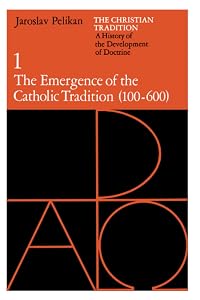
The Christian Tradition: A History of the Development of Doctrine, Volume 1: The Emergence of the Catholic Tradition (100-600)
by Jaroslav Pelikan
The Christian Tradition: A History of the Development of Doctrine (1), 西方傳統. 經典與解釋
On This Page
Description
In this five-volume opus--now available in its entirety in paperback--Pelikan traces the development of Christian doctrine from the first century to the twentieth. "Pelikan's The Christian Tradition [is] a series for which they must have coined words like 'magisterial'."--Martin Marty, CommonwealTags
Recommendations



Member Reviews
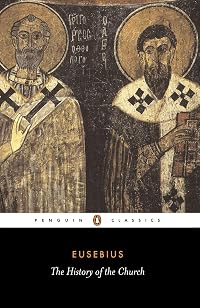
Caveat lector: whereas Eusebius in his Ecclesiastical History was occasionally prone to conversational phrasings along the likes of "so much, then, concerning him" or "so much, then, concerning these things" as segues from one train of thought to the next, you'll find no such linguistic waste in volume 1 of Pelikan's magisterial treatment of the history of Christian doctrine. Undoubtedly such trite colloquialisms would be seen by Pelikan as unorthodox in that their conversational nature was detrimental to the subject matter at hand, having no overt substance or content to offer. Pelikan is the church's Sergeant Joe Friday, who is interested in "just the facts, ma'am." Put differently, the book is dense. When Professor Pelikan wants to show more shift the subject matter from one line of thought to another (and who are you, dear reader, to even question such a transition; your only option is to obediently follow), he does so pragmatically, with an appropriate header (not that "Presuppositions of Christological Doctrine" sufficiently prepares the novitiate for the avalanche that follows).
I purchased this book on January 12, 2006 (thank you, Amazon) and thus apparently used it as an occasional reference for eight years before having the courage to attack it from beginning to end over the course of the past seven weeks. To those who have read through it in a shorter period of time (and in larger chunks), I commend you.
In an introductory autobiographical essay for Orthodoxy & Western Culture (written in honor of Pelikan's 80th birthday), Pelikan recalls that in 1944, at the age of 20, he entered the PhD program at the University of Chicago's divinity school "fully conscious (probably more than fully conscious) of my powers," which included mastery of several languages. As the owner of several of his books, who am I to disagree? I humbly offer five stars -- as if the world needs an additional voice proclaiming his unprecedented scholarship. show less
I purchased this book on January 12, 2006 (thank you, Amazon) and thus apparently used it as an occasional reference for eight years before having the courage to attack it from beginning to end over the course of the past seven weeks. To those who have read through it in a shorter period of time (and in larger chunks), I commend you.
In an introductory autobiographical essay for Orthodoxy & Western Culture (written in honor of Pelikan's 80th birthday), Pelikan recalls that in 1944, at the age of 20, he entered the PhD program at the University of Chicago's divinity school "fully conscious (probably more than fully conscious) of my powers," which included mastery of several languages. As the owner of several of his books, who am I to disagree? I humbly offer five stars -- as if the world needs an additional voice proclaiming his unprecedented scholarship. show less
I don't think that the English language has a word that is sufficient to describing just how excellent this book is. Every Christian and, really, every non-Christian should have to read this book. Pelikan describes in a good amount of detail, but in a nonetheless very approachable and readable manner, the development of doctrine from the close of the Apostolic era through to the time of St. Augustine, St. Gregory the Great, and the Fifth Ecumenical Council, hinting at the developments of both East and West slightly beyond. His approach is wide and his views are always fair and balanced. A very helpful feature of the book is the sidenote approach where, rather than in-text citations, footnotes, and endnotes, Pelikan instead lists the show more sources of his quotations and summaries to the side of where they are given. I'm looking forward to reading the rest of the books in this series. I cannot recommend enough reading this book, no matter your own personal doctrinal or non-doctrinal views. show less
This excellent book has done what I didn't think was possible -- interesting me in Christian doctrinal and theological history. Before reading this, I didn't like the fact that I didn't know much about the intellectual history of the church, but I'd never found anything on the subject that I could get through without either getting lost or bored. This first volume of a five-volume series is a great introduction to the subject for intelligent readers; Pelikan doesn't shy away from using technical terms, but he doesn't assume prior knowledge on the reader's part in doing so.
An excellent and commanding work on the development of doctrines within early catholicism from 100-600. The book is rather advanced and presupposes a healthy knowledge of theological concepts and the Greek language. Nevertheless, Pelikan provides a balanced perspective of the challenges that faced the early Christians in their formulations of their beliefs. A great resource.
Quite a complete presentation of early Christian doctrines. The focus of this book is really purely doctrinal, so there's not even a mention of how the church developed as an institution in Roman society. The discussion of the relationship between Christian doctrine and Greek philosophy was of particular interest to me.
I'll be honest when I say that I didn't read the whole book and I understood little of what I did read. Some of it was very intruiging, but it is one of those books where you need a dictionary next to you the entire time.
I sued to have the whole series and I traded it in for lawn furniture. He is dead like the rest of us will be soon enough but made his way toOrthodoxy.
Members
- Recently Added By
Lists

In Our Time books
4,934 works; 2 members
Author Information

107+ Works 15,929 Members
Jaroslav Pelikan (1923-2006) was Sterling Professor of History Emeritus at Yale University. He authored many books, including Whose Bible Is It? A History of the Scriptures through the Ages and Credo: Historical and Theological Guide to Creeds and Confessions of Faith in the Christian Tradition.
Awards and Honors
Awards
Series


Work Relationships
Common Knowledge
- Canonical title
- The Christian Tradition: A History of the Development of Doctrine, Volume 1: The Emergence of the Catholic Tradition (100-600) (100-600)
- Original title
- The Christian tradition : a history of the development of doctrine. Volume 1: the emergence of the Catholic tradition (100-600) (100-600)
- Alternate titles
- The emergence of the Catholic tradition (100-600) (100-600); 基督教傳統. 卷一
- Original publication date
- 1971
- Epigraph
- 'Cor ad cor loquitur',
Heart speaketh unto heart,
Cardinal Newman's coat of arms
'Veni Creator Spiritus',
Come, Creator Spirit,
Adolf von Harnack's epitaph - First words
- What the church of Jesus Christ believes, teaches and confesses on the basis of the word of God: this is Christian doctrine.
Classifications
Statistics
- Members
- 1,584
- Popularity
- 14,439
- Reviews
- 8
- Rating
- (4.43)
- Languages
- 7 — Chinese, English, French, German, Polish, Portuguese, Romanian
- Media
- Paper, Ebook
- ISBNs
- 7
- UPCs
- 1
- ASINs
- 10