On This Page
Tags
Members
- Recently Added By
Author Information

94+ Works 685 Members
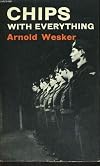
Arnold Wesker grew up in London's Stepney, and after time at the London School of Film Technique and in the Royal Air Force, worked at a number of jobs---carpenter's mate, farm laborer, pastry chef, among others---until Chicken Soup with Barley was performed on an Arts Council grant in 1958. Transferred from a theater in Coventry to the Royal show more Court, it was joined in repertory there by Roots in 1959 and I'm Talking about Jerusalem in 1960. The realistic trilogy centered on the Kahn family and their connections, in London and Norfolk: old Communists, arts-and-crafts idealists, torpid farm workers, young radicals---nothing less than "the working class today."A different sort of play occupied Wesker just before and after the trilogy---the panoramic description of the ordinary activities of a large group of characters. The Kitchen (1962) followed the rhythms of calm and crisis in a large restaurant; Chips with Everything (1962) dealt with the life of conscripts in an air force training camp. Critic Kenneth Tynan and others welcomed Wesker's microcosms as revelations of the nature of authority and work, and the possibility of collective social action. But Chips, produced in London and New York, was Wesker's last major success. After it, he withdrew temporarily from writing to direct Centre 42, an ambitious worker arts project, the failure of which is memorialized in Their Very Own and Golden City (1966), the chronicle of an idealistic city planner's destructive compromises. Wesker's alienation from the radical politics of the 1970s severed his connection with the British left and threatened his relation with the British theater. (Many of his later plays have had their debut abroad, in Sweden and in the United States.) Since The Four Seasons (1965), about the growing apart of a couple, Wesker's focus has been personal. The Merchant (1976) retells the story of Shylock; Caritas (1981) ends with the martyrdom of a nun; The Old Ones (1972) are brothers confronting the coming of death. The change in Wesker's drama has encouraged readers to return to the early plays and recognize that they are less about collective action than its human difficulties. "I would like to think," the playwright explains, "that my plays . . . have a higher proportion of poetry than journalism." (Bowker Author Biography) show less
Series

Work Relationships
Contains
Classifications
Statistics
- Members
- 19
- Popularity
- 1,328,444
- Languages
- English, German
- Media
- Paper
- ISBNs
- 4
- ASINs
- 3