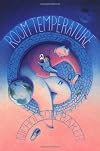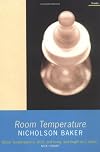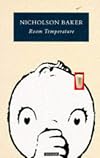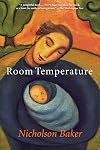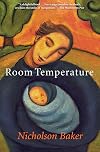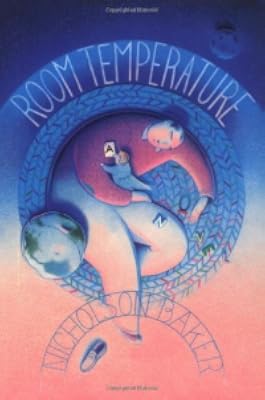
Room Temperature
by Nicholson Baker
On This Page
Description
Mike's thought on his newfound parenthood lead him back to his own childhood and to reflections on the objects of his youth-- from glass peanut butter jars to French horns.Tags
Recommendations














Member Reviews
Novel.
Nicholson Baker writes in 360-degree Sensurround--his descriptions of the seemingly banal awakening the most jaded of senses into recognition, admiration, and amusement. In Room Temperature, his self-deprecating, endlessly curious narrator is at home giving his baby girl a bottle and allowing his mind to wander. Uppermost in his thoughts are his wife and daughter, but there is also that obsession with commas and some concern with tiny taboos like nose-picking and stealing change from his parents. Truth-telling is the operative mode; at one point he tries to get his wife to explain a doodle by quoting a review of early Yeats: "Always true is always new." Room Temperature is a rare novel of domestic pleasure and stability, with a show more twist. "Was there ever a limit between us? Would disgust ever outweigh love?" Baker's alter ego asks, and seems determined to find out. show less
Nicholson Baker writes in 360-degree Sensurround--his descriptions of the seemingly banal awakening the most jaded of senses into recognition, admiration, and amusement. In Room Temperature, his self-deprecating, endlessly curious narrator is at home giving his baby girl a bottle and allowing his mind to wander. Uppermost in his thoughts are his wife and daughter, but there is also that obsession with commas and some concern with tiny taboos like nose-picking and stealing change from his parents. Truth-telling is the operative mode; at one point he tries to get his wife to explain a doodle by quoting a review of early Yeats: "Always true is always new." Room Temperature is a rare novel of domestic pleasure and stability, with a show more twist. "Was there ever a limit between us? Would disgust ever outweigh love?" Baker's alter ego asks, and seems determined to find out. show less
The Idea of Second Rank Artists, and a Connection Between Similes and Autism
In older art history, artists were ranked first, second, third... this common practice in connoisseurship, in art instruction (in the French Academy) and in earlier 20th century art history. The practice has fallen out of use for obvious reasons -- it has no articulated relation with historical meaning, and it is detached from politics, identity, and context -- but it is implicitly a strong presence in the teaching of art and art history, because it helps determine which artists are taught. The same happens in music and literature.
In practical terms, a second-rank artist is one that doesn't need to be taught or included in a textbook. Such an artist can be show more pushed out of the curriculum because of lack of space or time. In line with connoisseurial practices, such choices aren't reasoned: they're just made. It can be difficult, therefore, to know why certain artists, writers, or composers aren't in a given textbook or seminar. For me, Nicholson Baker is a good example of the issue. He is, in my reading, a strongly, clearly second-rank author, by which I mean if I had to choose between teaching him and teaching Pynchon, Updike, DeLillo, or Wallace to represent the 1980 and 1990s, I'd reluctantly have to omit Baker. Of course this sounds horrible, but it is the sort of decision that's made every day in classrooms and by editors, and it's hardly a slight to say of Baker that he's solidly second-rank: he'll be there, in every larger anthology and history.
What is it, then, that makes his second-rank status so clear? For me the entire notion of rankings comes up when I am distracted, in my reading, by thinking of the influences that shaped the author's work. (Same for music and visual art.)
Baker's influences
Baker's wonderful book "U and I" gives the most eloquent possible testimony to his permanent state of infatuation with Updike, and to his equally affectionate, but oddly distanced, relation to Nabokov. Both authors are guiding spirits in "Room Temperature" in the literal sense of that expression: I can sometimes see Baker's sense of them guiding his choices of words and turns of phrase. Updike is certainly the inspiration for "Room Temperature's" fidelity to the most commonplace subjects (the book is about the narrator bottle-feeding his infant daughter).
Other voices also speak over Baker's shoulder: DeLillo, Pynchon, Barthelme, and further afield Dickinson, Hopkins, Wordsworth, even Tennyson. For me the most intriguing one -- even though I'm fairly certain this wouldn't have occurred to Baker as he wrote -- is Raymond Roussel, especially the "New Impressions of Africa." Baker's trope of choice is the simile, and his rhetorical device of choice is the anaphora (formulas repeated clause by clause). He strings together similes: this is like this, and like this, and like this. Roussel's poem is the most drastic text I know in this regard: it's pathologically committed to endless, apparently disconnected comparisons. Roussel is present with uncanny exactitude in passages like this, which describes the shape of his baby daughter's nostril:
"The Bug's nostril had the innocent perfection of a Cheerio... a tiny dry clean salty ring, so small, with the odd but functional smallness of the tires on passenger planes, or of the smooth rim around the pistil of the brass pump head you fitted over a tire's stem valve to inflate it..."
And this passage, describing the sound Bug's nostril makes when the air was released:
"...like the sound strong dogs made as they strained at leashes... or the faint, high, sonar-like suffix of sound that the expensive kind of textured rubber balls added to the prosaic bounce of external impact on concrete..." (p. 39).
All this is compulsively detailed and improbable, like Roussel, and despite its faithful attachment to the products of American manufacturing from the 1950s to the 1980s, it's also persistently faintly surreal.
Similes and Autism
Reviewers have liked to say that Baker's similes provoke a "smile of recognition" (that's from an endorsement on the back cover of my copy), and they do, especially for me: he and I are very close in age, and we spent time in the same parts of the States. I am in that respect his ideal reader, because I recognize every description and allusion in the entire book, from stacked checkers to Bic pen ads to individual diagrams in Time-Life books, and including even a science display he describes in Philadelphia, now long gone. But "recognition" doesn't make me especially happy, and I think I seldom smiled. For me, his allusions and similes are at their best when their precision forces their ordinariness into surrealism, or when they build to unexpected insights rather than connecting dots I hadn't seen were linked. But they don't seem often to do either.
Most of the time his preferred similes are to mechanical operations. I'm sure I'm not the first to say there's an autism about Baker's work. It's a mild autism, as they say: manifesting in a preference for mechanical operations. The most interesting autistic-spectrum quality, however, is the way Baker's narrator is always wondering what his wife Patty thinks of things. A general incapacity to understand people's feelings, coupled with an interest in experimenting to find out what people feel, is also part of autism, and it is happily on display throughout the book, most prominently when she saves some inspection papers he found in a pocket, and makes a mobile out of them to entertain Bug. "She'd saved them! She'd made permanent use of them!" -- has special resonance if it's thought of as part of the narrator's ongoing experiments. (p. 15)
From this perspective, too, the many similes and the recognition (the safety) they elicit are like millions of madeleines: they answer Proust's fetishism with a democratic nostalgia, which is nevertheless autistic in its potentially endlessness. Everything, eventually, will become an object of nostalgia: speaking of the latches that still close tray tables on airlines, he writes: "I felt pity and shame for American plane engineers who had failed to see that thirty years of improvements in the on/off switch, the suitcase closure, the cassette ejection system, the umbrella lock, the calculator button.. were demanding that we dig deeper and find some subtler sort of click or even a clickless but convincing thumplet." (p. 46)
The best passage in the book, for me, is one toward the end in which he wonders why he makes a certain breathing sound when he smiles in bed, but not when he's up, and he suddenly concludes with an insight that he prints all in italics. It's homey, ordinary, and domestic, like everything else in the book, but it's also a bit fanatical, a little touched, and that's what makes it different than the many hundreds of other comparisons out of which the thought of the book is painstakingly constructed:
"No, the explanation had to be that smiles became more audible only at bedtime because toothpaste altered the chemical characteristics of one's saliva in such a way that encouraged an unusually loud, sticky effervescence along the gum line." (p. 106.) show less
In older art history, artists were ranked first, second, third... this common practice in connoisseurship, in art instruction (in the French Academy) and in earlier 20th century art history. The practice has fallen out of use for obvious reasons -- it has no articulated relation with historical meaning, and it is detached from politics, identity, and context -- but it is implicitly a strong presence in the teaching of art and art history, because it helps determine which artists are taught. The same happens in music and literature.
In practical terms, a second-rank artist is one that doesn't need to be taught or included in a textbook. Such an artist can be show more pushed out of the curriculum because of lack of space or time. In line with connoisseurial practices, such choices aren't reasoned: they're just made. It can be difficult, therefore, to know why certain artists, writers, or composers aren't in a given textbook or seminar. For me, Nicholson Baker is a good example of the issue. He is, in my reading, a strongly, clearly second-rank author, by which I mean if I had to choose between teaching him and teaching Pynchon, Updike, DeLillo, or Wallace to represent the 1980 and 1990s, I'd reluctantly have to omit Baker. Of course this sounds horrible, but it is the sort of decision that's made every day in classrooms and by editors, and it's hardly a slight to say of Baker that he's solidly second-rank: he'll be there, in every larger anthology and history.
What is it, then, that makes his second-rank status so clear? For me the entire notion of rankings comes up when I am distracted, in my reading, by thinking of the influences that shaped the author's work. (Same for music and visual art.)
Baker's influences
Baker's wonderful book "U and I" gives the most eloquent possible testimony to his permanent state of infatuation with Updike, and to his equally affectionate, but oddly distanced, relation to Nabokov. Both authors are guiding spirits in "Room Temperature" in the literal sense of that expression: I can sometimes see Baker's sense of them guiding his choices of words and turns of phrase. Updike is certainly the inspiration for "Room Temperature's" fidelity to the most commonplace subjects (the book is about the narrator bottle-feeding his infant daughter).
Other voices also speak over Baker's shoulder: DeLillo, Pynchon, Barthelme, and further afield Dickinson, Hopkins, Wordsworth, even Tennyson. For me the most intriguing one -- even though I'm fairly certain this wouldn't have occurred to Baker as he wrote -- is Raymond Roussel, especially the "New Impressions of Africa." Baker's trope of choice is the simile, and his rhetorical device of choice is the anaphora (formulas repeated clause by clause). He strings together similes: this is like this, and like this, and like this. Roussel's poem is the most drastic text I know in this regard: it's pathologically committed to endless, apparently disconnected comparisons. Roussel is present with uncanny exactitude in passages like this, which describes the shape of his baby daughter's nostril:
"The Bug's nostril had the innocent perfection of a Cheerio... a tiny dry clean salty ring, so small, with the odd but functional smallness of the tires on passenger planes, or of the smooth rim around the pistil of the brass pump head you fitted over a tire's stem valve to inflate it..."
And this passage, describing the sound Bug's nostril makes when the air was released:
"...like the sound strong dogs made as they strained at leashes... or the faint, high, sonar-like suffix of sound that the expensive kind of textured rubber balls added to the prosaic bounce of external impact on concrete..." (p. 39).
All this is compulsively detailed and improbable, like Roussel, and despite its faithful attachment to the products of American manufacturing from the 1950s to the 1980s, it's also persistently faintly surreal.
Similes and Autism
Reviewers have liked to say that Baker's similes provoke a "smile of recognition" (that's from an endorsement on the back cover of my copy), and they do, especially for me: he and I are very close in age, and we spent time in the same parts of the States. I am in that respect his ideal reader, because I recognize every description and allusion in the entire book, from stacked checkers to Bic pen ads to individual diagrams in Time-Life books, and including even a science display he describes in Philadelphia, now long gone. But "recognition" doesn't make me especially happy, and I think I seldom smiled. For me, his allusions and similes are at their best when their precision forces their ordinariness into surrealism, or when they build to unexpected insights rather than connecting dots I hadn't seen were linked. But they don't seem often to do either.
Most of the time his preferred similes are to mechanical operations. I'm sure I'm not the first to say there's an autism about Baker's work. It's a mild autism, as they say: manifesting in a preference for mechanical operations. The most interesting autistic-spectrum quality, however, is the way Baker's narrator is always wondering what his wife Patty thinks of things. A general incapacity to understand people's feelings, coupled with an interest in experimenting to find out what people feel, is also part of autism, and it is happily on display throughout the book, most prominently when she saves some inspection papers he found in a pocket, and makes a mobile out of them to entertain Bug. "She'd saved them! She'd made permanent use of them!" -- has special resonance if it's thought of as part of the narrator's ongoing experiments. (p. 15)
From this perspective, too, the many similes and the recognition (the safety) they elicit are like millions of madeleines: they answer Proust's fetishism with a democratic nostalgia, which is nevertheless autistic in its potentially endlessness. Everything, eventually, will become an object of nostalgia: speaking of the latches that still close tray tables on airlines, he writes: "I felt pity and shame for American plane engineers who had failed to see that thirty years of improvements in the on/off switch, the suitcase closure, the cassette ejection system, the umbrella lock, the calculator button.. were demanding that we dig deeper and find some subtler sort of click or even a clickless but convincing thumplet." (p. 46)
The best passage in the book, for me, is one toward the end in which he wonders why he makes a certain breathing sound when he smiles in bed, but not when he's up, and he suddenly concludes with an insight that he prints all in italics. It's homey, ordinary, and domestic, like everything else in the book, but it's also a bit fanatical, a little touched, and that's what makes it different than the many hundreds of other comparisons out of which the thought of the book is painstakingly constructed:
"No, the explanation had to be that smiles became more audible only at bedtime because toothpaste altered the chemical characteristics of one's saliva in such a way that encouraged an unusually loud, sticky effervescence along the gum line." (p. 106.) show less
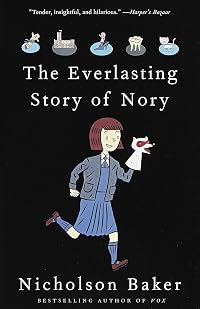
praise for attention to details in "whatever" world: I have read all of Mr.Bakers books, and with the exception of "The Everlasting Story..." (which indeed did seem to be everlasting) have read them with delight. Although he's often compared to Updike, I think he surpasses him due to his wit and his more creative sense of the strangeness of life. In "Room Temperature" we find the antidote, along with his other novels, to a modern world obsessed with speed, impersonal technology and the summational catchphrase "whatever". How wonderful it is to see an author bend his mind and spirit to the details of life with so much talent and fervor. And how wonderful to see that his books, plotless and demanding of full attention as they are, sell so show more well. It gives me hope for our civilization; it really does. On a sidenote - I am tired of critics and readers thinking he is cheapening his prose by writing on sexual topics. Sex is one of the most universal and fascinating and character-revealing subjects around; a great writer can make anything cerebral and holy, and a writer needs to go where his passions lie. Besides, do we really want every novel to be about rubber bands and bathroom hot air dryers? show less
The free associations of a man while he rocks his infant to sleep. So, no plot you'd care about, yet the detailed descriptions and wide range of his stream of consciousness are woven together with delight. There is humor, love, specificity, and tenderness that are captivating.
The entire core narrative of this book involves a new father feeding one bottle to his 6 month old daughter and thinking about life.
The recursion of flashbacks within flashbacks flesh out the ambitions and insecurities of the narrator. The effect is intimate and vulnerable. It's a style of storytelling I found fascinating in Mezzanine. Here it's even further refined.
I connected with the French horn lessons and musings on musical notation. Thoughts on the deprecation of technology and language emphasize the fleeting nature of our time on earth.
The stream of conscious narrative taken to extreme allows me to appreciate how other offers embrace the technique to various degrees. Rarely does anyone else use it to the exclusion of all other show more narrative tools. show less
The recursion of flashbacks within flashbacks flesh out the ambitions and insecurities of the narrator. The effect is intimate and vulnerable. It's a style of storytelling I found fascinating in Mezzanine. Here it's even further refined.
I connected with the French horn lessons and musings on musical notation. Thoughts on the deprecation of technology and language emphasize the fleeting nature of our time on earth.
The stream of conscious narrative taken to extreme allows me to appreciate how other offers embrace the technique to various degrees. Rarely does anyone else use it to the exclusion of all other show more narrative tools. show less
You gotta love Nicholson Baker's thing -- hyper-localized, funny flirty takes on the mundanities of life like air nozzles and toilet paper, but this study of a new father feeding his new baby a bottle is about as warm and charming as it sounds if you can imagine drilling that deep into it. If you can, you're in the hand s of both the master and inventor of the game.
Maybe I would have been irritated if it had been more than a hundred pages, but worth it for the scene with the suit pockets alone. Made me want to move to Quincy, procreate, and eat lots of peanut butter.
Members
- Recently Added By
Published Reviews
ThingScore 75
Baker's writing is on the order of the newest genetics. From a minute fragment of tissue, you grow an entire organism. An entire book does indeed sprout out of bottle-time in Wollaston. Whether it is a speculative novel or a speculative memoir depends on whether the father-narrator in the squeaky rocker is Baker himself, or Baker at one fictional remove. It makes no difference; either way, we show more are down the rabbit hole and into a garden of thinking reeds. show less
added by steevohenderson
Lists

The Guardian's 1000 Novels Everyone Must Read
1,005 works; 549 members
Author Information

30+ Works 14,370 Members
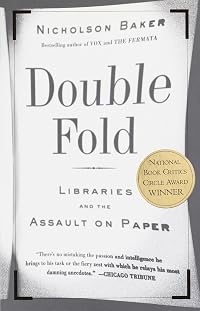
Nicholson Baker lives in Maine. Nicholson Baker was born in New York City on January 7, 1957. He briefly attended the Eastman School of Music before receiving a B.A. in philosophy from Haverford College. He is the author of both fiction and nonfiction works including The Mezzanine (1988); Room Temperature (1990); Vox (1992); The Fermata (1994); show more The Everlasting Story of Nory (1998); Checkpoint (2004); and The Anthologist (2009). His nonfiction work, Double Fold: Libraries and the Assault on Paper, won a National Book Critics Circle Award in 2001. (Bowker Author Biography) show less
Awards and Honors
Notable Lists
Common Knowledge
- Canonical title
- Room Temperature
- Original title
- Room Temperature
- Original publication date
- 1990
- People/Characters
- Mike Bug (Micky, Mickanore, Norker, Yamanicky, Hornefleur, Fatboy, Lowbrow, Dark Shitter)
- Epigraph
- 'I placed a jar in Tennessee...' Wallace Stevens.
- First words
- I was in the rocking chair giving our six-month-old Bug her late afternoon bottle.
- Original language
- English
Classifications
Statistics
- Members
- 603
- Popularity
- 48,774
- Reviews
- 11
- Rating
- (3.65)
- Languages
- 5 — Dutch, English, German, Spanish, Swedish
- Media
- Paper, Ebook
- ISBNs
- 13
- ASINs
- 5