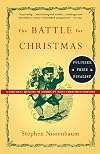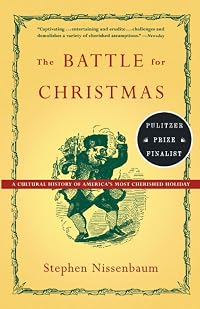
The Battle for Christmas
by Stephen Nissenbaum
On This Page
Description
PULITZER PRIZE FINALIST Drawing on a wealth of research, this "fascinating" book (The New York Times Book Review) charts the invention of our current Yuletide traditions, from St. Nicholas to the Christmas tree and, perhaps most radically, the practice of giving gifts to children. Anyone who laments the excesses of Christmas might consider the Puritans of colonial Massachusetts: they simply outlawed the holiday. The Puritans had their reasons, since Christmas was once an occasion for show more drunkenness and riot, when poor "wassailers" extorted food and drink from the well-to-do. In this intriguing and innovative work of social history, Stephen Nissenbaum rediscovers Christmas's carnival origins and shows how it was transformed, during the nineteenth century, into a festival of domesticity and consumerism. Bursting with detail, filled with subversive readings of such seasonal classics as "A Visit from St. Nicholas" and A Christmas Carol, The Battle for Christmas captures the glorious strangeness of the past even as it helps us better understand our present. show lessTags
Recommendations









Member Reviews
A well-researched (but slow, I probably wouldn't have made it through if I was only reading with my eyes) history of Christmas customs primarily in the United States -- how they got here, when they started, how they changed. The book dives into how (like most holidays) the mythos & traditions were invented and discusses the many other holidays & traditions that have come together to give us Christmas as we know it today (Saturnalia, John Canoe, Winter Solstice, Yule, Purim, Misrule, Belsnickel, end of harvest). There are deep dives into how we came to gift-giving, Christmas trees, and Santa Claus which were equally fascinating. I mean, Christmas trees are because of literature including traditions in a town (or single family) and then show more someone else said, "YES! Great idea! I too will write about that!" The book also discusses how the invention of the Christmas tradition(and gift-giving) played a part in the creation of childhood (instead of children being tiny adults).
I just saw on Threads someone being a smart-ass about how The Odyssey is fiction, and someone else saying, actually WE think it's fiction, but to the Greeks that were living in the time of Homer (and before), it was as real as Biblical stories are to some Christians. It was a culmination of centuries of oral tradition. And reading this at the same time as that conversation reminds me of how all holiday traditions are inventions of the cultures that celebrate them. We all want to believe our customs are ancient and true because we are humans that love stories to help us make sense of the world.
Being an "invented tradition" doesn't make the underlying idea less authentic or even take away from the importance or fun (the concerns of over-commercialization and "greedy children" have been around since the beginning). We're still inventing traditions today, example: Elf-on-the Shelf -- as invented as they come and has created an entirely new way for parents to spend money (I mean, they wrote a book; they created a brand; there are secondary markets for outfits and props; there are elf influencers and accounts dedicated to ideas!). The fact that it was recently invented doesn't make it less fun, doesn't make it less real for a kid who's been taught to believe, it doesn't take away from it at all. (And it's also totally OK if someone hasn't bought into the elf-hype.)
So invent away. Celebrate it however you want, but don't think for a second that it's always been this way and since it hasn't always been this way, we can all celebrate in whatever way is best for our family.
Merry Christmas! Happy Holidays! Gorge on food, make some good trouble, and may your days be filled with blessings & light. show less
I just saw on Threads someone being a smart-ass about how The Odyssey is fiction, and someone else saying, actually WE think it's fiction, but to the Greeks that were living in the time of Homer (and before), it was as real as Biblical stories are to some Christians. It was a culmination of centuries of oral tradition. And reading this at the same time as that conversation reminds me of how all holiday traditions are inventions of the cultures that celebrate them. We all want to believe our customs are ancient and true because we are humans that love stories to help us make sense of the world.
Being an "invented tradition" doesn't make the underlying idea less authentic or even take away from the importance or fun (the concerns of over-commercialization and "greedy children" have been around since the beginning). We're still inventing traditions today, example: Elf-on-the Shelf -- as invented as they come and has created an entirely new way for parents to spend money (I mean, they wrote a book; they created a brand; there are secondary markets for outfits and props; there are elf influencers and accounts dedicated to ideas!). The fact that it was recently invented doesn't make it less fun, doesn't make it less real for a kid who's been taught to believe, it doesn't take away from it at all. (And it's also totally OK if someone hasn't bought into the elf-hype.)
So invent away. Celebrate it however you want, but don't think for a second that it's always been this way and since it hasn't always been this way, we can all celebrate in whatever way is best for our family.
Merry Christmas! Happy Holidays! Gorge on food, make some good trouble, and may your days be filled with blessings & light. show less
12 Books of Christmas
#9 History
A stump of a pipe he held tight in his teeth,
And the smoke it encircled his head like a wreath
A memorable little detail from Clement Clark Moore’s St. Nicholas. Not the mitred Dutch bishop who visited on December 6 (his saint’s day), rewarding obedient children and punishing naughty ones. An authentic American descendant, “a jolly old elf,” small enough to slide down chimneys but with enough of a belly to get his furry suit “tarnished with ashes and soot.” Elfin. That’s important. NOT the obese, human immortalized by the drawings of Thomas Nast and resurrected every year in thousands of department stores, holiday parades, and office parties. Moore’s was probably a bit craggy, a working show more man’s elf.
The stump of a pipe is important. As everyone in those days knew, the aristocratic, affluent man (or woman) puffed on a long pipe, the longer the more dignified. Indeed, these people were called the Long Pipes, as noted in the 1812 edition of Washington Irving’s History of New York. The short, stumpy pipe belonged to lower-class, working people, not because they were cheaper, perhaps at first because they could be held clamped in the teeth more conveniently while laborers went about their work, but eventually as a proud, public gesture of class identity. Some workers even purchased long pipes and broke them off at the stem to show they had deliberately chosen a short pipe – “a stump of a pipe,” if you will.
Such tidbits of information, you will find in every section of Professor Stephen Nissenbaum’s scholarly history, The Battle for Christmas (Knopf, c1996). The scholarly nature of the tome is announced in its subtitle: A Social and Cultural History of Christmas That Shows How It Was Transformed from an Unruly Carnival Season into the Quintessential American Family Holiday. Professor Nissenbaum has done his research well. His text is filled with quotations, anecdotes, and documentary evidence gathered from personal letters, diaries, journals, local newspapers, church and government documents as well as works published at the time and long since relegated to archives, rare books collections, and attics.
What he shows his readers, in effect, are the efforts of a healthy, cozy “American family holiday” to emerge. In Puritan New England any celebration of Christmas as a holy-day, or holiday, was strictly forbidden. Pastors insisted that so-called Christmas was simply a pagan festival covered with a Christian veneer; and, of course, they were right historically. Even so, the winter solstice continued to prove a seductive time for ordinary folk to make merry. Harvests were over but the coldest, hardest winter months were yet to come, so there was a time when workers were relatively idle. Cellars and granaries were full, beer and wine were fermenting just right, fresh meat was available – animals could not be slaughtered and their flesh preserved until these first cold spells. It was a time for feasting and drinking and reveling, for hunger and thirst and passions to be satisfied. With inebriation rampant, misrule became the rule. Anger and lust found expression in riotous behavior. In some cases a Lord of Misrule was named; he was worked up with rich food and liquor and then expected to have sex publicly with a woman provided him.
So what Nissenbaum describes for us is a tug of war lasting several centuries – between restraint and excess, self-control and self-indulgence, severity and debauchery. One of the ways to keep people off the streets, of course, was to transform Christmas into a domestic holiday – to emphasize family feasts, homes decorated with evergreens, gift exchanges among family, family “traditions” (sometimes historic, sometimes invented), eventually focusing almost exclusively on young children. So, to this historian, the “battle” for Christmas has been between a boisterous, loud, unruly carnival, and quieter, but cheerful, family parties.
Legislative recognition of Christmas as a legal holiday began in the mid-1800s, eventually supported by laborers as a guaranteed release from toil in factories and offices. Himself Jewish, Nissenbaum pays relatively little attention to religious pageants, cantatas, and the like. He concludes with an epilogue in which he traces efforts to highlight other holidays, in addition to or even as substitutes for Christmas revelry: e.g., Thanksgiving, Kwanzaa, Chanukah, even First Night (a more sober New Year’s Eve).
For all its scholarly documentation (50 to 100 detailed end notes per chapter) and detailed piling up of repetitious evidence, The Battle for Christmas is a very readable book. The curious tidbits, the accounts quoted from letters and autobiographies, the surprising transformations can be genuinely entertaining as well as informative. I recommend it for browsing or sampling. I never read (or reread) the whole thing during any holiday season, but instead enjoy a chapter or two. The eight chapters focus on Puritan opposition to Christmas, the “invention” of Santa Claus, the Victorian parlor and the creation of “childhood,” a history of gift-giving, the Christmas tree as a symbol of domesticity (especially among abolitionists), Christmas charity drives, and “wassailing” among slaves in the antebellum South. With the commercialization of Christmas, the “battle” took on a new form: selfishness replaced dissipation as the problem to be overcome.
The Battle represents social and cultural history as its best. If you don’t devour the whole thing (and you probably won’t), at least treat yourself to morsels. And, by all means, read Chapter 2, “Revisiting ‘A Visit from St. Nicholas’.” Nissenbaum concludes, “Between being a jolly plebeian elf and a jolly fat uncle, the real St. Nicholas would surely have found it difficult to choose.” The latter won out, and was domesticated and idealized. In their famous editorial, beginning “Yes, Virginia, there is a Santa Claus,” the New York Sun used the child’s vision to strike out against “the skepticism of a skeptical age.” Clement Moore’s work became “an oasis of respectability,” and to this day has helped preserve the “childlike faith,” the poetry, the romance of Christmas.
Professor Nissenbaum deserves recognition and gratitude for his exemplary history, but also for his contribution to the "joys of Christmas." show less
#9 History
A stump of a pipe he held tight in his teeth,
And the smoke it encircled his head like a wreath
A memorable little detail from Clement Clark Moore’s St. Nicholas. Not the mitred Dutch bishop who visited on December 6 (his saint’s day), rewarding obedient children and punishing naughty ones. An authentic American descendant, “a jolly old elf,” small enough to slide down chimneys but with enough of a belly to get his furry suit “tarnished with ashes and soot.” Elfin. That’s important. NOT the obese, human immortalized by the drawings of Thomas Nast and resurrected every year in thousands of department stores, holiday parades, and office parties. Moore’s was probably a bit craggy, a working show more man’s elf.
The stump of a pipe is important. As everyone in those days knew, the aristocratic, affluent man (or woman) puffed on a long pipe, the longer the more dignified. Indeed, these people were called the Long Pipes, as noted in the 1812 edition of Washington Irving’s History of New York. The short, stumpy pipe belonged to lower-class, working people, not because they were cheaper, perhaps at first because they could be held clamped in the teeth more conveniently while laborers went about their work, but eventually as a proud, public gesture of class identity. Some workers even purchased long pipes and broke them off at the stem to show they had deliberately chosen a short pipe – “a stump of a pipe,” if you will.
Such tidbits of information, you will find in every section of Professor Stephen Nissenbaum’s scholarly history, The Battle for Christmas (Knopf, c1996). The scholarly nature of the tome is announced in its subtitle: A Social and Cultural History of Christmas That Shows How It Was Transformed from an Unruly Carnival Season into the Quintessential American Family Holiday. Professor Nissenbaum has done his research well. His text is filled with quotations, anecdotes, and documentary evidence gathered from personal letters, diaries, journals, local newspapers, church and government documents as well as works published at the time and long since relegated to archives, rare books collections, and attics.
What he shows his readers, in effect, are the efforts of a healthy, cozy “American family holiday” to emerge. In Puritan New England any celebration of Christmas as a holy-day, or holiday, was strictly forbidden. Pastors insisted that so-called Christmas was simply a pagan festival covered with a Christian veneer; and, of course, they were right historically. Even so, the winter solstice continued to prove a seductive time for ordinary folk to make merry. Harvests were over but the coldest, hardest winter months were yet to come, so there was a time when workers were relatively idle. Cellars and granaries were full, beer and wine were fermenting just right, fresh meat was available – animals could not be slaughtered and their flesh preserved until these first cold spells. It was a time for feasting and drinking and reveling, for hunger and thirst and passions to be satisfied. With inebriation rampant, misrule became the rule. Anger and lust found expression in riotous behavior. In some cases a Lord of Misrule was named; he was worked up with rich food and liquor and then expected to have sex publicly with a woman provided him.
So what Nissenbaum describes for us is a tug of war lasting several centuries – between restraint and excess, self-control and self-indulgence, severity and debauchery. One of the ways to keep people off the streets, of course, was to transform Christmas into a domestic holiday – to emphasize family feasts, homes decorated with evergreens, gift exchanges among family, family “traditions” (sometimes historic, sometimes invented), eventually focusing almost exclusively on young children. So, to this historian, the “battle” for Christmas has been between a boisterous, loud, unruly carnival, and quieter, but cheerful, family parties.
Legislative recognition of Christmas as a legal holiday began in the mid-1800s, eventually supported by laborers as a guaranteed release from toil in factories and offices. Himself Jewish, Nissenbaum pays relatively little attention to religious pageants, cantatas, and the like. He concludes with an epilogue in which he traces efforts to highlight other holidays, in addition to or even as substitutes for Christmas revelry: e.g., Thanksgiving, Kwanzaa, Chanukah, even First Night (a more sober New Year’s Eve).
For all its scholarly documentation (50 to 100 detailed end notes per chapter) and detailed piling up of repetitious evidence, The Battle for Christmas is a very readable book. The curious tidbits, the accounts quoted from letters and autobiographies, the surprising transformations can be genuinely entertaining as well as informative. I recommend it for browsing or sampling. I never read (or reread) the whole thing during any holiday season, but instead enjoy a chapter or two. The eight chapters focus on Puritan opposition to Christmas, the “invention” of Santa Claus, the Victorian parlor and the creation of “childhood,” a history of gift-giving, the Christmas tree as a symbol of domesticity (especially among abolitionists), Christmas charity drives, and “wassailing” among slaves in the antebellum South. With the commercialization of Christmas, the “battle” took on a new form: selfishness replaced dissipation as the problem to be overcome.
The Battle represents social and cultural history as its best. If you don’t devour the whole thing (and you probably won’t), at least treat yourself to morsels. And, by all means, read Chapter 2, “Revisiting ‘A Visit from St. Nicholas’.” Nissenbaum concludes, “Between being a jolly plebeian elf and a jolly fat uncle, the real St. Nicholas would surely have found it difficult to choose.” The latter won out, and was domesticated and idealized. In their famous editorial, beginning “Yes, Virginia, there is a Santa Claus,” the New York Sun used the child’s vision to strike out against “the skepticism of a skeptical age.” Clement Moore’s work became “an oasis of respectability,” and to this day has helped preserve the “childlike faith,” the poetry, the romance of Christmas.
Professor Nissenbaum deserves recognition and gratitude for his exemplary history, but also for his contribution to the "joys of Christmas." show less
I just re-read this book over the Christmas holiday after it sitting on my shelf for 14 years. This should be required reading for everyone who complains about either "the War on Christmas" or "what a shame it is that Christmas has become more commercial." Little do these people know that what Christmas was in "the good old days" was really pretty much a drunken brawl & that the wholesome, family-values Christmas traditions didn't enter the picture until around 1830.
Eminently readable and full of interesting insights into the way America celebrates Christmas, this book is highly recommended.
Eminently readable and full of interesting insights into the way America celebrates Christmas, this book is highly recommended.
Interesting, scholarly, in-depth look at Christmas as it was celebrated in America up to the beginning of the 20th century.
I do think the author is wrong about Dickens' A Christmas Carol. Nissenbaum says that Scrooge never encounters the poor, except in his vision of Marley. While A Christmas Carol is hardly a book in the same class as Bleak House or Little Dorritt, there are some quiet demands made of the reader's sense of social justice. When Scrooge meets the Ghost of Christmas Present, they converse about the two "scowling, wolfish" children under the Ghost's robe. They are Want and Ignorance, foisted on the world by the failure of society to provide for the common necessities of the poor. Scrooge's heartless comments about show more workhouses and prisons and the surplus population are thrown back at him by the Ghost. And there's an interesting conversation about the laws which closed the shops where the poor could cook their dinners, along with other places of "innocent enjoyment" that would allow them rest and relaxation.
And wheeeeee! The folks that insist there's a "war on Christmas?" Try time-traveling to a time when the celebration of the holiday was illegal. show less
I do think the author is wrong about Dickens' A Christmas Carol. Nissenbaum says that Scrooge never encounters the poor, except in his vision of Marley. While A Christmas Carol is hardly a book in the same class as Bleak House or Little Dorritt, there are some quiet demands made of the reader's sense of social justice. When Scrooge meets the Ghost of Christmas Present, they converse about the two "scowling, wolfish" children under the Ghost's robe. They are Want and Ignorance, foisted on the world by the failure of society to provide for the common necessities of the poor. Scrooge's heartless comments about show more workhouses and prisons and the surplus population are thrown back at him by the Ghost. And there's an interesting conversation about the laws which closed the shops where the poor could cook their dinners, along with other places of "innocent enjoyment" that would allow them rest and relaxation.
And wheeeeee! The folks that insist there's a "war on Christmas?" Try time-traveling to a time when the celebration of the holiday was illegal. show less
The Battle for Christmas by Stephen Nissenbaum was a Finalist for the 1997 Pulitzer Prize for History. It was a very interesting book, looking at the development of Christmas celebrations from early Europe to modern America. What intrigued me the most is that the Christmas we know did not form until the mid 1800s and was initially decried for its blatant commercialism. Also the idea that in Pilgrim America, Thanksgiving was promoted as a holiday to cancel out the Saturnalian celebration that served as Christmas. The Christmas then was little of what we consider Christmas celebration today.
Nissenbaum has written a thoroughly researched history of Christmas in America. He argues that Christmas as it is observed today in millions of American homes is the result of deliberate efforts in the 19th century to domesticate an untamed, carnival holiday that was little more than an occasion for widespread misbehavior and rituals of social inversion. One important means of domestication was the publication of new literature with Christmas themes, such as "The Night Before Christmas" by Clement C. Moore, Washington Irving's "Sketchbook," and Charles Dickens's "Christmas Carol," all wildly popular in the first half of the century.
Nissenbaum argues that the rampant commercialism of the season we experience today, often decried in both show more the media and the pulpit, is not a recent phenomenon at all but was part and parcel of that same 19th century effort to tame Christmas and make it a more family-friendly holiday. He makes a convincing case. A weakness of the book is the relative absence of any discussion of Christmas as a major component of the church calendar and its meaning as a Christian observance.
The book, a Pulitzer Prize finalist, contains a plethora of endnotes, a full index, and many black and white photos and illustrations. show less
Nissenbaum argues that the rampant commercialism of the season we experience today, often decried in both show more the media and the pulpit, is not a recent phenomenon at all but was part and parcel of that same 19th century effort to tame Christmas and make it a more family-friendly holiday. He makes a convincing case. A weakness of the book is the relative absence of any discussion of Christmas as a major component of the church calendar and its meaning as a Christian observance.
The book, a Pulitzer Prize finalist, contains a plethora of endnotes, a full index, and many black and white photos and illustrations. show less
Until the 19th century, Christmas celebrations had more to do with the midwinter pagan celebrations of the Saturn and Bacchus, according to a history of the Christmas celebration by Stephen Nissenbaum. The Christmas portrayed by Dickens of the family gathered together for a day of hard-earned rest and modest excess was a novelty. The holiday itself was only beginning to take shape as the dominating force between Thanksgiving and New Year’s.
Traditionally, December in Europe was a time for celebrating the end of the harvest season, when beer and wine were fully fermented. In fact, rowdy was the rule with massive feast-ing and cuckoldry. The Puritans suppressed the holiday. In Massachusetts there was a five shilling fine for celebrating show more Christmas. Pagan and consuetudinary celebrations die hard, and when the church decided in the fourth century to link the birth of Christ with a traditional holiday — there was no biblical reason for picking December 25th — it was essentially making a very political decision. “In return for insuring massive observance of the anniversary of the Savior's birth by assigning it to this resonant date, the church for its part tacitly agreed to allow the holiday to be celebrated more or less the way it always had been.” Despite Puritan animus, the holiday was making a rebound by the mid-19th century, but even as late as the 18th century Christmas “was not centered around the family or on children or giving presents.” It was the “religion of domesticity,” as Nissenbaum calls it, that swept through society in the early 19th century that marked the change. Indeed popular culture reinforces the historical fact. We don’t pine after a medieval Christmas, rather a Victorian one. And the iconography revolves around horse-drawn sleighs, gaslights, petticoats and dark furniture. The precipitate change came from cities, especially New York, where the traditional Christmas was taking children into the streets for rather unseemly activities. There was a push by propertied New Yorkers to move the celebration off the streets and into the homes. Soon St. Nicholas was imported and transformed into the ruddy, obese, hen-pecked icon of Thomas Nast. And the secular shopping spree was born.
Les Standisford's [b:The Man Who Invented Christmas: How Charles Dickens's A Christmas Carol Rescued His Career and Revived Our Holiday Spirits|3098796|The Man Who Invented Christmas How Charles Dickens's A Christmas Carol Rescued His Career and Revived Our Holiday Spirits|Les Standiford|http://photo.goodreads.com/books/1225394065s/3098796.jpg|3129951] argues that Dickens rescued and re-invented Christmas, a holiday that the Puritans abhorred and made illegal.
revised 5/8/09 show less
Traditionally, December in Europe was a time for celebrating the end of the harvest season, when beer and wine were fully fermented. In fact, rowdy was the rule with massive feast-ing and cuckoldry. The Puritans suppressed the holiday. In Massachusetts there was a five shilling fine for celebrating show more Christmas. Pagan and consuetudinary celebrations die hard, and when the church decided in the fourth century to link the birth of Christ with a traditional holiday — there was no biblical reason for picking December 25th — it was essentially making a very political decision. “In return for insuring massive observance of the anniversary of the Savior's birth by assigning it to this resonant date, the church for its part tacitly agreed to allow the holiday to be celebrated more or less the way it always had been.” Despite Puritan animus, the holiday was making a rebound by the mid-19th century, but even as late as the 18th century Christmas “was not centered around the family or on children or giving presents.” It was the “religion of domesticity,” as Nissenbaum calls it, that swept through society in the early 19th century that marked the change. Indeed popular culture reinforces the historical fact. We don’t pine after a medieval Christmas, rather a Victorian one. And the iconography revolves around horse-drawn sleighs, gaslights, petticoats and dark furniture. The precipitate change came from cities, especially New York, where the traditional Christmas was taking children into the streets for rather unseemly activities. There was a push by propertied New Yorkers to move the celebration off the streets and into the homes. Soon St. Nicholas was imported and transformed into the ruddy, obese, hen-pecked icon of Thomas Nast. And the secular shopping spree was born.
Les Standisford's [b:The Man Who Invented Christmas: How Charles Dickens's A Christmas Carol Rescued His Career and Revived Our Holiday Spirits|3098796|The Man Who Invented Christmas How Charles Dickens's A Christmas Carol Rescued His Career and Revived Our Holiday Spirits|Les Standiford|http://photo.goodreads.com/books/1225394065s/3098796.jpg|3129951] argues that Dickens rescued and re-invented Christmas, a holiday that the Puritans abhorred and made illegal.
revised 5/8/09 show less
Members
- Recently Added By
Lists

Books in the Bibliography of Contested Continent by Peter Mancall
495 works; 1 member
Author Information

7+ Works 1,491 Members
Awards and Honors
Awards
Common Knowledge
- People/Characters
- Clement Clarke Moore
Classifications
- Genres
- History, Nonfiction, General Nonfiction, Religion & Spirituality
- DDC/MDS
- 394.2 — Society, government, & culture Customs, etiquette & folklore General customs Special Occasions
- LCC
- GT4986 .A1 .N57 — Geography, Anthropology and Recreation Manners and customs (General) Manners and customs (General) Customs relative to public and social life
- BISAC
Statistics
- Members
- 561
- Popularity
- 52,553
- Reviews
- 8
- Rating
- (3.97)
- Languages
- English
- Media
- Paper, Audiobook, Ebook
- ISBNs
- 4
- ASINs
- 3