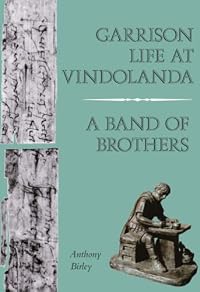
Garrison Life at Vindolanda: A Band of Brothers
by Anthony Birley
On This Page
Description
The ink writing-tablets, first indentified at Roman Vindolanda, just south of Hadrian's Wall, in 1973, revealed a hitherto unknown papyrus-substitute, thin leaves of wood for day-to-day book-keeping and letters. Dating mostly from the years AD 90-125 (Hadrian's Wall was begun in 122), these unique tablets represent the largest collection of original Roman letters ever found. The book paints a detailed picture of two Roman auxilary regiments, the 9th Cohort of Batavians and the 1st Cohort of show more Tungrians. Among the 400 named officers and personnel, the Batavian prefect Flavius Cerialis features prominently, together with his wife Sulpicia Lepidina, who received the now famous birthday party invitation from her friend Claudia Severa, wife of Cerialis' colleague and fellow hunting enthusiast Aelius Brocchus. In addition to covering officers and familes, friends and colleagues, this book brings to life the ordinary soldiers and their names and duties; military routine, duty-reports, leave and deserters; the supply of food, drink and other goods; merchants and contractors; visitors and entertainment as well as day-to-day enthusiasms as varied as hunting and religion. This book, by the Chairman of the Vindolanda Trust, not only distils all the recovered material, including many unpublished writing-tablets, but makes full use of the other archaeological evidence. The result is an unparalleled insight into the spirit of the day-today life on the north-west edge of the Empire in the three decades before Hadrian's Wall was built. show lessTags
Recommendations








Member Reviews
Vindolanda was a Roman fort in northern England - Hadrian's wall was built just to the north of it. Unusual conditions caused an amazing amount of organic material to be preserved from the 100 C.E. time period, including hundreds of fragmentary documents - ink on thin strips of wood.
This book includes photographic reproductions of dozens of these documents. I am fascinated by paleography but have no expertise at all. It was exceedingly challenging to look at this ancient writing and compare it to the transcription provided, to try to make out which little mark is a "c" and which an "e", for example.
The book starts with a quick modern history of the site - when people first recognized it as a Roman ruin and when excavations revealed show more the soggy treasures - they were all under water, in anaerobic conditions, like a bog. This discovery is only from around 1970.
The book then reviews the local terrain and how the fort is situated relative to the other Roman forts in northern England and in Scotland. It discusses the various movements of Roman troops in Britain in the first couple of Centuries C.E.
The main body of the book is a review of the contents of the letters. There is a lot of talk about buying and selling of basic supplies. There is talk too of people traveling to visit each other. These documents are not literature, not intended for any audience beyond the recipient. They are just letters and probably account records.
Birley stays quite close to the documents themselves, He does guess at meanings and tries to fill in the blank spaces. But he is careful to distinguish what the documents say from his guesses. There is no grand narrative here, beyond the raw historical sequence of troops arriving and leaving, the soldiers and their officers and the regional government. Birley sorts the documents topically and then just surveys their contents, focusing on the more complete ones.
That such a collection of documents survives from that time is rather amazing. Birley does a nice job of sharing that treasure with his readers. It's probably the best unvarnished look available of day to day life on the frontier of the Roman Empire. show less
This book includes photographic reproductions of dozens of these documents. I am fascinated by paleography but have no expertise at all. It was exceedingly challenging to look at this ancient writing and compare it to the transcription provided, to try to make out which little mark is a "c" and which an "e", for example.
The book starts with a quick modern history of the site - when people first recognized it as a Roman ruin and when excavations revealed show more the soggy treasures - they were all under water, in anaerobic conditions, like a bog. This discovery is only from around 1970.
The book then reviews the local terrain and how the fort is situated relative to the other Roman forts in northern England and in Scotland. It discusses the various movements of Roman troops in Britain in the first couple of Centuries C.E.
The main body of the book is a review of the contents of the letters. There is a lot of talk about buying and selling of basic supplies. There is talk too of people traveling to visit each other. These documents are not literature, not intended for any audience beyond the recipient. They are just letters and probably account records.
Birley stays quite close to the documents themselves, He does guess at meanings and tries to fill in the blank spaces. But he is careful to distinguish what the documents say from his guesses. There is no grand narrative here, beyond the raw historical sequence of troops arriving and leaving, the soldiers and their officers and the regional government. Birley sorts the documents topically and then just surveys their contents, focusing on the more complete ones.
That such a collection of documents survives from that time is rather amazing. Birley does a nice job of sharing that treasure with his readers. It's probably the best unvarnished look available of day to day life on the frontier of the Roman Empire. show less
Ratings
Members
- Recently Added By
Author Information

15+ Works 1,399 Members
Anthony Birley was Professor of Ancient History at Manchester 1974-90 and at Dusseldorf 1990-2002.
Classifications
- Genres
- History, Nonfiction, Anthropology, General Nonfiction
- DDC/MDS
- 936.288104 — History & geography History of ancient world (to ca. 499) Europe north and west of Italian Peninsula to ca. 499 England to 410 and Wales to 410
- LCC
- DA145 — History of Europe, Asia, Africa and Oceania Great Britain History of Great Britain England History By period Early and medieval to 1485 Celts. Romans. Saxons. Danes. Normans
Statistics
- Members
- 45
- Popularity
- 657,557
- Reviews
- 1
- Rating
- (4.33)
- Languages
- English
- Media
- Paper
- ISBNs
- 1