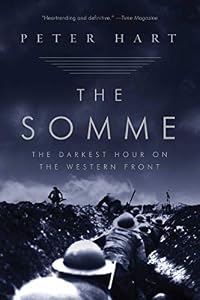
The Somme: The Darkest Hour on the Western Front
by Peter Hart
On This Page
Description
One of the bloodiest battles of modern warfare—a military tragedy that would come to define a generationOn July 1, 1916, the British Army launched the "Big Push" that was supposed to bring an end to the horrific stalemate on the Western Front between British, French, and German forces. What resulted was one of the greatest single human catastrophes in the history of warfare. Scrambling out of trenches in the face of German machine guns and artillery fire, the Allied Powers lost over show more twenty thousand soldiers that first day, but this "battle" would drag on for another four deadly months.
As the oral historian at the Imperial War Museum in London, Peter Hart has brought to light new material never before seen or heard. The Somme is an unparalleled evocation of World War I's iconic contest—the definitive account of one of the most harrowing battles of the twentieth century.
. show less
Tags
Recommendations










Member Reviews
The combined British and French offensive in the Somme River Valley of 1916 was one of the deadliest battles in the history of warfare. It lasted from July 1 until the middle of November when winter weather compelled a relaxation of hostilities. The British suffered 419,654 casualties, with 131,000 dead; the French had 204,000 casualties; the Germans 450,000 – 600,000. The original goal was to break through the German trenches on the western front, their first objective being the village of Bapaume, which lay about 5 miles behind the first German trenches. When the breakthrough proved impossible, the offensive continued in order to relieve pressure on the French, who were engaged in a battle of similar magnitude at Verdun. In the end, show more the British had moved the front line forward a few hundred yards, and the German trenches remained substantially intact. The village of Bapaume remained in German hands.
Hart’s narrative takes us from the first day of the battle, when the British incurred 57,470 casualties and 19,240 dead, to its sanguinary climax. He covers in significant detail virtually every significant attack, and there were many. His technique is to give a general overview, and then fill in the details with extensive quotes from letters written by the participants. Looking back nearly 100 years, one has to marvel at the literacy of the British army.
The book is a treasure trove for the serious student of World War I. However, it, like the battle itself, takes its toll on the reader. There were a great many individual attacks, all with agonizingly similar results: a heavy artillery barrage was followed by a “charge” of infantry men weighed down by their battle impedimenta, and a virtual slaughter in no man’s land. Sometimes the attackers actually made it to the German trenches, but even when they succeeded in taking the trench, they were seldom able to hold it because a prompt counterattack drove them back to the original start line.
During the course of several months, the British adapted their tactics slightly, but only slightly. They learned that the intensity of the artillery barrage was crucial to any success. They became more adept at the “creeping” barrage that landed just ahead of the advancing infantry. The men learned to use shell holes for cover, but usually found them already occupied, often by corpses. The first tanks were introduced by the British in this battle, but though they at first terrified the Germans, they were very slow and prone to frequent mechanical breakdown.
Hart’s criticism of the British generals, Douglas Haig in particular, is less harsh than that of most other analysts I have read. Haig believed that the Germans might have prevailed in 1914 if they had only persevered in their attacks a little longer, and he did not want to make the same mistake. Thus, the British Army dug in for the long haul, and suffered heavy casualties that it could ill afford, for insignificant tactical gain.
Moreover, to win the war, Haig reasoned that it would not be sufficient merely to take back the French territory lost. The German army had to be defeated. To Haig, it was a waste of manpower to engage in battles in other theaters, as the “Easterners” like David Lloyd George and Winston Churchill advocated. Hart opines that Haig and (his second in command) Robertson “may have been unimaginative, they were definitely ruthless when required, but above all they were hard, practical men and they were entirely right” in assessing how to beat the Germans in the situation they faced.
There were political as well as strategic considerations in play as well: "Even if Haig had fully realized the depth and breadth of the losses suffered by his assaulting divisions on 1 July he could not have aborted the offensive without seriously jeopardizing the Entente Cordiale with France and Russia … They were unlikely to look on with any great sympathy if Britain tried to evade her share of the 'butcher’s bill.'”
Evaluation: Hart’s favorable analysis of Haig is pointed and controversial. (Some of the epithets that have been applied to Haig include "The Butcher of the Somme" and "The Worst General of World War I.") It is also very terse, taking up no more than 15 pages of a 550 page book. The remaining 530 pages support Hart’s characterization of the military leadership as “unimaginative.” I would not recommend this book to anyone who did not want to read a blow-by-blow account of a five and one-half month battle. show less
Hart’s narrative takes us from the first day of the battle, when the British incurred 57,470 casualties and 19,240 dead, to its sanguinary climax. He covers in significant detail virtually every significant attack, and there were many. His technique is to give a general overview, and then fill in the details with extensive quotes from letters written by the participants. Looking back nearly 100 years, one has to marvel at the literacy of the British army.
The book is a treasure trove for the serious student of World War I. However, it, like the battle itself, takes its toll on the reader. There were a great many individual attacks, all with agonizingly similar results: a heavy artillery barrage was followed by a “charge” of infantry men weighed down by their battle impedimenta, and a virtual slaughter in no man’s land. Sometimes the attackers actually made it to the German trenches, but even when they succeeded in taking the trench, they were seldom able to hold it because a prompt counterattack drove them back to the original start line.
During the course of several months, the British adapted their tactics slightly, but only slightly. They learned that the intensity of the artillery barrage was crucial to any success. They became more adept at the “creeping” barrage that landed just ahead of the advancing infantry. The men learned to use shell holes for cover, but usually found them already occupied, often by corpses. The first tanks were introduced by the British in this battle, but though they at first terrified the Germans, they were very slow and prone to frequent mechanical breakdown.
Hart’s criticism of the British generals, Douglas Haig in particular, is less harsh than that of most other analysts I have read. Haig believed that the Germans might have prevailed in 1914 if they had only persevered in their attacks a little longer, and he did not want to make the same mistake. Thus, the British Army dug in for the long haul, and suffered heavy casualties that it could ill afford, for insignificant tactical gain.
Moreover, to win the war, Haig reasoned that it would not be sufficient merely to take back the French territory lost. The German army had to be defeated. To Haig, it was a waste of manpower to engage in battles in other theaters, as the “Easterners” like David Lloyd George and Winston Churchill advocated. Hart opines that Haig and (his second in command) Robertson “may have been unimaginative, they were definitely ruthless when required, but above all they were hard, practical men and they were entirely right” in assessing how to beat the Germans in the situation they faced.
There were political as well as strategic considerations in play as well: "Even if Haig had fully realized the depth and breadth of the losses suffered by his assaulting divisions on 1 July he could not have aborted the offensive without seriously jeopardizing the Entente Cordiale with France and Russia … They were unlikely to look on with any great sympathy if Britain tried to evade her share of the 'butcher’s bill.'”
Evaluation: Hart’s favorable analysis of Haig is pointed and controversial. (Some of the epithets that have been applied to Haig include "The Butcher of the Somme" and "The Worst General of World War I.") It is also very terse, taking up no more than 15 pages of a 550 page book. The remaining 530 pages support Hart’s characterization of the military leadership as “unimaginative.” I would not recommend this book to anyone who did not want to read a blow-by-blow account of a five and one-half month battle. show less
Peter Hart provides an excellent perspective on the day to day tactics in the battle, and the experience of ordinary soldiers and artillerymen at the front. There are extensive quotations from participants, mostly British, but also a few Germans. The maps and photos are also very good. The book is not as strong on the overall strategy of the battle and the British role in WWI, and very little is provided about what is happening on the German side. Overall, very worthwhile.
a good and very detailed examation of that bloody battle. I wonder how men on both sides endured it
In trying to be comprehensive, the author went into overkill in detailing one of the bloodiest battles of World War One. Still, a good mix of perspectives from tacticians to soldiers, and knockout research. Limited to British p.o.v. primarily.
Ratings
Members
- Recently Added By
Published Reviews
ThingScore 75
Hart has no big-picture sense of the place of the Great War in the narrative of the 20th century—he is as committed to the mud of Flanders and Picardy as his forebears were. Nonetheless, as one turns his pages, one is compelled to be impressed by the way he builds his relentless and one-dimensional case.
added by Shortride
Author Information

28 Works 1,721 Members
Peter Hart is Oral Historian of the Imperial War Museum in London. He is the author of many works of military history, including Gallipoli and Fire and Movement: The British Expeditionary Force and the Campaign of 1914.
Awards and Honors
Distinctions
Series
Belongs to Publisher Series
Common Knowledge
- Original publication date
- 2005
- People/Characters
- Douglas Haig
- Important places
- Picardy, Hauts-de-France, France; Somme, Hauts-de-France, France; Western Front in World War I
- Important events
- World War I (1914 | 1918); Battle of the Somme (1916-07-01 | 1916-11-18)
Classifications
- Genres
- History, Nonfiction, General Nonfiction
- DDC/MDS
- 940.4272 — History & geography History of Europe History of Europe Military History Of World War I Land campaigns and battles of 1914-1916
- LCC
- D545 .S7 .H348 — History of Europe, Asia, Africa and Oceania History (General) World War I (1914-1918)
- BISAC
Statistics
- Members
- 399
- Popularity
- 77,706
- Reviews
- 4
- Rating
- (4.06)
- Languages
- English, German
- Media
- Paper, Audiobook, Ebook
- ISBNs
- 10
- ASINs
- 10