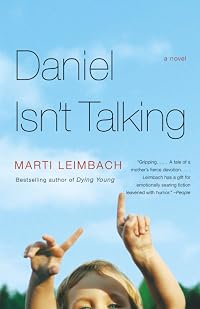
Daniel Isn't Talking
by Marti Leimbach
On This Page
Description
A novel exploring the effects of autism on a young family explains a mother's determination to help her autistic child, taking on the experts and her own family to teach her child to become as "normal" as possible.Tags
Recommendations

































Member Reviews
Vaccines don’t cause autism. Unorthodox ideas don’t cure it. But autistic kids are real individuals with real families, and Marti Leimback’s novel convincingly evokes that reality with engaging humor and enthralling detail. The only way I knew this book was fiction, in fact, was from the way those details drew me to share the protagonist’s life rather than just hearing about it.
An American woman living in England, Melanie feels that slight detachment from reality familiar to expats everywhere. A fracturing marriage adds to the separation of real life from intended dreams. But her autistic child is even more detached, and Melanie fights to get the right treatment for him—treatment that might work—running the gamut of “was show more it the vaccine?” “will goat’s milk help?” and “please don’t lock him away in a school for no-hopers.”
Daniel isn't Talking isn't a personal experience story or a self-help book. In fact, it would probably be risky to use it for self-help as, among other things, it honestly explores the doubts a mother might have about the vaccines and the prognoses given her child. But it's an enthralling novel, filled with memorably characters, humor, pathos and hope. Its miracles are those small miracles of real life, and its message offers a hope worth pursuing, for mothers, wives, carers and children alike.
Disclosure: I picked it up at a book exchange because I have a relative with autism. show less
An American woman living in England, Melanie feels that slight detachment from reality familiar to expats everywhere. A fracturing marriage adds to the separation of real life from intended dreams. But her autistic child is even more detached, and Melanie fights to get the right treatment for him—treatment that might work—running the gamut of “was show more it the vaccine?” “will goat’s milk help?” and “please don’t lock him away in a school for no-hopers.”
Daniel isn't Talking isn't a personal experience story or a self-help book. In fact, it would probably be risky to use it for self-help as, among other things, it honestly explores the doubts a mother might have about the vaccines and the prognoses given her child. But it's an enthralling novel, filled with memorably characters, humor, pathos and hope. Its miracles are those small miracles of real life, and its message offers a hope worth pursuing, for mothers, wives, carers and children alike.
Disclosure: I picked it up at a book exchange because I have a relative with autism. show less
This is a good book which I appreciated much more after I read it completely and also read "A note from the author". During my read of the novel, I thought it was transforming into a competition between the two men in Melanie's life, but, by the end of the book, I saw it was much more than that. My favorite part about Daniel, Melanie's autistic son, was when the author wrote the following which seemed to run more true in the way it was expressed than anything else in this book.
"Some mothers appear to make a badge out of autism, behaving as though it is not a disability but a "difference" and that we shouldn't be seeking to cure these children. Understanding is what is in order, they cry, a broader mind, an enlightened perspective. What show more you know about such people is that they have a child who functions very well, who may have Asperger's syndrome and not full-blown autism, and that they have probably not scrubbed feces from their carpet, or watched their child dry and rock in what looks like agony because he cannot speak. These people annoy me a little, although I admire how they cope, admire their presence of mind, their fearless defenses of their children. But we've walked different paths, and they are talking about mine as though they've been there, which they have not, and will not. Because having a child with autism--at least the type of autism I have experienced--is less like walking a patch than like hacking at a jungle with a scythe, not able to see much in front of you at all except more stuff you have to clear or step over, or around, or through." show less
"Some mothers appear to make a badge out of autism, behaving as though it is not a disability but a "difference" and that we shouldn't be seeking to cure these children. Understanding is what is in order, they cry, a broader mind, an enlightened perspective. What show more you know about such people is that they have a child who functions very well, who may have Asperger's syndrome and not full-blown autism, and that they have probably not scrubbed feces from their carpet, or watched their child dry and rock in what looks like agony because he cannot speak. These people annoy me a little, although I admire how they cope, admire their presence of mind, their fearless defenses of their children. But we've walked different paths, and they are talking about mine as though they've been there, which they have not, and will not. Because having a child with autism--at least the type of autism I have experienced--is less like walking a patch than like hacking at a jungle with a scythe, not able to see much in front of you at all except more stuff you have to clear or step over, or around, or through." show less
Daniel is autistic. He started out laughing and playing peek-a-boo just as any other baby. But sometime after his first birthday his mother, Melanie, knew there was something wrong with her son. Her husband, Stephen, dismisses it as motherly hysteria. When Daniel is finally diagnosed Stephen turns on Melanie and asks her why she didn’t pick it up earlier. All the experts tell her just to put Daniel in a special school, but Melanie won’t give up on improving her son’s quality of life. Stephen loses patience and leaves Melanie and moves in with his ex-girlfriend.
There is no happy ending for Daniel – he is autistic, there is no cure. What makes this book so good is Melanie’s fight for her son – how she puts her whole being into show more finding the best treatment for him – fighting medical bureaucracy. She has an able-bodied daughter, Emily, as well – she never lets Emily feel second best. The book is well-written, well researched, and the characters are very real. There is a dark humour through the book – and it gives hope. I didn’t like the way the author dismisses all the established methods for dealing with Autism – but she did teach that you never give up getting the best treatment you can. show less
There is no happy ending for Daniel – he is autistic, there is no cure. What makes this book so good is Melanie’s fight for her son – how she puts her whole being into show more finding the best treatment for him – fighting medical bureaucracy. She has an able-bodied daughter, Emily, as well – she never lets Emily feel second best. The book is well-written, well researched, and the characters are very real. There is a dark humour through the book – and it gives hope. I didn’t like the way the author dismisses all the established methods for dealing with Autism – but she did teach that you never give up getting the best treatment you can. show less
"Daniel Isn't Talking" by Marti Leimbach is a glimpse inside the life of a mother who is passionate about finding the key to unlock her young autistic son's mind.
Her husband, Stephen, is a man who does not look beyond the surface of Daniel's illness, which eventually drives a wedge between the couple, and they separate.
Melanie seeks out every doctor, every alternative, every possible method to try to set her son free from the quiet prison of autism....and meets a man named Andy who begins the process of "play therapy" with young Daniel. Over time, Daniel begins to respond to this therapy, slowly but surely....and Melanie's hopes begin to soar.
Melanie goes back and forth, wishing her husband to be a participant in this effective show more treatment for their son, as well as to come back home, at least for the children's sake (there is a young daughter too, who is not autistic). But between her longing for her husband to come back home, she begins seeing Andy as more than just a therapist for her son, but as a man who seems to care for her and her family in a personal way.
The book is a page turner, smooth and very well written. If the reader knows a person with autism, you will relate to this book. If the reader does not know a person with autism, you will find this book to be a fascinating look inside the complex world of a challenging and sometimes misunderstood illness.
I very highly recommend this book to all. I'd love to read more by this excellent writer. show less
Her husband, Stephen, is a man who does not look beyond the surface of Daniel's illness, which eventually drives a wedge between the couple, and they separate.
Melanie seeks out every doctor, every alternative, every possible method to try to set her son free from the quiet prison of autism....and meets a man named Andy who begins the process of "play therapy" with young Daniel. Over time, Daniel begins to respond to this therapy, slowly but surely....and Melanie's hopes begin to soar.
Melanie goes back and forth, wishing her husband to be a participant in this effective show more treatment for their son, as well as to come back home, at least for the children's sake (there is a young daughter too, who is not autistic). But between her longing for her husband to come back home, she begins seeing Andy as more than just a therapist for her son, but as a man who seems to care for her and her family in a personal way.
The book is a page turner, smooth and very well written. If the reader knows a person with autism, you will relate to this book. If the reader does not know a person with autism, you will find this book to be a fascinating look inside the complex world of a challenging and sometimes misunderstood illness.
I very highly recommend this book to all. I'd love to read more by this excellent writer. show less
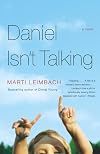
Ok, I admit that what made me check out this book was the cute pic of the little boy on the front cover, NOT because I actually knew anything about it. As I started to read, I wish I hadn't--the subject matter was so depressing! I think that all you moms can relate to the main character, though, a person who would give her life to better her child's. The book got better, though, and by the end, I was happy that Daniel was talking. ~Mel
Seemed like chick lit for autism moms. Was entertaining, poignant, a little on the harlequin romance side with the perfect child-play-therapist-who-saves-the-child developing into a love interest. But shoot, if we don't need a little escapist fantasy, who does?
I was drawn to this story because the plot involves a young family trying to come to grips with the reality of a small child who is not talking. Since I have a grandchild who had language delays, I readily identified with the struggle, fears and pain of the young mother, an American woman who married a British man and lives in England. The writing is so candid and realistic, that I was certain the author wrote from personal experience. After finishing the story, I wrote an email to Marti Leimbach and to my surprise, she answered immediately and yes, she is the mother of an autistic son. This book does not sugar coat the situation and yet is not depressing. Realistically dealing with the family dynamics the novel shows that such life show more events impact everyone in the family and the author champions honesty and authenticity. show less
Members
- Recently Added By
Lists

BingoDOG - Books About Autism: Fiction
27 works; 14 members
Author Information
20+ Works 858 Members
Common Knowledge
- Quotations
- Some mothers appear to make a badge out of autism, behaving as though it is not a disability but a "difference" and that we shouldn't be seeking to cure these children. Understanding is what is in order, they cry, a broader m... (show all)ind, an enlightened perspective. What you know about such people is that they have a child who functions very well, who may have Asperger's syndrome and not full-blown autism, and that they have probably not scrubbed feces from their carpet, or watched their child dry and rock in what looks like agony because he cannot speak. These people annoy me a little, although I admire how they cope, admire their presence of mind, their fearless defenses of their children. But we've walked different paths, and they are talking about mine as though they've been there, which they have not, and will not. Because having a child with autism--at least the type of autism I have experienced--is less like walking a patch than like hacking at a jungle with a scythe, not able to see much in front of you at all except more stuff you have to clear or step over, or around, or through.
Classifications
Statistics
- Members
- 391
- Popularity
- 79,548
- Reviews
- 24
- Rating
- (3.57)
- Languages
- Dutch, English, German, Spanish
- Media
- Paper, Ebook
- ISBNs
- 20
- ASINs
- 3