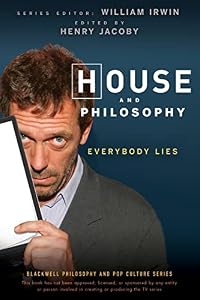
House and Philosophy: Everybody Lies
by Henry Jacoby (Editor)
The Blackwell Philosophy and Pop Culture Series
On This Page
Description
"Dr. Gregory House is arguably the most complex and challenging antihero in the history of television, but is there more to this self-important genius than gray matter and ego? This book takes a deeper look at House to reveal the philosophical underpinnings of this popular medical drama and its cane-waving curmudgeon's most outrageous behavior. What emerges is a remarkable character who is part Sherlock Holmes, part Socratic philosopher, part Nietzschean superman, part Taoist rhetorician, show more and not at all as screwed up as you might think."--Jacket. show lessTags
Recommendations









Member Reviews
Recently, I was asked by a friend to list fifteen of the most influential fictional characters in my life...characters that would always stick with me. Since the list didn't specify between literary and television/film characters, I had difficulty, at least in retrospect, leaving Gregory House off of that list. House is a character that has always resonated with me. On my, how should I say, less than optimistic days, I've been told that I have everything in common with him except walking with a cane. There's something about being so good at what you do that you can get by with saying whatever you think that is alluring to me...though perhaps it shouldn't be. That, though, is exactly the appeal.
This book was loaned to me by a friend. I show more haven't explored philosophy in popular culture titles much as of yet, but have been interested in doing so, and this was as good a place as any to begin. The book is a collection of essays from philosophy professors at various American universities, and the content varies from literary analysis to arguments presenting which philosophical perspectives the character of House espouses. With respect to the individual scholars, the quality of the content of these essays varies dramatically from the thought provoking to the unbelievable. One essay discusses in depth the inspiration of the character of House by the character of Sherlock Holmes, and points out fascinating correlations between House's television program and the literary world of Doyle. One essay discusses House's presentation of Sarte's philosophy ("Hell is other people"), and an entire section of the book discusses the ethics of the physicians in the show as they correspond to accepted medical ethics in the "real world." Other essays leave you flipping pages quickly to reach the end of the them because they lack all credibility from their premise forward (House as Zen Bhuddist rhetorician? Really?).
What fascinates me most about the book, however, is that it speaks to the quality of the character of Gregory House as he has been conceived by the screenwriters and brought to life by Hugh Laurie. There is something about this character, as much as he alternately repulses and attracts us, that makes us unable to look away, almost as though we've driven by a car accident. Whether it is disgust or admiration that motivates the viewer, almost everyone I know that watches this show has something constructive and insightful to say about House. The character is simply that powerful.
The academic ventures of recent years to discuss the rhetoric, philosophy, and theology of popular culture is an important pursuit to our society, and this book is evidence of that. The philosophy isn't presented at a deep academic level, but rather in a well-balanced style that meets both the philosophical novice and the student who has studied philosophy at some depth in the middle. The language is accessible, and overall the book goes by very quickly once you begin. All in all, If you're a fan of the show, this is a worthwhile read, if for no other reason than the fact that you will be able to discuss the next episode with much more insight and depth. show less
This book was loaned to me by a friend. I show more haven't explored philosophy in popular culture titles much as of yet, but have been interested in doing so, and this was as good a place as any to begin. The book is a collection of essays from philosophy professors at various American universities, and the content varies from literary analysis to arguments presenting which philosophical perspectives the character of House espouses. With respect to the individual scholars, the quality of the content of these essays varies dramatically from the thought provoking to the unbelievable. One essay discusses in depth the inspiration of the character of House by the character of Sherlock Holmes, and points out fascinating correlations between House's television program and the literary world of Doyle. One essay discusses House's presentation of Sarte's philosophy ("Hell is other people"), and an entire section of the book discusses the ethics of the physicians in the show as they correspond to accepted medical ethics in the "real world." Other essays leave you flipping pages quickly to reach the end of the them because they lack all credibility from their premise forward (House as Zen Bhuddist rhetorician? Really?).
What fascinates me most about the book, however, is that it speaks to the quality of the character of Gregory House as he has been conceived by the screenwriters and brought to life by Hugh Laurie. There is something about this character, as much as he alternately repulses and attracts us, that makes us unable to look away, almost as though we've driven by a car accident. Whether it is disgust or admiration that motivates the viewer, almost everyone I know that watches this show has something constructive and insightful to say about House. The character is simply that powerful.
The academic ventures of recent years to discuss the rhetoric, philosophy, and theology of popular culture is an important pursuit to our society, and this book is evidence of that. The philosophy isn't presented at a deep academic level, but rather in a well-balanced style that meets both the philosophical novice and the student who has studied philosophy at some depth in the middle. The language is accessible, and overall the book goes by very quickly once you begin. All in all, If you're a fan of the show, this is a worthwhile read, if for no other reason than the fact that you will be able to discuss the next episode with much more insight and depth. show less
One would think a book on the philosophy of House MD could only go so far. It is just a TV show, right? Sure, but a show that presents probing ethical, moral, and philosophical questions; probably more so than any other currently in prime time. You have characters (The mesmerizing idiosyncrasies of the titular character alone could probably take up a whole book) and premises that are ripe for philosophical examination. The essay on House as an embodiment of Nietzsche's Ubermensch is of particular interest, as the thought had crossed my mind before, but to see it examined in such detail was quite a treat.
This was an interesting read with a few good essays. However, several of the essays had practical issues (the quoted episode was about a different character) and two flat out misquoted the show and based the article ON that misquote. I spent half the time in contemplation and the other half raging at the book. If the goal was to get an emotional reaction, it succeeded. In the bios of the authors, one said that she thought Hugh Laurie's British accent on Jeeves & Wooster was excellent. I sure hope that was a joke...
The e book format I bought was buggy due to the chapter and sub-chapter layout and the index.
The e book format I bought was buggy due to the chapter and sub-chapter layout and the index.
House is my favourite TV show. Reading this book was a real treat. It enabled me to probe deeper into House's character and into the moral and ethical questions the show raises.
House and Philosophy is a collection of essays by different authors, each exploring the TV show, and especially Dr. House himself, from a different philosophical perspective. You do not need to be an expert in philosopy to read this book, but it will help if you are familiar with the TV show as the examples are drawn from particular episodes.
Now, usually, collections of essays are my least favourite type of reading. But, in this case, the authors obviously worked together very well and there is none of the repetition that often plagues this kind of book as each show more author feels the need to set out basic premises or background information.
This is part of a pop culture and philosophy series, and I plan to look for more titles. show less
House and Philosophy is a collection of essays by different authors, each exploring the TV show, and especially Dr. House himself, from a different philosophical perspective. You do not need to be an expert in philosopy to read this book, but it will help if you are familiar with the TV show as the examples are drawn from particular episodes.
Now, usually, collections of essays are my least favourite type of reading. But, in this case, the authors obviously worked together very well and there is none of the repetition that often plagues this kind of book as each show more author feels the need to set out basic premises or background information.
This is part of a pop culture and philosophy series, and I plan to look for more titles. show less
Either you love House or philosophy or both in which case you will likely enjoy this work. It is written at an introductory level for educated persons or undergraduates so you will not necessarily discover anything profound about philosophy but you will find an interesting application of philosophy about a hit TV show, in particular the acerbic, but in some ways lovable, Gregory House, M.D.
Is House Zen? Is House moral or not? Can House feel love and if not what does it mean? So many important questions.... But seriously, this book provides a unique and interesting look into the one of the most popular series of today.
Sometimes knowing MORE about a subject takes all the fun out of it. (review by MasterDeski's dad, but maybe he just likes the TV show more than he likes philosophy... )
Members
- Recently Added By
Author Information
All Editions
Series

Common Knowledge
- People/Characters
- Gregory House; Sister Augustine; James Wilson; Robert Chase; Allison Cameron; Eric Foreman (show all 10); Remy "Thirteen" Hadley; Chris Taub; Lawrence Kutner; Lisa Cuddy
- Important places
- Princeton-Plainsboro Teaching Hospital; 221B Baker Street
- Related movies
- House M.D. (2004 | IMDb)
- First words
- Dr. Gregory House, that brillant pill-popping bastard, limps along the halls of Princeton-Plainsboro Teaching Hospital, knocking aside medical ethics with a wave of his cane.
- Last words
- (Click to show. Warning: May contain spoilers.)In that case, we would gladly endure his rudeness, his dishonesty, and his willingness to break the law.
Classifications
- Genres
- Philosophy, Nonfiction, General Nonfiction
- DDC/MDS
- 791.4572 — Arts & recreation Recreation, sports, and performing arts Movies, TV, Video Motion pictures, radio, television, podcasting Television Programs; television plays Single programs
- LCC
- PN1992.77 .H63 .H65 — Language and Literature Literature (General) Literature (General) Drama Broadcasting Television broadcasts
- BISAC
Statistics
- Members
- 435
- Popularity
- 70,400
- Reviews
- 10
- Rating
- (3.77)
- Languages
- English, Hungarian, Polish, Spanish
- Media
- Paper, Ebook
- ISBNs
- 8
- ASINs
- 1