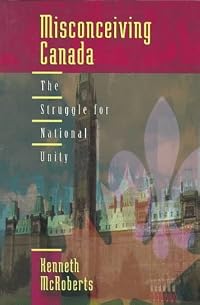
Misconceiving Canada: The Struggle for National Unity
by Kenneth McRoberts
On This Page
Description
In the fall of 1996, the prospects for Canada looked bleak; of the many unity crises that Canada has known, this one was undoubtedly the worst. The November 1995 referendum on Quebec sovereignty produced the smallest of victories for the forces of federalism: 0.06% or 54,288 votes; it couldeasily have gone the other way. Moreover, surveys have regularly indicated that in a new referendum the Yes vote could prevail. If there ever was a last chance for Canada this would seem to be it.This book show more begins by exploring the deep historical roots of the conception of Canada that Trudeau and his colleagues tried to change. The book then moves on to examine how successive governments tried to re-examine the relationship between Quebec and the rest of the country. McRoberts examines therole of the Trudeau government, official bilingualism, multiculturalism, the Mulroney era, and the failures of both the Meech Lake and the Charlottetown Accords. The final chapter of the book examines the 1995 Quebec referendum with its near victory of the Yes vote, which can only be seen as proofof the failure of the Trudeau strategy, and the current federal government's failure to deliver meaningfully on promises made during the referendum.The conclusion begins with a review of this critical reassessment of the strategy and its consequences for Canada. It then maps out some of the routes to resolving the crisis that become available once that strategy is abandoned: formalizing asymmetry within Canadian federalism, revising languagepolicy on a territorial basis, recasting Canada as a multinational confederation, and so on. Whether any of this can be done, however, is an open question.Yet if Quebec should opt for sovereignty it will be important to remember that Canadians and Quebecois are not naturally the worst of enemies as some have claimed, and would still have common interests that need protection. This volume will explore ways of doing this. In the last analysis, as thisbook shows, a vote for sovereignty is not inevitable but would be the result of errors and miscalculations that were made, often with the best of intentions, by our political class. In particular, it would have stemmed from a national unit strategy that was based on a misconception ofCanada. show lessTags
Members
- Recently Added By
Author Information

6 Works 49 Members
Kenneth McRoberts is Principal of Glendon College, York University, Toronto, where he is also Professor of Political Science.
Classifications
Statistics
- Members
- 13
- Popularity
- 1,764,894
- Languages
- English
- Media
- Paper, Ebook
- ISBNs
- 2