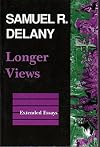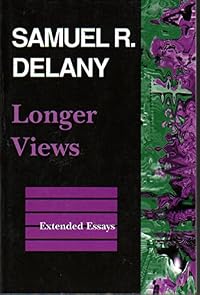
Longer Views
by Samuel R. Delany
On This Page
Description
A comprehensive expansion of the theoretical writings of one of our most important cultural critics.Tags
Recommendations























Member Reviews
When Delaney is writing about literature he loves, he's fascinating. His philosophy is trite ("About every fragment of reality, an infinite number of different statements can be made. For every fragment of reality, an infinite number of different models can be made.") and his formal criticism is to me incomprehensible; the worst of this collection is far too personal and unpleasantly confessional.
Folk who know Delaney won't be surprised by that last response, but might be surprised by what provoked it. I'm not bothered by his sexual anecdotes (indeed, there's a fascination to a sexual experience so different to mine and to what I consider in many different ways the mainstream). Instead, what left me embarassed for the guy is the kind of show more self-conscious self-judgement on show in the following:
"Like many children who get along easily with their peers, I was an incredibly vicious and self-centred child, a liar when it suited me and a thief when I could get away with it, who, with an astonishing lack of altruism, had learned some of the advantages of being nice to people nobody else wanted to be bothered with." This paragraph is followed by "I think, sometimes, when we are trying to be the most honest, the fictionalizing process is at its strongest." I couldn't agree more, but Delaney seems to say this in the same confessional mode ("What do they remember that, perhaps, I have forgotten--either because it was too painful, too damning, or because it made no real impression at all?") while I'm left wishing he'd written with a little more distance and a little less grovelling.
It's a shame to only be able to quote in support of my negative response, but the positive one (which on balance outweighs the negative) comes much more from the large-scale structure of these essays than from any specific felicities of phrasing. The preface describes the collection of long essays as "the least commercial of all works", while the introduction by Ken James notes the "norm which is somehow being supplemented, exceeded, transgressed" presupposed by the term "extended essay". Some of these essays are simply long, like an unextended essay with more of the same. But some are structural experiments that do indeed transgress, as gay critics are wont to do, and delightfully so.
7. I never thought of myself when young as someone who, someday, would have "quite a collection of old moustache-wax brushes." But I do ... simply because I now have quite a moustache! And much later in the same essay (which begins with the proposition "Rhetoric is the ash of discourse"): 24. "Man," says Dennis in the half-dark, "I'll fuck you up the ass so much the cum'll be runnin' out your nose--you won't need any moustache wax!" Odd how affection manifests itself in various ages and epochs, in various social niches. The humanity undercuts the pretension, and forces you to reconsider the possibility that there might be something to "the ash of discourse" after all... if you can identify with a gay man's sexual affection via his moustache wax, maybe you can identify with a postmodern critic as well.
(I'll be honest: my identification didn't go so far as to make any part of the "cyborg" essay Reading at Work comprehensible to me.)
I left this collection with enormous curiosity for Delaney's fiction; I'd be equally curious about his autobiography if I didn't expect him to spend a good deal of time excoriating his former self. show less
Folk who know Delaney won't be surprised by that last response, but might be surprised by what provoked it. I'm not bothered by his sexual anecdotes (indeed, there's a fascination to a sexual experience so different to mine and to what I consider in many different ways the mainstream). Instead, what left me embarassed for the guy is the kind of show more self-conscious self-judgement on show in the following:
"Like many children who get along easily with their peers, I was an incredibly vicious and self-centred child, a liar when it suited me and a thief when I could get away with it, who, with an astonishing lack of altruism, had learned some of the advantages of being nice to people nobody else wanted to be bothered with." This paragraph is followed by "I think, sometimes, when we are trying to be the most honest, the fictionalizing process is at its strongest." I couldn't agree more, but Delaney seems to say this in the same confessional mode ("What do they remember that, perhaps, I have forgotten--either because it was too painful, too damning, or because it made no real impression at all?") while I'm left wishing he'd written with a little more distance and a little less grovelling.
It's a shame to only be able to quote in support of my negative response, but the positive one (which on balance outweighs the negative) comes much more from the large-scale structure of these essays than from any specific felicities of phrasing. The preface describes the collection of long essays as "the least commercial of all works", while the introduction by Ken James notes the "norm which is somehow being supplemented, exceeded, transgressed" presupposed by the term "extended essay". Some of these essays are simply long, like an unextended essay with more of the same. But some are structural experiments that do indeed transgress, as gay critics are wont to do, and delightfully so.
7. I never thought of myself when young as someone who, someday, would have "quite a collection of old moustache-wax brushes." But I do ... simply because I now have quite a moustache! And much later in the same essay (which begins with the proposition "Rhetoric is the ash of discourse"): 24. "Man," says Dennis in the half-dark, "I'll fuck you up the ass so much the cum'll be runnin' out your nose--you won't need any moustache wax!" Odd how affection manifests itself in various ages and epochs, in various social niches. The humanity undercuts the pretension, and forces you to reconsider the possibility that there might be something to "the ash of discourse" after all... if you can identify with a gay man's sexual affection via his moustache wax, maybe you can identify with a postmodern critic as well.
(I'll be honest: my identification didn't go so far as to make any part of the "cyborg" essay Reading at Work comprehensible to me.)
I left this collection with enormous curiosity for Delaney's fiction; I'd be equally curious about his autobiography if I didn't expect him to spend a good deal of time excoriating his former self. show less
Ratings
Members
- Recently Added By
Author Information

196+ Works 28,843 Members
Samuel R. Delany Jr. was born in Harlem, New York on April 1, 1942. He is a science fiction and short story writer. His first novel, The Jewels of Aptor, was published in 1962. He has written more than 20 novels and collections of short stories, memoirs, and critical essays. He has received numerous awards including the Nebula Award for best novel show more for Babel-17 in 1966 and The Einstein Intersection in 1967, the Nebula Award for best short story for Aye, and Gomorrah and Time Considered as a Helix of Semi-Precious Stones, the Hugo Award for best short story for Time Considered as a Helix of Semi-Precious Stones in 1970 and for his non-fiction book, The Motion of Light in Water, and the Bill Whitehead Award for Lifetime Achievement in Gay Literature in 1993. He is as a professor in the department of English at the University at Buffalo, Buffalo, New York. (Bowker Author Biography) Samuel R. Delany is a professor of English & Creative Writing at Temple University in Philadelphia. (Publisher Provided) show less
Common Knowledge
- Canonical title
- Longer Views
- Original publication date
- 1996
- Dedication
- For Henry Finder and Kwame Anthony Appiah
- First words
- In a crucial epoch that has privileged, for twenty years or more, difference, decantering, discontinuity, diversity, and pluralism over the elder gods of Unity, Totality, and Mastery, so much American nonfiction still finds i... (show all)tself attempting to appease those elder gods and their former conventions. -Preface
The term "extended essay," in its very articulation, seems to presuppose a norm which is somehow being supplemented, exceeded, transgressed. -Ken James, Introduction
What follows is a work of popular cultural history, not of original research. It required not one foray into any other library save my own. -Chapter 1, Wagner/Artaud - Canonical DDC/MDS
- 814.54
- Canonical LCC
- PS3554.E437
Classifications
- Genres
- Nonfiction, Literature Studies and Criticism, Fiction and Literature
- DDC/MDS
- 814.54 — Literature & rhetoric American literature in English American essays in English 20th Century 1945-1999
- LCC
- PS3554 .E437 — Language and Literature American literature American literature Individual authors 1961-
- BISAC
Statistics
- Members
- 137
- Popularity
- 237,898
- Reviews
- 1
- Rating
- (3.90)
- Languages
- English
- Media
- Paper, Ebook
- ISBNs
- 4
- ASINs
- 2