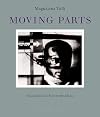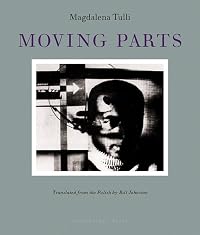
Moving parts
by Magdalena Tulli
On This Page
Description
A feckless, comical narrator struggles against all odds to tell a story for which he is responsible, but which he neither controls nor understands. His characters multiply, repeat, and go astray; his employer pays no attention, asleep in a drunken stupor. The increasingly desperate narrator clambers over rooftops and through underground passages, watching helplessly as his characters reappear in different times and settings and start rival stories against his will. This brilliant, wryly show more humorous work tells of the sadness of the world and of the inadequate means that language and storytelling offer for describing and understanding it. Yet it does so in Tulli's characteristically clear, concrete, gorgeous prose. This extraordinary work, unique in both form and message, shows a European master at the height of her powers and constitutes a major contribution to a new century of European literature. A wildly inventive page-turner. show lessTags
Recommendations


















Member Reviews
In this playful and perceptive novella, Tulli explores what it means to pluck a story out of life, how fiction and reality intersect, and how the past enters the present, and the difficulty, if not impossibility, of telling a story that really represents life. She does this by creating the character of "the narrator," a man who has been hired by some mysterious person or organization to write a story. From the beginning, when the "narrator" tries to figure out who his characters are, he is out of his depth, as the "characters" go off and do things he doesn't necessarily want them to do, as more "characters" enter the "story," and as he finds his way through streets, buildings, stairways, elevators, and basements to try to both follow show more and constrain them. The time frame is fractured too, as the beginning of the novella seems to be in the present, but towards the end the "characters," including the "narrator," find themselves in wartime Poland, possibly during the Warsaw uprising.
In between, Tulli and the "narrator" meditate on language and grammar, on how they shape both the story and reality. For example, Tulli writes:
The narrator hopes that at this point he'll finally be able to put his foot on the dry land of the past tense, in the kingdom of certainty where facts live and flourish. Only there do they flourish, nowhere else: the past tense is their entire world, the homeland of truths that are incontrovertible though, it must be admitted, usually contradictory. p. 23
They (two of the "characters") would make some tea, and sit in the armchairs, teacups in hand, discussing the worrying suspicion that they would have to relinquish their polished floors and their phonograph and record collection, and they continually cast doubt on something that was blindingly obvious given the ineluctable way in which the future tense turns into the past. They even tried to joke about this process, but their jokes were not entirely successful; they were not funny enough for them to convince themselves they were safely beyond the reach of grammar. p. 95
This is the third of Tulli's books that I've read. All have been fascinating, all have been different. But, in all of them, Tulli writes beautiful, occasionally poetic prose and is an extremely detailed observer of the world around her, particularly of color and architecture, human activities and home furnishings. This was a delightful and thought-provoking read. show less
In between, Tulli and the "narrator" meditate on language and grammar, on how they shape both the story and reality. For example, Tulli writes:
The narrator hopes that at this point he'll finally be able to put his foot on the dry land of the past tense, in the kingdom of certainty where facts live and flourish. Only there do they flourish, nowhere else: the past tense is their entire world, the homeland of truths that are incontrovertible though, it must be admitted, usually contradictory. p. 23
They (two of the "characters") would make some tea, and sit in the armchairs, teacups in hand, discussing the worrying suspicion that they would have to relinquish their polished floors and their phonograph and record collection, and they continually cast doubt on something that was blindingly obvious given the ineluctable way in which the future tense turns into the past. They even tried to joke about this process, but their jokes were not entirely successful; they were not funny enough for them to convince themselves they were safely beyond the reach of grammar. p. 95
This is the third of Tulli's books that I've read. All have been fascinating, all have been different. But, in all of them, Tulli writes beautiful, occasionally poetic prose and is an extremely detailed observer of the world around her, particularly of color and architecture, human activities and home furnishings. This was a delightful and thought-provoking read. show less
Moving Parts is an incredible, truly insightful novel in which the narrator looses control of his story. What? Yes! He becomes a character and cannot get out of the view of the reader. This is not a book to breeze though, it is jam packed full of brilliant quotes and stunning writing. The concept of this novel, and the storyline are completely unlike anything that I have read before. The depth in language use and parts of speech was over my head many times, but a lover of grammar would fall in love with the way words such as "predicate" and "parts of speech" are woven into regular everyday language, which the author does with ease.
While reading the word choice and use of certain phrases I could not help but to feel that I was missing show more out, that it was incredibly vast and I was only drinking from the surface. If you are a person who loves to think, who loves incredible well-thought deep quotes and an intense knowledge of language captivates you, this is your book. Read it and you will love it. It will speak to you and drive you to a deeper understanding about the other books that you love to read. It will guide you through the feelings characters suffer in being written about, and those that narrators must endure in order to tell their story (even if they don't want to), it will help you know more about the concept of a novel, in which all is created...but by whom? Who is in charge of these books that we read, who leads the reader? How would it be if things were not the way they should be in a novel, if the characters did not follow what the narrator asked of them, if past and future were slowly blurred and confusion was the key theme of the story? Read Moving Parts by Magdalena Tulli and you will surely be submersed in this fictional chaos of writing and will be taken to a deeper understanding of our current idea: a fictional novel, in which nothing really exists, except in our minds, our desires and on the paper.
Quotes from Moving Parts:
"All he can do, and that only to a certain degree, is to govern grammatical forms, an essential element, especially as open space, of their own accord taking on the forms of the future tense, without any obligations" (p.26).
"The parts, always the same ones, wait like traps into which new characters will continue to fall, irrespective of their own wishes, promises, and misgivings" (p. 62).
"They even tried to joke about this process, but their jokes were not entirely successful; they were not funny enough for them to convince themselves that they were sagely beyond the reach of grammar. And so in the end, exhausted by the anticipation of leaving and by visions of an uncertain future, they changed the subject, returning to a certain betrayal, because betrayal was at least something they were capable of understanding" (p. 95).
" Hardly anything is possible any longer. And no truth will appear until the secure forms of the past tense impose order" (p. 132). show less
While reading the word choice and use of certain phrases I could not help but to feel that I was missing show more out, that it was incredibly vast and I was only drinking from the surface. If you are a person who loves to think, who loves incredible well-thought deep quotes and an intense knowledge of language captivates you, this is your book. Read it and you will love it. It will speak to you and drive you to a deeper understanding about the other books that you love to read. It will guide you through the feelings characters suffer in being written about, and those that narrators must endure in order to tell their story (even if they don't want to), it will help you know more about the concept of a novel, in which all is created...but by whom? Who is in charge of these books that we read, who leads the reader? How would it be if things were not the way they should be in a novel, if the characters did not follow what the narrator asked of them, if past and future were slowly blurred and confusion was the key theme of the story? Read Moving Parts by Magdalena Tulli and you will surely be submersed in this fictional chaos of writing and will be taken to a deeper understanding of our current idea: a fictional novel, in which nothing really exists, except in our minds, our desires and on the paper.
Quotes from Moving Parts:
"All he can do, and that only to a certain degree, is to govern grammatical forms, an essential element, especially as open space, of their own accord taking on the forms of the future tense, without any obligations" (p.26).
"The parts, always the same ones, wait like traps into which new characters will continue to fall, irrespective of their own wishes, promises, and misgivings" (p. 62).
"They even tried to joke about this process, but their jokes were not entirely successful; they were not funny enough for them to convince themselves that they were sagely beyond the reach of grammar. And so in the end, exhausted by the anticipation of leaving and by visions of an uncertain future, they changed the subject, returning to a certain betrayal, because betrayal was at least something they were capable of understanding" (p. 95).
" Hardly anything is possible any longer. And no truth will appear until the secure forms of the past tense impose order" (p. 132). show less
Ratings
Members
- Recently Added By
Author Information

8+ Works 402 Members
Some Editions
Awards and Honors
Notable Lists
Common Knowledge
- Canonical title
- Moving parts
- Original publication date
- 2003 (original Polish) (original Polish); 2005 (English: Johnston) (English: Johnston); 2008 (German translation) (German translation)
- Disambiguation notice
- Original title: Tryby
Classifications
- Genres
- Fiction and Literature, General Fiction
- DDC/MDS
- 891.8 — Literature & rhetoric Literatures of other languages East Indo-European and Celtic literatures West and South Slavic languages (Bulgarian, Slovene, Polish, Czech, Slovak, Serbo-Croatian, and Macedonian)
- LCC
- PG7179 .U45 .T7913 — Language and Literature Slavic languages and literatures. Baltic languages. Albanian language Slavic. Baltic. Albanian Slavic Polish
- BISAC
Statistics
- Members
- 70
- Popularity
- 447,631
- Reviews
- 2
- Rating
- (3.80)
- Languages
- Czech, English, Polish
- Media
- Paper, Ebook
- ISBNs
- 5
- ASINs
- 1