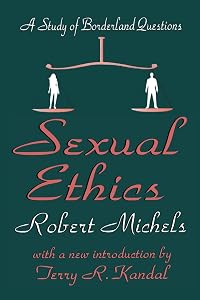
Sexual ethics: A study of borderland questions
by Robert Michels
2 Members (2.00)
On This Page
Description
In his treatment of the issues raised by the movements of women for equal rights a century ago, Michels anticipated controversies and conflicts about which people care deeply today. He took a clear position in support of the desirability of equality between the sexes. In consequence, it remains relevant to current debates within feminism over equality and difference and the corresponding challenge to, and feminist critique of, social science arising from the (re) emergence of "difference" show more feminism.Sexual Ethics constitutes both an analysis of the "woman problem" and a document describing the wars between the sexes during this period and an important and overlooked piece of history of the classic sociological tradition. Michels observed that the national and economic conflicts in modern Europe were vast in scale and revealed sharply sensed injustices, and also that sex antagonisms are becoming more acute. He presented an argument, consistent with his theoretical position, about the seriousness of women's rights. Michels' discussions of sexuality, sexual morality, and the relations of the sexes had as its stimulus "the new sexual ethic" advocated by feminists. He pointed out that true equality required equality of rights to sexual liberty for women or chastity prior to marriage for men.Michels supported premarital chastity for men as an ideal, but he doubted that very many would practice it. Michels was virtually alone in the sociological tradition in seeking to illuminate the "struggle for love" between men and women by reference to the "erotic coquetry" in the sexual behavior of "lower animals." Despite his stand for equality of men and women in sexual matters, a recurrent theme in Sexual Ethics is that men are sexually more aggressive than women, at least in part due to social structures and cultural traditions. Michels advocated family planning (but opposed abortion) in the interests of marital and family happiness and economic well-being, especially for the poor.In his new introduction, Terry R. Kandal discusses Robert Michels' life. He explores, among other topics, Michels' treatment of the woman question and the reactions of Michels' contemporaries to the same question. He also discusses the feminist critique of social science, and the place of Michels in and the gender questions of our times. The book will be of particular interest to those interested in the history of relations between men and women as well as those interested in questions of biological determinism. show lessTags
Member Reviews
Members
- Recently Added By
Author Information

7 Works 297 Members
Robert Michels was a German sociologist who spent the last 10 years of his life in Italy. In the English-speaking world, he is most famous for his book "Political Parties" (1911), in which he formulated the problem of the oligarchic tendencies of organizations. "He who says organization," he asserted, "says oligarchy." But political parties, he show more believed, are less oligarchic than single-purpose organizations concerned with specific reforms or with technical problems. An important study of the International Typographical Union, "Union Democracy" by Seymour M. Lipset, Martin A. Trow, and James S. Coleman (1956), has been said by some scholars to challenge many of Michels's findings about organizations. Rather, by pointing out the essential characteristics of a democratic trade union, this book confirms Michels's thesis. Michels also wrote about democracy, socialism, revolution, class conflict, trade unionism, mass society, nationalism, imperialism, and intellectuals, and he made intensive studies of the politics of the working class. (Bowker Author Biography) show less
Classifications
- Genres
- Nonfiction, Sociology, Sexuality and Gender Studies
- DDC/MDS
- 306.7 — Society, government, & culture Social sciences, sociology & anthropology Social Behavior - Dating, Marriage, Divorce Sexual relations
- LCC
- HQ21 .M6313 — Social sciences The family. Marriage, Women and Sexuality The Family. Marriage. Women Sexual life Sexual behavior and attitudes. Sexuality
- BISAC
Statistics
- Members
- 2
- Popularity
- 6,044,492
- Rating
- (2.00)
- Languages
- English
- Media
- Paper, Ebook
- ISBNs
- 3