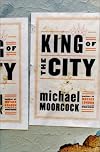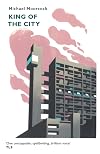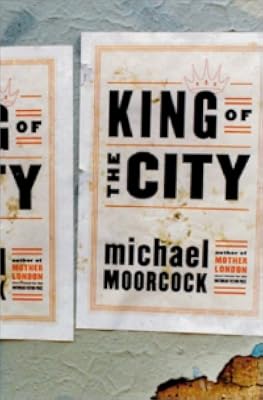
King of the City
by Michael Moorcock
On This Page
Description
More than a decade ago, Michael Moorcock's extraordinary Mother London gave stunning new breath and style to contemporary literature. With Bruce Chatwin's Utz and Salman Rushdie's The Satanic Verses, the novel was short-listed for Britain's prestigious Whitbread Prize. Now, with scathing wit and enthralling vision, the author whom the Washington Post has praised as "one of the most exciting discoveries in the contemporary English novel in] 40 or so years" returns to a city transformed and show more transforming, and in peril of its life.These are the times and trials of Dennis Dover, former rock guitarist, photojournalist, and paparazzo. Denny inhabits a world of vibrant color, smell, and sound, where novel experience and unpredictability are anchored by steadfast tradition and history. Mother London's many vagaries give Denny Dover joy and succor, always seducing him home from the Earth's terrible places, where the face of death is as common as the blood that stains the local dirt. And London is where Rosie Beck is, when she isn't off elsewhere combating the planet's great ills.Denny's brilliant, beautiful, socially conscious cousin has always been an indispensable part of his being -- his soul mate and his soul. Since childhood they have been inseparable, delighting in the daily discoveries of a life with no limits. But now the metropolis that nurtured them is threatened by a powerful, unstoppable force that consumes the past indiscriminately and leaves nothing of substance in its wake.The terminator is named John Barbican Begg. A hanger-on from Denny and Rosie's youth, he has become the morally corrupt center of their London and the richest, most rapacious creature in the Western Hemisphere. Now, as their cherished landmarks tumble, conspiracy, secrets, lies, and betrayal become the centerpieces of Rosie and Dennis's days. For Barbican has but one goal: to devour the entire world. And the only choice left is to join in, drop out ... or plot to destroy.A sprawling work of incomparable invention, King of the City is eccentric and remarkable, a unique urban love story with a pit-bull bite that confirms the unparalleled literary genius of the amazing Michael Moorcock. show lessTags
Recommendations


















Member Reviews
More immediately accessible but less humane than Moorcock's masterful Mother London, King of the City is a dense, frustrating, wild, funny, incisive, and wide-ranging romp through the second half of the twentieth century. Seen through the eyes of a single narrator, Denny Dover, a rock star turned photojournalist turned paparazzo, the book covers the slow death of London's micro-neighborhoods and their unique cultures, victims of gentrification and neoliberalism, personified in Denny's cousin John Barbican Begg. Their antagonistic frenemy relationship is complicated by the fact that they are both in love with another cousin, Rosie, a quintessential do-gooder/NGO worker who rises to become one of England's most prominent philanthropists show more and Johnny's widow.
The writing fizzes with wit and spleen, the descriptions are vivid, and many of the satirical elements dealing with fame/celebrity, capitalism/"globalization", gentrification, and the culture of screens/privacy read as if they could have been written today (2025) rather than a quarter-century ago. The portrait of a changing London is incredible and so pointed and filled with rage and sadness. I particularly appreciated how the Ye Olde East End simulacrum Barbican builds after tearing down the real thing starts to disintegrate; the stone and wood veneers mimicking the now-demolished historical architecture peel off after just a few years. It's all very Dismaland avant la lettre. (Maybe Moorcock is Bansky? You heard it first here, folks!)
There is a cast of, if not thousands, at least hundreds, real and imagined. It gets a little confusing, as everyone seems to be related through blood, marriage, or step-sibling-dom, and I couldn't always keep track of these webs. I also had trouble figuring out why some people appear as themselves (Lemmy, David Bowie, Johnny Lydon, Salman Rushdie, many more) while others are given silly aliases (Kingsley and Martin Amis were the only ones I was 100% sure about, but I think Sting, Julian Barnes, and a few others also appear under fake names). Even with the obfuscation it's like a who's-who of the interesting and arty of the mid-70s through late 90s, an insane little puzzle to figure out.
While this book was in many ways a staggering work of art, I had trouble with the pacing at times. Sometimes we speed through decades at a breakneck speed; other times 50 pages are spent in minute detail on rehearsals for a Live-Aid-like concert that takes place in the middle of Tower Bridge. A long set-piece in North Africa felt slow as treacle and tangential to the main event, only to become crucially important to the characters' relationships later in the book. I might read 100 pages in a day, and then struggle to get through 5 the next. The ending was (on the surface) unsatisfactory, though ambiguous enough to provide some food for thought. These issues stopped the book from being a true five-star read, but there is no denying how inventive, strange, hilarious, and angry it is. show less
The writing fizzes with wit and spleen, the descriptions are vivid, and many of the satirical elements dealing with fame/celebrity, capitalism/"globalization", gentrification, and the culture of screens/privacy read as if they could have been written today (2025) rather than a quarter-century ago. The portrait of a changing London is incredible and so pointed and filled with rage and sadness. I particularly appreciated how the Ye Olde East End simulacrum Barbican builds after tearing down the real thing starts to disintegrate; the stone and wood veneers mimicking the now-demolished historical architecture peel off after just a few years. It's all very Dismaland avant la lettre. (Maybe Moorcock is Bansky? You heard it first here, folks!)
There is a cast of, if not thousands, at least hundreds, real and imagined. It gets a little confusing, as everyone seems to be related through blood, marriage, or step-sibling-dom, and I couldn't always keep track of these webs. I also had trouble figuring out why some people appear as themselves (Lemmy, David Bowie, Johnny Lydon, Salman Rushdie, many more) while others are given silly aliases (Kingsley and Martin Amis were the only ones I was 100% sure about, but I think Sting, Julian Barnes, and a few others also appear under fake names). Even with the obfuscation it's like a who's-who of the interesting and arty of the mid-70s through late 90s, an insane little puzzle to figure out.
While this book was in many ways a staggering work of art, I had trouble with the pacing at times. Sometimes we speed through decades at a breakneck speed; other times 50 pages are spent in minute detail on rehearsals for a Live-Aid-like concert that takes place in the middle of Tower Bridge. A long set-piece in North Africa felt slow as treacle and tangential to the main event, only to become crucially important to the characters' relationships later in the book. I might read 100 pages in a day, and then struggle to get through 5 the next. The ending was (on the surface) unsatisfactory, though ambiguous enough to provide some food for thought. These issues stopped the book from being a true five-star read, but there is no denying how inventive, strange, hilarious, and angry it is. show less
A surfeit of pleasures.
A modern Dickens, which it doesn't try to hide, it even makes a direct reference to [b: Bleak House |31242|Bleak House|Charles Dickens|https://images.gr-assets.com/books/1280113147s/31242.jpg|2960365]. Wonderful descriptive writing, 5 or 6 big vivid set pieces that you'll never forget. The characters are hyper-real, like real people but just a bit more interesting than any real person has a right to be ;) .
The narrator has his own unique voice, with his own slang etc. this can be a little disconcerting at the start but you soon get used to it.
In similar fashion to [b: Mother London|60160|Mother London|Michael Moorcock|https://images.gr-assets.com/books/1347548766s/60160.jpg|1145243] we start off in present day show more (circa 1997) then jump back in time and get a biography of events until we catch up with ourselves again in the last chapter. Unlike Mother London, there is only one point-of-view character and the time jumps are kept to a minimum, so in that regard its far easier to follow.
Nevertheless, i still got a little confused at times as to the year or mixed up among some of the side characters. It doesn't help that some of the cast have nicknames or are sometimes referred to by their first or last names.
Its a very England and London specific book so there were a lot of references i didn't get. Some of the political and social elements went over my head too. But none of that mattered in the end.
Like most Dickens novels there is a plot but nobody pays much attention to it. You could say its a commentary on the rise of consumer culture and the 1% but its really about the development of the various characters. And as for those characters, this time around (see below) our incestuous triumvirate are three cousins, our POV character who is anex-Rock n'Roll star turned photojournalist, a hyper-intelligent Angelina Jolie-esque aid organizer and a man i can best describe as a combination of Gordon Gekko and Charles Foster-Kane .
It wasn't always perfect, there where peaks and troughs but overall a very easy 5 stars to give. An incredibly dense feeling book, 110% of story.
******************************
Ok this is so weird, Moorcock has now written the same story at least 3 times! First there was [b: Elric of Melniboné |30036|Elric of Melniboné (Elric, #1)|Michael Moorcock|https://images.gr-assets.com/books/1388345555s/30036.jpg|388812], then [b: Jerry Cornelius|2715615|The Final Programme|Michael Moorcock|https://images.gr-assets.com/books/1367455525s/2715615.jpg|1978586] and now this. That's not to say the stories are similar, they're all incredibly different but its the difference between '10 things i hate about you' and the 'Taming of the Shrew', or perhaps a little further apart, like 'Sons of Anarchy' and 'Hamlet'.
With 'Jerry Cornelius' i dismissed the similarities as Moorcock just being short of an idea but by now it feels more deliberate. As if the author is working on some sort of Meta level, creating his own myth-cycle or something.
Anyway none of that actually matters, this is an entirely self-suffient book so i've reviewed it entirely on its own merits. show less
A modern Dickens, which it doesn't try to hide, it even makes a direct reference to [b: Bleak House |31242|Bleak House|Charles Dickens|https://images.gr-assets.com/books/1280113147s/31242.jpg|2960365]. Wonderful descriptive writing, 5 or 6 big vivid set pieces that you'll never forget. The characters are hyper-real, like real people but just a bit more interesting than any real person has a right to be ;) .
The narrator has his own unique voice, with his own slang etc. this can be a little disconcerting at the start but you soon get used to it.
In similar fashion to [b: Mother London|60160|Mother London|Michael Moorcock|https://images.gr-assets.com/books/1347548766s/60160.jpg|1145243] we start off in present day show more (circa 1997) then jump back in time and get a biography of events until we catch up with ourselves again in the last chapter. Unlike Mother London, there is only one point-of-view character and the time jumps are kept to a minimum, so in that regard its far easier to follow.
Nevertheless, i still got a little confused at times as to the year or mixed up among some of the side characters. It doesn't help that some of the cast have nicknames or are sometimes referred to by their first or last names.
Its a very England and London specific book so there were a lot of references i didn't get. Some of the political and social elements went over my head too. But none of that mattered in the end.
Like most Dickens novels there is a plot but nobody pays much attention to it. You could say its a commentary on the rise of consumer culture and the 1% but its really about the development of the various characters. And as for those characters, this time around (see below) our incestuous triumvirate are three cousins, our POV character who is an
It wasn't always perfect, there where peaks and troughs but overall a very easy 5 stars to give. An incredibly dense feeling book, 110% of story.
******************************
Ok this is so weird, Moorcock has now written the same story at least 3 times! First there was [b: Elric of Melniboné |30036|Elric of Melniboné (Elric, #1)|Michael Moorcock|https://images.gr-assets.com/books/1388345555s/30036.jpg|388812], then [b: Jerry Cornelius|2715615|The Final Programme|Michael Moorcock|https://images.gr-assets.com/books/1367455525s/2715615.jpg|1978586] and now this. That's not to say the stories are similar, they're all incredibly different but its the difference between '10 things i hate about you' and the 'Taming of the Shrew', or perhaps a little further apart, like 'Sons of Anarchy' and 'Hamlet'.
With 'Jerry Cornelius' i dismissed the similarities as Moorcock just being short of an idea but by now it feels more deliberate. As if the author is working on some sort of Meta level, creating his own myth-cycle or something.
Anyway none of that actually matters, this is an entirely self-suffient book so i've reviewed it entirely on its own merits. show less
King of the City is at once splenetic and hilarious, tearing into people and institutions who deserve it, yet affectionate about the many different, vital worlds of London and its denizens
Ratings
Members
- Recently Added By
Lists

london novels (adult)
21 works; 3 members
Author Information

659+ Works 65,182 Members
Michael Moorcock, 1939 - Writer Michael Moorcock was born December 18, 1939 in Mitcham, Surrey, England. Moorcock was the editor of the juvenile magazine Tarzan Adventures from 1956-58, an editor and writer for the Sexton Blake Library and for comic strips and children's annuals from 1959-61, an editor and pamphleteer for Liberal Party in 1962, show more and became editor and publisher for the science fiction magazine New Worlds in 1964. He has worked as a singer-guitarist, has worked with the rock bands Hawkwind and Blue Oyster Cult and is a member of the rock band Michael Moorcock and the Deep Fix. Moorcock's writing covers a wide range of science fiction and fantasy genres. "The Chronicles of Castle Brass" was a sword and sorcery novel, and "Breakfast in the Ruins: A Novel of Inhumanity" uses the character Karl Glogauer as a different person in different times. Karl participates in the political violence of the French Revolution, the Paris Commune, and a Nazi concentration camp. Moorcock also wrote books and stories that featured the character Jerry Cornelius, who had no consistent character or appearance. "The Condition of Muzak" completed the initial Jerry Cornelius tetralogy and won Guardian Literary Prize in 1977. "Byzantium Endures" and "The Laughter of Carthage" are two autobiographical novels of the Russian emigre Colonel Pyat and were the closest Moorcock came to conventional literary fiction. "Byzantium Endures" focuses on the first twenty years of Pyat's life and tells of his role in the Russian revolution. Pyat survives the revolution and the subsequent civil war by working first for one side and then another. "The Laughter of Carthage" covers Pyat's life from 1920-1924 telling of his escape from Communist Russia and his travels in Europe and America. It's a sweeping picture of the world during the 1920's because it takes the character from living in Constantinople to Hollywood. Moorcock returned to the New Wave style in "Blood: A Southern Fantasy" (1994) and combined mainstream fiction with fantasy in "The Brothel of Rosenstrasse," which is set in the imaginary city of Mirenburg. MoorCock won the 1967 Nebula Award for Behold the Man and the 1979 World Fantasy Award for his novel, Gloriana. (Bowker Author Biography) show less
Some Editions
Common Knowledge
- Original publication date
- 2000
Classifications
Statistics
- Members
- 214
- Popularity
- 151,498
- Reviews
- 3
- Rating
- (3.46)
- Languages
- English
- Media
- Paper, Ebook
- ISBNs
- 8
- UPCs
- 1
- ASINs
- 3