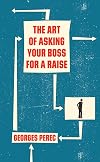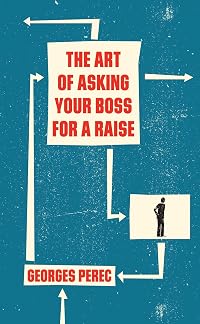
The Art of Asking Your Boss for a Raise
by Georges Perec
On This Page
Description
A long-suffering employee in a big corporation has summoned up the courage to ask for a raise. But as he runs through the coming encounter in his mind, his neuroses come to the surface: What's the best day to see the boss? What if he doesn't offer you a seat when you go into his office? And should you ask that tricky question about his daughter's illness? You can try to navigate these difficult decisions for yourself at www.theartofaskingyourbossforaraise.com ... The Art of Asking Your show more Boss for a Raise is a hilarious account of an employee losing his identity--and possibly his sanity--as he tries to put on the most acceptable face for the corporate world, with its rigid hierarchies and hostility to ideas and innovation. If he follows a certain course of action, so this logic goes, he will succeed--but, in accepting these conditions, are his attempts to challenge his world of work doomed from the outset? Neurotic and pessimistic, yet endearing, comic and never less than entertaining, Perec's Woody Allen-esque underling presents an acute and penetrating vision of the world of office work, as pertinent today as it was when it was written in 1968. show lessTags
Recommendations








































Member Reviews
In 1968 members of a French company that made supercomputers for industry were eager to learn if their computers could be used to create works of art. A Parisian computer expert wrote a flowchart for an employee of a large corporation to use to obtain a raise, which was given to the supercomputing company, who proposed the challenge to Georges Perec (one wonders if the company knew what it was getting into when Perec was chosen to write this book!).
The book consists of a one sentence monologue by a hapless employee of a large company, whose life and most of his work career seems to focus on obtaining a meager raise from his boss, Mr X. In his quest, which smacks of Kafka mixed with Don Quixote, our hero must navigate dangerous cafeteria show more food, the fickle moods of Mr X and Miss Y, recurrent outbreaks of measles, the all too frequent weekends that disrupt his plans, and, most importantly, his own incompetence and bad luck. This was a very entertaining, witty and quick read, which made for a perfect book to read on a short flight.
Anyone who wishes to get a taste of the book is encouraged to check out a flowchart based on it, at http://www.theartofaskingyourbossforaraise.com. show less
The book consists of a one sentence monologue by a hapless employee of a large company, whose life and most of his work career seems to focus on obtaining a meager raise from his boss, Mr X. In his quest, which smacks of Kafka mixed with Don Quixote, our hero must navigate dangerous cafeteria show more food, the fickle moods of Mr X and Miss Y, recurrent outbreaks of measles, the all too frequent weekends that disrupt his plans, and, most importantly, his own incompetence and bad luck. This was a very entertaining, witty and quick read, which made for a perfect book to read on a short flight.
Anyone who wishes to get a taste of the book is encouraged to check out a flowchart based on it, at http://www.theartofaskingyourbossforaraise.com. show less
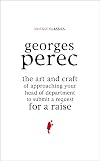
Unlike anything I've ever read. The true title is the art and craft of approaching your head of department to submit a request for a raise. Although the book's cover says something different, this is listed in all its long-winded glory on the title page.
Weird little book. No punctuation. No capitalization. I would recommend stealing away to a comfy, quiet spot to take in this book-length sentence. Let the narrator's anxiety wash all over you. Is the boss in? Is your coworker in a good mood? What the hell is a T60? Will the office need to be quarantined to prevent an outbreak of measles!? But more importantly, how many times can I approach my boss and fail to get this raise?
It's a challenge to find a suitable place to pause and set the show more book down. I don't really think there is one. Trying to jump back in, even a few minutes later, is disorienting. Perec dances circles around me. Here is his experiment. A short book, presenting a problem, and working it out as if a computer were thinking things through. show less
Weird little book. No punctuation. No capitalization. I would recommend stealing away to a comfy, quiet spot to take in this book-length sentence. Let the narrator's anxiety wash all over you. Is the boss in? Is your coworker in a good mood? What the hell is a T60? Will the office need to be quarantined to prevent an outbreak of measles!? But more importantly, how many times can I approach my boss and fail to get this raise?
It's a challenge to find a suitable place to pause and set the show more book down. I don't really think there is one. Trying to jump back in, even a few minutes later, is disorienting. Perec dances circles around me. Here is his experiment. A short book, presenting a problem, and working it out as if a computer were thinking things through. show less
Com um humor judaico neurótico obsessivo digno de Woody Allen e Larry David, Perec descreve matematicamente um organograma de forma linear em suas infinitas possibilidades e sem pontuações, o que o torna realmente cansativo de ler, mas que é de uma genialidade sem volta.
A funny little book recommended by Darryl (kidzdoc) in which Perec set out to write an "unreadable" circuitous text which is free of punctuation and based on a flow chart that describes the almost insurmountable challenge that an employee faces when attempting to ask for a raise from his superior. Perec attempts to present every possibility demonstrated in the flow chart: You go to see your boss, Mr. X in his office. Is he there? No. You stop by the PA, Miss Y's desk for a chat. Is she in a good mood? No. Too bad, you walk around the office for a while and try again. Is Mr. X There this time? No. You try Miss Y again: is she in a good mood now? Yes. Good, you chat with her for a bit until Mr. X arrives. Does he invite you into his show more office? No. He tells you to come back later. Only later, he might be felled by an attack of measles, and you'll have to attempt the circuit one more time when he's recovered. This time trying to overcome the possibility of your boss suffering from food poisoning, sending you to another irrelevant department, or maybe not one but two of Mr. X's daughters having caught the measles, with risk of contamination, and so on. The book is only 100 pages long, and what makes it amusing is the repetition of the same actions over and over again, into which Perec introduces tiny variations for great comic effect. I liked it a lot, though I made the mistake of putting it down about halfway through and when I picked it up again on a different day and in a different mood, I must say I couldn't help but ask myself why I was even bothering. Recommended if you're into experimental and quirky. If you're curious, the interactive flow chart is right here: http://www.theartofaskingyourbossforaraise.com show less
It was Perec, so: It was fun, it was exhausting, it was a delight.
This is either an amazing litereary achievement or it isn’t it’s one or t’other but let’s just assume to keep things simple – for we must do our best to keep things simple – that it is a work of art where perec demonstrates a unique ability to think like a computer so far ahead of his time and let’s not forget a marvellous translation by david bellos but what if it isn’t an amazing book in which case you circumperambulate to the beginning of this review and
So I heard of Perec and wanted to peruse his ingenuity, so I got a hold of Life . . ., but although I could see it was very clever, it was not the right thing at the moment for me, so I got a hold of three other of his books, now I had a choice of which to read, I could read any of the three, so say I started with a book which did not contain a particular symbol, this is so nifty, but just writing this part without that symbol shows how nifty that is, translation on top of that, but did not go smoothly as far as clarity or rationality, so on to another, phew, even eek for noise, uneasy being e-less, another book was Ok, but say my attention was instead drawn to this little number, and indeed I settled into reading this, and the flow was show more quite nice, and even though the flow was quite nice, after a while, being necessary to wrap around again, the flow was still nice, quite, but one wanted to get on with things, which after enough loops, not inevitably, but nevertheless, coming to a finality, but that would be a spoiler, and I have to consider that not everybody has read the book, certainly some people who have not read the book may not want to view a spoiler, now I have two obvious choices, I can conclude this with a spoiler, in which case, I would have to block it off for those who have not read the book and who furthermore do not care to see the spoiler, or I could leave the ending as such, spoiler, I am leaving it as such. By the way, I highly recommend procuring a beat up copy of this book to preemptively place in the workplace or interview background, to demostrate quite how clever one is in a overtly cleverly concealed way. show less
Members
- Recently Added By
Lists

Books Read in 2014
2,343 works; 86 members
Author Information

150+ Works 13,572 Members
Georges Perec was born in Paris on March 7, 1936 and was educated in Claude-Bernard and Geoffroy-Saint-Hilaire. Perec was a parachutist in the French Military before he began publishing his writing in magazines like Partisans. Perec also wrote the book, Life: A Users Manual. Perec is noted for his constrained writing: his 300-page novel La show more disparition (1969) is a lipogram, written without ever using the letter "e". Perec won the Prix Renaudot in 1965, the Prix Jean Vigo in 1974, the Prix Médicis in 1978. Georges Perec died on March 3, 1982. (Bowker Author Biography) show less
Some Editions
Series
Belongs to Publisher Series
Work Relationships
Has the adaptation
Common Knowledge
- Canonical title
- The Art of Asking Your Boss for a Raise
- Original title
- L'art et la manière d'aborder son chef de service pour lui demander un augmentation
- Original publication date
- 1968-12
- People/Characters
- Mr. X; Miss Y
- First words
- Introduction: Forty years ago there was no Windows, Web, or email; there were no laptops and the Mac Classic had not been invented.
- Last words
- (Click to show. Warning: May contain spoilers.)...straight off if he asks you to be seated and agrees to hear you out try to persuade him just one more time.
- Original language
- French
Classifications
Statistics
- Members
- 351
- Popularity
- 89,828
- Reviews
- 10
- Rating
- (3.73)
- Languages
- 12 — Czech, Dutch, English, French, German, Italian, Japanese, Norwegian (Bokmål), Portuguese, Spanish, Swedish, Turkish
- Media
- Paper, Audiobook, Ebook
- ISBNs
- 22
- ASINs
- 4