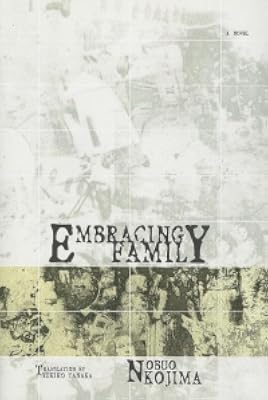
Embracing Family
by Nobuo Kojima
On This Page
Description
Set during the U.S. Occupation following World War II, Embracing Family is a novel of conflict--between Western and Eastern traditions, between a husband and wife, between ideals and reality. At the opening of the book, Miwa Shunsuke and his wife are trapped in a strained marriage, subtly attacking one another in a manner similar to that of the characters in Who's Afraid of Virginia Woolf? When his wife has an affair with an American GI, Miwa is forced to come to terms with the show more disintegration of their relationship and the fact that his attempts to repair it only exacerbate the situation. An award-winning novel, critics have read this book as a metaphor of postwar Japanese society, in which the traditional moral and philosophical basis of Japanese culture is neglected in favor of Western conventions. show lessTags
Recommendations






Member Reviews
I gave this a 3 star rating not because of poor writing style, but topic content mainly. The book set out to discuss Western influence on post-occupied Japan. It does this in such a subtle way that it is almost non-existent.
The first chapter deals with Western ideals and asthetics, primarily through the character George. George symbolizes (at least in my opinion) the intrusion of the West into our protagonist's life.
Past this point, the majority of the book deals with the wife's breast cancer.The actual story of the wife and husband are what make this book redeeming. It gives a glimpse into the difference of cultures and some brief discussion on Western influence via the new home. If you are wanting a short book on the struggles faced show more fighting cancer, you may enjoy this book.
The ending is not the strongest but not terrible. I won't give any spoilers here but it felt like the book ended a chapter prior and this resolution felt out of place. I suspect the author wanted to show our protagonist returning to Eastern mannerisms.
Overall, the book deals little with Western culture in Japan. It tends to rely on symbolism to suggest that Western culture brought folly to the East and that a mixture of the two would not work out. Aside from this, roughly 70 percent of the book is about cancer and the toll it takes on the family. While I typically enjoy Japanese literature, this would not be a book I recommend to others. It is one you can easily read in a single setting but I doubt the story sticks with me for too long. You may give it a try and see if it speaks to you, as it isn't a terrible read but I think Japanese literature has a lot stronger candidates and cancer stories a lot more moving. show less
The first chapter deals with Western ideals and asthetics, primarily through the character George. George symbolizes (at least in my opinion) the intrusion of the West into our protagonist's life.
Past this point, the majority of the book deals with the wife's breast cancer.The actual story of the wife and husband are what make this book redeeming. It gives a glimpse into the difference of cultures and some brief discussion on Western influence via the new home. If you are wanting a short book on the struggles faced show more fighting cancer, you may enjoy this book.
The ending is not the strongest but not terrible. I won't give any spoilers here but it felt like the book ended a chapter prior and this resolution felt out of place. I suspect the author wanted to show our protagonist returning to Eastern mannerisms.
Overall, the book deals little with Western culture in Japan. It tends to rely on symbolism to suggest that Western culture brought folly to the East and that a mixture of the two would not work out. Aside from this, roughly 70 percent of the book is about cancer and the toll it takes on the family. While I typically enjoy Japanese literature, this would not be a book I recommend to others. It is one you can easily read in a single setting but I doubt the story sticks with me for too long. You may give it a try and see if it speaks to you, as it isn't a terrible read but I think Japanese literature has a lot stronger candidates and cancer stories a lot more moving. show less
Ratings
Members
- Recently Added By
Author Information

4+ Works 45 Members
Some Editions
Awards and Honors
Awards
Common Knowledge
- Canonical title
- Embracing Family
- Original title
- Ho-yokazoku
- Original publication date
- 1965 (original Japanese) (original Japanese); 2005 (English: Tanaka) (English: Tanaka)
- Original language
- Japanese
Classifications
- Genres
- Fiction and Literature, General Fiction, Historical Fiction
- DDC/MDS
- 895.6 — Literature & rhetoric Asian Literature Literatures of East and Southeast Asia Japanese
- LCC
- PL832 .O395 .A28 — Language and Literature Languages and literatures of Eastern Asia, Africa, Oceania Languages of Eastern Asia, Africa, Oceania Japanese language and literature Japanese literature Individual authors and works
- BISAC
Statistics
- Members
- 39
- Popularity
- 744,935
- Reviews
- 1
- Rating
- (2.79)
- Languages
- English, French, German
- Media
- Paper
- ISBNs
- 4