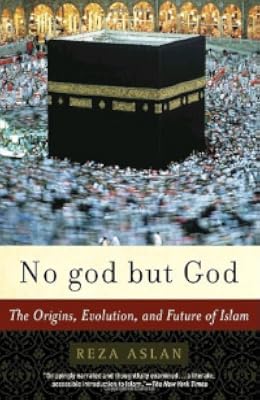
No God but God: The Origins, Evolution, and Future of Islam
by Reza Aslan
On This Page
Description
Examines the rituals and traditions of Islam, and discusses the revelation of Muhammad as Prophet and the subsequent uprising against him and the emergence of his successors.Tags
Recommendations





Member Reviews
Fascinating read.
'No God but God' deals with Islam's roots, the tumultuous period after the Prophet's death, the movements that sprung up as Islam spread across continents, the various sects of Islam and the conflicts between them, schools of thought like Traditionalism and Rationalism, the rise of fundamentalism and so forth.
It compresses 1500 years of history into 300 pages and yet, manages to be highly readable and engaging. Historical context is perhaps the most important factor in understanding any religion and in particular, Islam. That is seemingly lost on most Muslims these days so Aslan getting that message across without rubbing any side the wrong way is an achievement.
It's a non-fiction account if that wasn't already show more obvious and the material is reliably cited. Most books on Islam have a tendency to either become an apology or paint an apocalyptic scenario where it's the believers versus the heretics so the balanced and well sourced approach to the religion's history is well appreciated.
That being said, there were some contentious points. Aslan comes down particularly hard on the Caliphs (Uthman in particular). The Ulama get a lot of stick as well but many, including me, would argue that's well warranted.
Nevertheless, I'll give it five stars. This book is an accessible starting point for non-Muslims and Muslims alike. After reading a few books on Islam and its history, I can't believe how laughably naive my views were about my own religion so I appreciate anything that fosters interfaith and intrafaith understanding and dialogue while remaining neutral.
A must read for anyone interested in understanding Islam rather than painting it with broad brushstrokes. show less
'No God but God' deals with Islam's roots, the tumultuous period after the Prophet's death, the movements that sprung up as Islam spread across continents, the various sects of Islam and the conflicts between them, schools of thought like Traditionalism and Rationalism, the rise of fundamentalism and so forth.
It compresses 1500 years of history into 300 pages and yet, manages to be highly readable and engaging. Historical context is perhaps the most important factor in understanding any religion and in particular, Islam. That is seemingly lost on most Muslims these days so Aslan getting that message across without rubbing any side the wrong way is an achievement.
It's a non-fiction account if that wasn't already show more obvious and the material is reliably cited. Most books on Islam have a tendency to either become an apology or paint an apocalyptic scenario where it's the believers versus the heretics so the balanced and well sourced approach to the religion's history is well appreciated.
That being said, there were some contentious points. Aslan comes down particularly hard on the Caliphs (Uthman in particular). The Ulama get a lot of stick as well but many, including me, would argue that's well warranted.
Nevertheless, I'll give it five stars. This book is an accessible starting point for non-Muslims and Muslims alike. After reading a few books on Islam and its history, I can't believe how laughably naive my views were about my own religion so I appreciate anything that fosters interfaith and intrafaith understanding and dialogue while remaining neutral.
A must read for anyone interested in understanding Islam rather than painting it with broad brushstrokes. show less
Aslan presents a clear, engaging narrative of the history and development of Islam in all of its complexity. I appreciated the thorough discussion on Iran and the influence of (very) current events on the ongoing Islamic Reformation. While it was written and even updated before the rise of ISIS, this book helped me understand where and how radical Islamic sects like al Qaeda originate and how the American enterprise of democracy building in the Middle East was inevitably doomed.
There was a lot to like in this book, subtitled "The Origins, Evolutions, and Future of Islam". It served me well as a good introduction to the Muslim faith, about which I knew lamentably little. I have a new appreciation for the diversity of belief that Islam encompasses, and I finally (mostly) understand the differences between the Shi'a, Sunni, and Sufi branches of Islam.
The biggest and most important takeaway, of course, is reinforcement of the knowledge that a very small percentage of the world's Muslims hold the kind of fundamentalist viewpoint that has led to terrorist attacks on the West. Aslan's explanation of how the words of the Quran have been interpreted in ways that seem completely contrary to the actions and words of its show more prophet, Mohammed, is akin to describing a centuries-long game of telephone played to advance political viewpoints. Things get lost in translation and interpretation, accidentally and deliberately, but once lost they are difficult to retrieve.
It's also less than heartening to read that much of the growth in fundamentalist Islam came about as a direct result of Western colonial activity in the Middle East, India, and Africa. It's difficult to read about brutal suppression and the deliberate pitting of one faith's true believers against another's in order to ensure native populations would be too fractured to mount a successful revolution, especially with the hindsight of what those actions wrought over the long term and into our current political landscape. In that sense, this book only reaffirmed my belief that we have no place, militarily, in the Middle East today. What is happening in Iraq is tragic, to be sure, and partly our fault, but nothing we do now is likely to make it better. We would have been far better off never to have started the war in the first place. Perhaps it's no use crying over those past decisions but we need to keep reminding people that time has proven them to be total failures lest we stumble into the same minefield all over again, as has happened time and again.
Given all of that, Aslan seems unduly optimistic that the current brand of fundamentalist Islam that has led to so many terrorist attacks will wane as the overwhelmingly young Muslim population moves away from that message and toward a version of populist democracy. He cites the people's uprisings in Tunisia, Egypt, and Libya to support his view, although a reader can't help but notice that the book was written before the "Arab Spring" failed to truly catch hold and in some places was brutally suppressed or slid backwards into tyranny once again.
Aslan also is optimistic that Islam and democracy can (and will) co-exist, though he rightly points out that we in the West must stop thinking our brand of democracy is the only right way to do it. Certainly we have an innate distrust of government that overtly espouses a religious viewpoint, but Aslan argues that just as Muhammed ruled the city of Medina without persecuting the Jewish and Christian minorities who lived and traded there, the same sort of faith-based governance could work today.
As you might expect from a book that encompasses more than 900 years of history in just 300 pages, the best that can be said about No god but God is that it is a decent introduction to Islam for those like me who knew little. Further reading would be necessary to truly understand many of the complex subjects that Aslan only lightly touches on, but he provides a strong starting point for the curious. show less
The biggest and most important takeaway, of course, is reinforcement of the knowledge that a very small percentage of the world's Muslims hold the kind of fundamentalist viewpoint that has led to terrorist attacks on the West. Aslan's explanation of how the words of the Quran have been interpreted in ways that seem completely contrary to the actions and words of its show more prophet, Mohammed, is akin to describing a centuries-long game of telephone played to advance political viewpoints. Things get lost in translation and interpretation, accidentally and deliberately, but once lost they are difficult to retrieve.
It's also less than heartening to read that much of the growth in fundamentalist Islam came about as a direct result of Western colonial activity in the Middle East, India, and Africa. It's difficult to read about brutal suppression and the deliberate pitting of one faith's true believers against another's in order to ensure native populations would be too fractured to mount a successful revolution, especially with the hindsight of what those actions wrought over the long term and into our current political landscape. In that sense, this book only reaffirmed my belief that we have no place, militarily, in the Middle East today. What is happening in Iraq is tragic, to be sure, and partly our fault, but nothing we do now is likely to make it better. We would have been far better off never to have started the war in the first place. Perhaps it's no use crying over those past decisions but we need to keep reminding people that time has proven them to be total failures lest we stumble into the same minefield all over again, as has happened time and again.
Given all of that, Aslan seems unduly optimistic that the current brand of fundamentalist Islam that has led to so many terrorist attacks will wane as the overwhelmingly young Muslim population moves away from that message and toward a version of populist democracy. He cites the people's uprisings in Tunisia, Egypt, and Libya to support his view, although a reader can't help but notice that the book was written before the "Arab Spring" failed to truly catch hold and in some places was brutally suppressed or slid backwards into tyranny once again.
Aslan also is optimistic that Islam and democracy can (and will) co-exist, though he rightly points out that we in the West must stop thinking our brand of democracy is the only right way to do it. Certainly we have an innate distrust of government that overtly espouses a religious viewpoint, but Aslan argues that just as Muhammed ruled the city of Medina without persecuting the Jewish and Christian minorities who lived and traded there, the same sort of faith-based governance could work today.
As you might expect from a book that encompasses more than 900 years of history in just 300 pages, the best that can be said about No god but God is that it is a decent introduction to Islam for those like me who knew little. Further reading would be necessary to truly understand many of the complex subjects that Aslan only lightly touches on, but he provides a strong starting point for the curious. show less
One of the things I loved about No god but God is that the author’s personal religious beliefs never really compromises his retelling of the history. It’s almost as if he’s taking a non-Muslim perspective at times in order to prove or explain things, which I really liked because it shows that he’s rational and logical and doesn’t fall back on religious arguments that can’t be proven all the time.
I loved is how he writes about the religion in the Arabian penninsula before Islam. He goes a lot more in depth than most authors do on the subject. He does a lot to put things into perspective and to show how truly tolerant and accepting the early Islamic community was. Which is one thing that Aslan keeps bringing up and trying to show more prove - that the ummah is meant to encompass Christians, Jews, and Muslims. Not just Muslims.
Aslan is a rationalist and it definitely shows. Whenever he questions an Islamic concept it always seems to strengthen his faith instead of damaging it. I think it’s supposed to do that to the reader, too. It certainly worked for me. I’ve always been a firm believer in the idea that you cannot have true faith until you question it, and that questioning your religion or your faith is a good thing. show less
I loved is how he writes about the religion in the Arabian penninsula before Islam. He goes a lot more in depth than most authors do on the subject. He does a lot to put things into perspective and to show how truly tolerant and accepting the early Islamic community was. Which is one thing that Aslan keeps bringing up and trying to show more prove - that the ummah is meant to encompass Christians, Jews, and Muslims. Not just Muslims.
Aslan is a rationalist and it definitely shows. Whenever he questions an Islamic concept it always seems to strengthen his faith instead of damaging it. I think it’s supposed to do that to the reader, too. It certainly worked for me. I’ve always been a firm believer in the idea that you cannot have true faith until you question it, and that questioning your religion or your faith is a good thing. show less
Reza Aslan has written an important and wonderfully readable book on the history of Islam. A devout Muslim who cares deeply about his religion, Aslan is also a thoughtful humanist. No god but God generously, gracefully and intelligently incorporates both these sets of values. It’s important for Americans to read this book: we keep asking, Why do they hate us?, and reply foolishly with thoughtless answers like, Because they’re jealous of our freedoms (as George W. Bush has maintained for the past several years). More likely, it seems to me, the answer lies in our own ignorance: what do we really know about Islam? Recently I was asked to teach an Introduction to Humanities class at a community college. The regular instructor bailed show more out at the last minute; I was given a textbook on a Friday and told to be prepared to start teaching the following Monday. I read fast, but knew I had to skim most of the required textbook in order to prepare. One of the chapters I read in detail, though, was the one on the history of Islam. To my horror is read, in this widely used textbook, the authors’ claim that the Prophet Mohammed married Fatima. This kind of ignorance of other cultures and other faiths is deeply offensive. In this case, Fatima, as we all should know, was the Prophet’s daughter (his wife’s name was Khadija). How could the authors (an archeologist and a theologian, both of prestigious U.S. universities) implicitly accuse Mohammad of a crime—incest—that all the children of Abraham find offensive?
Indeed, when I taught the history of the three dominant monotheisms, my students were quite surprised to learn that Judaism, Christianity and Islam in fact share a common origin. We are, it seems, even ignorant of Christianity’s origins. This makes books like Aslan’s all the more crucial. “One could argue,” he states—and this is a fine example of his graceful sidestepping of our ignorance in favor of displaying humanist generosity—“that the clash of monotheisms is the inevitable result of monotheism itself. Whereas a religion of many gods posits many myths to describe the human condition, a religion of one god tends to be monomythic; it rejects not only all other gods, it rejects all other explanations for God.” “Religion,” he continues by way of pointing out the importance of myth, “is not faith. Religion is the story of faith… that provides a common language with which a community of [believers] can share with each other their numinous encounter with the Divine Presence.”
“It is not important whether the stories describing the childhood of Muhammad, Jesus, or David are true. What is important is what these stories say about our prophets, our messiahs, our kings”—in other words, about our cultural millieux. This is a crucial point for Aslan, especially in conjunction with the idea that religion is a “story,” a narrative of faith. For as he relates the long history of Islam, and especially its early years, Aslan argues that contemporary Islam doesn’t have to be the way it is: Muslims could change the story of their religion. By implication, this is true of all three monotheisms—Christians don’t have to suppress women or murder homosexuals. This, though, is only an implication in Aslan’s book: the subtitle claims it’s about the “future of Islam,” but he doesn’t waste too much time prognosticating. What Aslan does claim (though with almost no comparative analysis) is that Islam, at 1,500 years old, is in approximately the same stage Christianity was when Martin Luther and others instigated the Reformation. This is a fascinating idea, but I suspect it may be wishful thinking on Aslan’s part.What I especially treasure about this book is Aslan’s discussion of the first generation of Islam, which is well researched and beautifully articulate. As with all textually based religions (meaning, again, the religions of “the Book,” the three monotheisms that trace their descent from Abraham) there is a dirty little secret at the heart of the matter, namely, that the authors of the texts had political agendas. ‘Twas ever thus with stories but, when there are a billion or more people basing their lives and everyday actions on a text, it’s important to consider the sources. Muhammad and his Companions worked out a communal way of life in Medina but, for the most part, the Prophet’s revelations and laws were not written down until after his death. (Though not, as Aslan argues, because Muhammad was illiterate; how could that be when he was a successful businessman with records to keep and orders to place?) All three monotheisms are deeply misogynistic but that doesn’t necessarily implicate Jesus or Muhammad: “when the Quran warned believers not to ‘pass on your wealth and property to the feeble-minded (sufaha)…’ the early Quranic commentators—all of them male—declared, despite the Quran’s warning on the subject, that ‘the sufaha are women and children… and both of them must be excluded from inheritance’.” Again, the parallels to the early history of Christianity are worth keeping in mind. When Paul wrote “Let your women keep silence in the churches” in Corinthians and again in Timothy, “Let the woman learn in silence with all subjection. But I suffer not a woman to teach, nor to usurp authority over the man, but to be in silence,” we may be looking at Paul’s misogyny or that of one of his later editor’s. The point I take away from Aslan is that we must wrestle interrogatively with these texts and we must also always remember that we can change the stories we tell about them.
No god but God is not without its biases and flaws. Aslan holds an MFA from the famous Workshop at the University of Iowa, and he makes an embarrassing English major’s math mistake in his discussion of the community at Medina. Muhammad and his Companions, driven out of Mecca, found refuge in Medina where there were already both traditional Arabian polytheists as well as a large community of Jews, of whom, Aslan says at one point, the Jews “may have totaled in the thousands.” Some thirty pages later he discusses the massacre of Jews (an infamous sore point between the two religions) by the first generation of Muslims, stating that “the total number of men who were killed vary from 400 to 700 (depending on the source)” while “the highest estimates still represent no more than a tiny fraction of the total population of Jews who resided in Medina and its environs.” Whether we take the original population of Jews in Medina as 7,000 (which is in line with Aslan’s first statement of “thousands”) or even 70,000, that adds up to either ten percent or one percent “of the total population”—not “a tiny fraction.” What Aslan fails to acknowledge, as so many apologists for monotheism fail to do, is that monomythic religions are necessarily competitive for both resources and believers—and that competition inevitably results in some sort of violence. His discussion of contemporary militant Islam is likewise hampered by a strange elision: he begins with Pakistan and promises to come full circle but never returns to the situation there.
If Aslan hedges his bets as regards the violence inherent in monotheism, he is elegant and (especially in our contemporary climate of monotheistic textual fundamentalism) courageous in insisting on a historical understanding of Islam. His explanation of the split between Sunni and Shi’a is the clearest I’ve yet read, and his discussion of Islam’s beautiful mysticism—the Sufis—is a pleasure to read. For those wanting to understand the history of Islam, Aslan is ideal on all but the last one hundred or so years. If his portrayal of the violence of Islam is flawed, his hope that that narrative can be overcome is admirable.
[Originally published in Curled Up with a Good Book] show less
Indeed, when I taught the history of the three dominant monotheisms, my students were quite surprised to learn that Judaism, Christianity and Islam in fact share a common origin. We are, it seems, even ignorant of Christianity’s origins. This makes books like Aslan’s all the more crucial. “One could argue,” he states—and this is a fine example of his graceful sidestepping of our ignorance in favor of displaying humanist generosity—“that the clash of monotheisms is the inevitable result of monotheism itself. Whereas a religion of many gods posits many myths to describe the human condition, a religion of one god tends to be monomythic; it rejects not only all other gods, it rejects all other explanations for God.” “Religion,” he continues by way of pointing out the importance of myth, “is not faith. Religion is the story of faith… that provides a common language with which a community of [believers] can share with each other their numinous encounter with the Divine Presence.”
“It is not important whether the stories describing the childhood of Muhammad, Jesus, or David are true. What is important is what these stories say about our prophets, our messiahs, our kings”—in other words, about our cultural millieux. This is a crucial point for Aslan, especially in conjunction with the idea that religion is a “story,” a narrative of faith. For as he relates the long history of Islam, and especially its early years, Aslan argues that contemporary Islam doesn’t have to be the way it is: Muslims could change the story of their religion. By implication, this is true of all three monotheisms—Christians don’t have to suppress women or murder homosexuals. This, though, is only an implication in Aslan’s book: the subtitle claims it’s about the “future of Islam,” but he doesn’t waste too much time prognosticating. What Aslan does claim (though with almost no comparative analysis) is that Islam, at 1,500 years old, is in approximately the same stage Christianity was when Martin Luther and others instigated the Reformation. This is a fascinating idea, but I suspect it may be wishful thinking on Aslan’s part.What I especially treasure about this book is Aslan’s discussion of the first generation of Islam, which is well researched and beautifully articulate. As with all textually based religions (meaning, again, the religions of “the Book,” the three monotheisms that trace their descent from Abraham) there is a dirty little secret at the heart of the matter, namely, that the authors of the texts had political agendas. ‘Twas ever thus with stories but, when there are a billion or more people basing their lives and everyday actions on a text, it’s important to consider the sources. Muhammad and his Companions worked out a communal way of life in Medina but, for the most part, the Prophet’s revelations and laws were not written down until after his death. (Though not, as Aslan argues, because Muhammad was illiterate; how could that be when he was a successful businessman with records to keep and orders to place?) All three monotheisms are deeply misogynistic but that doesn’t necessarily implicate Jesus or Muhammad: “when the Quran warned believers not to ‘pass on your wealth and property to the feeble-minded (sufaha)…’ the early Quranic commentators—all of them male—declared, despite the Quran’s warning on the subject, that ‘the sufaha are women and children… and both of them must be excluded from inheritance’.” Again, the parallels to the early history of Christianity are worth keeping in mind. When Paul wrote “Let your women keep silence in the churches” in Corinthians and again in Timothy, “Let the woman learn in silence with all subjection. But I suffer not a woman to teach, nor to usurp authority over the man, but to be in silence,” we may be looking at Paul’s misogyny or that of one of his later editor’s. The point I take away from Aslan is that we must wrestle interrogatively with these texts and we must also always remember that we can change the stories we tell about them.
No god but God is not without its biases and flaws. Aslan holds an MFA from the famous Workshop at the University of Iowa, and he makes an embarrassing English major’s math mistake in his discussion of the community at Medina. Muhammad and his Companions, driven out of Mecca, found refuge in Medina where there were already both traditional Arabian polytheists as well as a large community of Jews, of whom, Aslan says at one point, the Jews “may have totaled in the thousands.” Some thirty pages later he discusses the massacre of Jews (an infamous sore point between the two religions) by the first generation of Muslims, stating that “the total number of men who were killed vary from 400 to 700 (depending on the source)” while “the highest estimates still represent no more than a tiny fraction of the total population of Jews who resided in Medina and its environs.” Whether we take the original population of Jews in Medina as 7,000 (which is in line with Aslan’s first statement of “thousands”) or even 70,000, that adds up to either ten percent or one percent “of the total population”—not “a tiny fraction.” What Aslan fails to acknowledge, as so many apologists for monotheism fail to do, is that monomythic religions are necessarily competitive for both resources and believers—and that competition inevitably results in some sort of violence. His discussion of contemporary militant Islam is likewise hampered by a strange elision: he begins with Pakistan and promises to come full circle but never returns to the situation there.
If Aslan hedges his bets as regards the violence inherent in monotheism, he is elegant and (especially in our contemporary climate of monotheistic textual fundamentalism) courageous in insisting on a historical understanding of Islam. His explanation of the split between Sunni and Shi’a is the clearest I’ve yet read, and his discussion of Islam’s beautiful mysticism—the Sufis—is a pleasure to read. For those wanting to understand the history of Islam, Aslan is ideal on all but the last one hundred or so years. If his portrayal of the violence of Islam is flawed, his hope that that narrative can be overcome is admirable.
[Originally published in Curled Up with a Good Book] show less
A dense but readable and valuable overview of Islam's roots, and the events that led, centuries later, to the factional fighting in the news now. I was particularly taken by the early stories of the Prophet. How have I never heard that awesome story of men washing the heart of the boy Muhammad in a big bowl of snow? (So much better than guys arriving with frankincense and myrrh.)
I find meager hope in the reminder that Christianity evolved through Inquisition and Reformation over 15 centuries, and that Islam in entering its 15th century.
I find meager hope in the reminder that Christianity evolved through Inquisition and Reformation over 15 centuries, and that Islam in entering its 15th century.
In this book, the author explains Islam in all its beauty and complexity. Beginning with a vivid account of the social and religious milieu in which the Prophet Muhammad forged his message, the author paints a portrait of the first Muslim community as a radical experiment in religious pluralism and social egalitarianism. He demonstrates how, after the Prophet's death, his successors attempted to interpret his message for future generations – an overwhelming task that fractured the Muslim community into competing sects. Finally, he examines how, in the shadow of European colonialism, Muslims developed conflicting strategies to reconcile traditional Islamic values with the realities of the modern world, thus launching what he terms the show more Islamic Reformation. show less
Members
- Recently Added By
Published Reviews
THESE are rough times for Islam. It is not simply that frictions have intensified lately between Muslims and followers of other faiths. There is trouble, and perhaps even greater trouble, brewing inside the Abode of Peace itself, the notional Islamic ummah or nation that comprises a fifth of humanity.
News reports reveal glimpses of such trouble -- for instance, in the form of flaring strife show more between Sunni and Shiite Muslims in places like Iraq and Pakistan. Yet the greater tensions, while similarly rooted in the distant past, are less visible to the wider world. The rapid expansion of literacy among Muslims in the past half-century, and of access to new means of communication in the last decade, have created a tremendous momentum for change. Furious debates rage on the Internet, for example, about issues like the true meaning of jihad, or how to interpret and apply Islamic law, or how Muslim minorities should engage with the societies they live in. show less
News reports reveal glimpses of such trouble -- for instance, in the form of flaring strife show more between Sunni and Shiite Muslims in places like Iraq and Pakistan. Yet the greater tensions, while similarly rooted in the distant past, are less visible to the wider world. The rapid expansion of literacy among Muslims in the past half-century, and of access to new means of communication in the last decade, have created a tremendous momentum for change. Furious debates rage on the Internet, for example, about issues like the true meaning of jihad, or how to interpret and apply Islamic law, or how Muslim minorities should engage with the societies they live in. show less
added by private library
Lists

LtGen James Mattis' Reading List
58 works; 2 members

Books on Islamic Feminism
43 works; 1 member

Vlogbrothers Book Recommendations
307 works; 4 members
Author Information

13+ Works 7,208 Members
Born in Iran, Dr. Reza Aslan is a writer and scholar of religion. He is also President and CEO of Aslan Media Inc. Dr. Aslan has degrees in Religions from Santa Clara University, Harvard University, and the University of California, Santa Barbara, as well as a Master of Fine Arts from the University of Iowa. He is a member of the Council on show more Foreign Relations, the Los Angeles Institute for the Humanities, and the Pacific Council on International Policy. Dr. Aslan also serves on the national advisory board of the Levantine Cultural Center, building bridges between Americans and the Arab/Muslim world. Aslan's first book, the International Bestseller, No god but God: The Origins, Evolution, and Future of Islam (Heinemann 2005), has been translated into thirteen languages, and named one of the 100 most important books of the last decade. He is also the editor of the anthology Tablet & Pen: Literary Landscapes from the Modern Middle East: A Words Without Borders Anthology (WW Norton 2010). His latest work is entitled Zealot: The Life and Times of Jesus of Nazareth (Random House 2013). Dr. Aslan lives in Los Angeles where he is Associate Professor of Creative Writing at the University of California, Riverside. (Bowker Author Biography) show less
Awards and Honors
Awards
Notable Lists
Common Knowledge
- Canonical title
- No God but God: The Origins, Evolution, and Future of Islam
- Original publication date
- 2005
- Epigraph
- In the name of God, the Compassionate, the Merciful
- Dedication
- Thank you. Mom and Dad, for never doubting me; Catherine Bell, for getting me started; Frank Conroy, for finding me; Daniel Menaker, for trusting me; Amanda Fortini, for fixing me; my teachers, for challenging me; and Ian Wer... (show all)rett, for absolutely everything else.
- First words
- In the arid, desolate basin of Mecca, surrounded on all sides by the bare mountains of the Arabian desert, stands a small, nondescript sanctuary that the ancient Arabs refer to as the Ka'ba: the Cube.
- Last words
- (Click to show. Warning: May contain spoilers.)We are all living in it.
- Blurbers
- Zakaria, Fareed; Feldman, Noah; Esposito, John L.; Cook, Steven; Reiss, Tom
Classifications
Statistics
- Members
- 2,317
- Popularity
- 8,573
- Reviews
- 37
- Rating
- (4.07)
- Languages
- 10 — Chinese, Danish, Dutch, English, French, German, Italian, Farsi/Persian, Polish, Spanish
- Media
- Paper, Audiobook, Ebook
- ISBNs
- 30
- ASINs
- 9