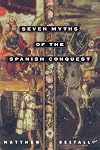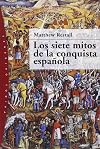
Seven Myths of the Spanish Conquest
by Matthew Restall
On This Page
Description
"Here is an exploration of the ways in which the history of the Spanish Conquest has been misread and passed down to become popular knowledge of these events. The book offers a fresh account of the activities of the best-known conquistadors and explorers, including Columbus, Cortes, and Pizarro." "Using a wide array of sources, historian Matthew Restall highlights seven key myths, uncovering the source of the inaccuracies and exploding the fallacies and misconceptions behind each myth. This show more book shows, for instance, that native Americans did not take the conquistadors for gods and that small numbers of vastly outnumbered Spaniards did not bring down great empires with stunning rapidity. We discover that Columbus was correctly seen in his lifetime - and for decades after - as a briefly fortunate but unexceptional participant in efforts involving many southern Europeans. It was only much later that Columbus was portrayed as a great man who fought against the ignorance of his age to discover the new world. Restall also shows that the Spanish Conquest relied heavily on black and native allies, who provided many thousands of fighters, vastly outnumbering the conquistadors. In fact, the native perception of the Conquest differed sharply from the Spanish version - they saw it as a native civil war in which the Spaniards played an important but secondary role." "The Conquest, Restall shows, was more complex - and more fascinating - than conventional histories have portrayed it. Seven Myths of the Spanish Conquest offers a richer and more nuanced account of a key event in the history of the Americas."--Jacket. show lessTags
Recommendations







Member Recommendations
Member Reviews
En este libro se explora cómo surgieron y pasaron al acervo popular los errores de interpretación acerca de la historia de la conquista española de América. Se ofrece, asimismo, una nueva crónica de las actividades de los conquistadores y exploradores más célebres, entre los que se cuentan Colón, Cortés y Pizarro. A partir de una amplia selección de fuentes, el historiador Matthew Restall destaca siete mitos esenciales, en los cuales revela el origen de las inexactitudes y refuta las falacias implícitas. Este texto atractivo y bien documentado muestra, por ejemplo, que los indígenas americanos no confundían a los conquistadores con dioses, y que no es cierta la idea de que unos pocos españoles conquistaron grandes imperios show more con extraordinaria rapidez, enfrentándose a un enemigo numéricamente muy superior. Descubrimos, asimismo, que Colón era considerado en su tiempo ¿y durante varias décadas después¿ como un navegante en absoluto extraordinario que participó en las campañas donde intervinieron también muchos otros europeos meridionales, una idea que coincide con los hechos históricos. Fue mucho después cuando se caracterizó a Colón como un gran hombre que se enfrentó a la ignorancia de sus contemporáneos para descubrir el nuevo mundo. Restall muestra también que la conquista española dependía en gran medida de los aliados negros e indígenas, que proporcionaban muchos miles de combatientes, cifras que superaban con mucho el contingente de conquistadores españoles. Este libro nos enseña, así, que la conquista fue mucho más compleja ¿y más fascinante¿de lo que la describen las historias convencionales. show less
Jun 7, 2007Spanish
Ratings
Members
- Recently Added By
Lists

r/AskHistorians' Recommended Books
1,068 works; 19 members

In Our Time books
4,934 works; 2 members
Author Information
25+ Works 1,049 Members
Matthew Restall is the Edwin Erle Sparks Professor of Latin American History and director of Latin American studies at Pennsylvania State University. He lives State College, Pennsylvania, with his wife and the youngest of his four daughters.
Awards and Honors
Distinctions
Common Knowledge
- Original title
- Seven Myths of the Spanish Conquest
- Original publication date
- 2003
- People/Characters
- Pedro de Alvarado; Atahualpa; Christopher Columbus; Hernán Cortés; Bernal Diaz del Castillo; Franciscans (show all 11); Francisco Lopez de Gomara; Isabella I, Queen of Castile and León; Bartolome de Las Casas; Moctezuma II; Francisco Pizarro
- Important places
- Guatemala; Inca Empire; Peru; Tenochtitlán, Mexico; Yucatán, México
- Important events
- Spanish Conquest of Peru
- Dedication
- To anyone who has ever been my student; to Jim and Felipe, whose student I will always be; and to Lucy, tommorrow's student.
- First words
- When Bernal Diaz first saw the Aztec capital he was lost for words.
- Last words
- (Click to show. Warning: May contain spoilers.)Or, if "purpose" sounds too dutiful. perhaps we can turn to Bernal Diaz for a simpler reason for our reading: that the story has in it "much to ponder", and is, in the end, "a remarkable tale"
Classifications
Statistics
- Members
- 314
- Popularity
- 101,961
- Reviews
- 1
- Rating
- (3.71)
- Languages
- English, Polish, Portuguese, Spanish
- Media
- Paper, Audiobook, Ebook
- ISBNs
- 14
- ASINs
- 5